Parent–teacher meetings: what not to say, and what to ask instead

Ten minutes, a queue behind you, and a teacher who has said the same sentences forty times. Here is how to make it count.
Before you go
Write down two or three questions. Ten minutes disappears fast, and most parents leave having heard a summary and asked nothing.
Ask your child first: what do you think the teacher will say, what is going well, what is hard, is there anything you want me to ask? Children are often accurate and it prepares them for whatever comes.
Bring the report or the notebook if there is a specific query, and bring a pen. Writing down what is agreed is what makes follow-up possible.
What not to say
'He is lazy at home too' — it closes the conversation and gives the teacher permission to stop looking for a reason.
'His sister was always top of the class' — comparison in front of a child, or about a child, is corrosive and tells the teacher nothing useful.
'What is her rank?' — ranking says little about progress and nothing about learning, and it steers the whole meeting toward marks.
'Are you sure? He says you always pick on him' — raise the concern, and phrase it as a question rather than an accusation, or the defensiveness ends the useful part of the meeting.
'We'll fix it, don't worry' — a promise that ends the conversation before you have found out what is wrong.
And do not spend the ten minutes apologising for your child. It is not what the time is for.
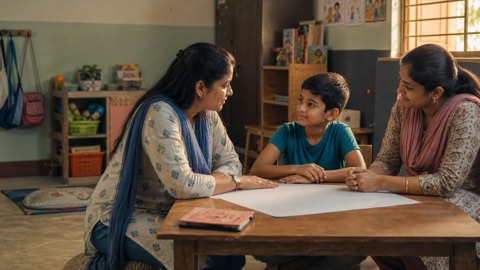

What to ask instead
'What is he like in class — not academically, as a person?' This single question produces more useful information than any other, and teachers rarely get asked it.
'Where specifically is the gap?' Not 'weak in maths' but which topic, which skill. That is what you can act on.
'What is he doing well that I might not know about?'
'Who does he sit with and play with?' Teachers see the social map, and it explains a great deal of behaviour and mood.
'What would help most at home — and what should I stop doing?' The second half of that question is the valuable one.
'How will we know if it is improving, and when should we talk again?' It turns a meeting into a plan.
Afterwards
Tell your child something specific and positive from the meeting, first, before anything else. What you lead with is what they remember about being discussed by adults.
If the report was bad, deal with it calmly and later, not in the car park. Anger at that moment teaches a child to dread the meeting rather than to work.
Send a short email summarising what was agreed, particularly if there is an action or a concern. It creates a record and it makes follow-up much easier.
And follow up on the date you agreed rather than waiting for the next term's meeting.
Frequently asked questions
The teacher only talks about marks.
Redirect with a specific question: 'and how is she in class as a person?' Most teachers welcome the shift; the marks script is what they expect parents to want.
I disagree with what was said.
Ask for examples rather than arguing. 'Can you tell me about a time that happened?' either produces evidence you needed to hear or reveals that there is not much behind it.
Should my child attend?
For older children, usually yes, at least for part. Being discussed in absentia is uncomfortable, and children behave better in a plan they helped make.
There is no time to ask anything.
Ask for a separate five-minute call or a short meeting. Teachers generally agree, and a specific request is easier to grant than a general complaint.
Reviewed by
- Nakul Phatak — CEO, theAsianparent India & IndonesiaHead of theAsianparent India; father of one
- Roshni Chugani — Head of Marketing, theAsianparent India & Singapore12 years in the mother-and-baby space; mother of two
Published by: theAsianparent editorial team