Speech delay: the milestones that matter and when to stop waiting

'He'll talk when he's ready' is right most of the time and expensive when it is wrong. Here are the milestones, the genuine red flags, and the home strategies that work while you wait.
The milestones
By 6 months: babbling, turning toward sounds, laughing. By 12 months: a few consonant sounds, responding to their name, understanding 'no', pointing and waving, one or two words. By 18 months: roughly 10-20 words, following simple instructions, pointing at things they want.
By 2 years: about 50 words and starting to join two together ('more milk', 'papa gone'), and being understood by family perhaps half the time. By 3 years: short sentences, understood by strangers most of the time, asking questions.
Understanding matters more than speaking. A child who follows instructions, points, brings you things, makes eye contact and communicates with gestures is developing language even if the words are slow. A child who does neither needs assessment.
Red flags — get it checked now
At any age: loss of skills the child already had (words that stopped, waving that stopped) — this needs assessment promptly. No response to loud sounds at any age. No babbling by 9 months. No gestures — no pointing, waving or showing — by 12 months.
No single words by 16-18 months. No two-word phrases by 2 years. Speech that no one outside the family can understand at 3. No eye contact, no response to their name, no interest in other children, repetitive movements, or extreme distress at changes in routine.
The first stop is a hearing test — an unrecognised hearing problem, including glue ear after repeated infections, is one of the commonest causes of delayed speech and one of the most fixable. Then a paediatrician, then a speech and language therapist. Early intervention works; waiting a year to see costs the child that year.

What helps at home
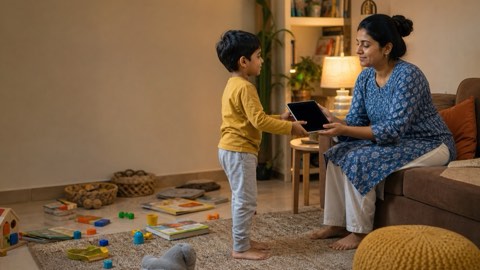
Talk constantly, in narration: describe what you are doing, name what they see, label what they hold. Children need to hear thousands of words a day, and household background chatter does not count — it has to be directed at them.
Follow their attention rather than directing it. Get face to face at their level, wait after you speak (count to five silently — children need processing time), and respond to any attempt: a gesture, a sound, a look. Then expand it: they say 'ball', you say 'yes, big red ball'.
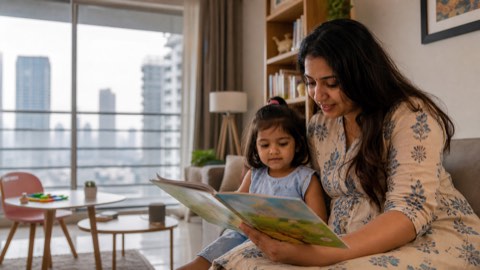
Read together daily from infancy, sing rhymes with actions, and play back-and-forth games — peekaboo, rolling a ball, taking turns. Turn-taking is the foundation of conversation.
Resist doing everything before they ask. If a child gets the water simply by looking at the glass, there is no reason to produce a word. Create small, kind gaps that require communication — pause, look expectant, wait.
Screens, bilingualism and the family theories
Screens are the biggest modern contributor to language delay in toddlers. Passive video, however educational the label, does not teach language — young children learn words from responsive humans. Guidance is no screens before eighteen months to two years, and very limited, co-viewed time after that. A child with delayed speech and heavy screen use should have the screens removed first; improvement is often quick.
Bilingualism does not cause speech delay. Indian children routinely grow up with two or three languages and turn out fine — total vocabulary across languages is on track even if each language looks smaller. Speak whichever language you speak best and most naturally with the child; a grandparent's fluent Marathi is worth more than a parent's stiff English.
Also untrue: that tongue-tie explains most speech delay (it affects some sounds and feeding, rarely language itself), that boys naturally talk much later so waiting is safe, and that an older sibling talking for them is the whole cause. Any of these may be part of a picture — none of them replaces an assessment when the red flags are present.
When to see a doctor
Book an assessment — not a wait-and-see — for: any loss of previously acquired words or skills; no babbling by 9 months; no gestures by 12 months; no words by 16-18 months; no two-word phrases by 2 years; speech unintelligible to strangers at 3 years; no response to sound or name at any age; or any concern about social interaction, eye contact and play. Start with hearing, then paediatrician, then speech therapy.
This article is general information, not medical advice, and is no substitute for personal medical advice. For any decision about your or your child's health, please consult your doctor.
Frequently asked questions
My relatives keep saying Einstein didn't speak till four. Should I relax?
That story is unverified, and the comparison costs children years of therapy they could have had. A late talker with good understanding, gestures and social connection often does catch up — but that judgement should come from an assessment, not from an anecdote.
Is speech therapy available affordably in India?
Government medical colleges, district early intervention centres, and the DEIC centres under the national child health programme provide services, and many NGOs run low-cost clinics. Ask your paediatrician for a referral rather than assuming private is the only route.
My child understands everything but says nothing
is that reassuring? — Partly. Good comprehension is a positive sign, but expressive delay still benefits from therapy, and the strategies above still apply. Get it assessed rather than waiting on the strength of understanding alone.
Will stopping one language help him speak faster?
No, and it usually harms: you lose fluency, richness and family connection for no gain. Keep the languages, keep them consistent (one person, one language works well), and get the assessment.
Sources
Every clinical figure on this page is taken from the guidelines below. Where our numbers and your doctor's differ, ask which guideline they follow.
- AAP. Language Delays in Toddlers: Information for Parents (HealthyChildren.org)Supports the specific red-flag thresholds cited on the page: no babbling by 9 months, no gestures by 12 months, no single words by 16–18 months, no two-word phrases by 2 years, and the recommendation to begin with a hearing test.
- NICE. Speech and language therapy for children and young people with developmental language disorder (NICE guideline NG98)Supports the recommendation for early referral to a speech and language therapist rather than a wait-and-see approach, and the emphasis on early intervention as more effective than delayed assessment.
- AAP. Language Development: 1 Year Olds (HealthyChildren.org)Supports the red-flag thresholds cited on the page: no single words by 16 months, no two-word phrases by 2 years, and the recommendation to seek assessment rather than adopting a wait-and-see approach for children meeting those criteria.
- NIH. Bilingualism and Language Development (NIDCD / NIH)Supports the page's statement that bilingualism does not cause speech delay and that total vocabulary across languages remains on track even when each individual language appears smaller than a monolingual child's vocabulary.
Reviewed by
- Nakul Phatak — CEO, theAsianparent India & IndonesiaHead of theAsianparent India; father of one
- Roshni Chugani — Head of Marketing, theAsianparent India & Singapore12 years in the mother-and-baby space; mother of two
Published by: theAsianparent editorial team