
Games that teach children to listen and follow instructions

Most children who 'never listen' are being given instructions they cannot hold in their head. Fix the instruction first, then play the games.
Fix the instruction first
A three-year-old can generally hold one step, a four-year-old two, a five-year-old two or three. 'Go upstairs, get your socks, put your shoes on and bring your bag' is four steps, and it is not a listening failure when only one happens.
Get close, get their eyes, and say one thing: 'shoes on, please.' Instructions shouted across a room while a child is absorbed in something are not heard in any meaningful sense, and repeating them louder does not help.
Say what to do rather than what to stop: 'walking feet' rather than 'don't run'. Young children process the action word and miss the negative.
Then wait. Five seconds of silence after an instruction is the single most effective technique on this page, and almost nobody does it.
Games for three to five
Simon says, which is a listening test disguised as a game and the best one there is.
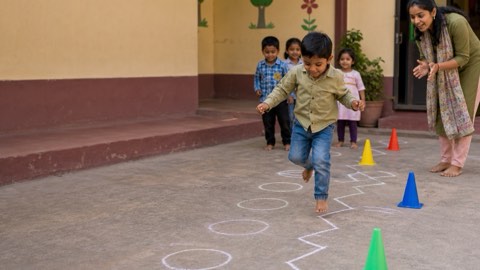
Freeze dance: move to music, stop when it stops. It builds the ability to inhibit an action, which is what following instructions actually requires.
Red light, green light, with a third colour added once they master two.
Silly instructions: 'touch your nose with your elbow', 'hop to the door and clap twice'. Two-step, then three-step, as they get better.
Treasure hunt with spoken clues, one at a time.
The listening walk: walk around the house or street and name every sound you hear. It trains attention to sound rather than obedience, which is the foundation.
Games for five to eight
Chinese whispers, which shows a child exactly what happens when listening is careless.
Barrier games: two people with identical sets of blocks and a barrier between them; one describes, the other builds. Brutally effective for both speaking and listening.
Cooking from spoken steps — the child does what you say, one step at a time, and the outcome shows whether they listened.
Three-step challenges with a timer, building to five steps.
Story sequencing: tell a short story, then have them retell it in order.
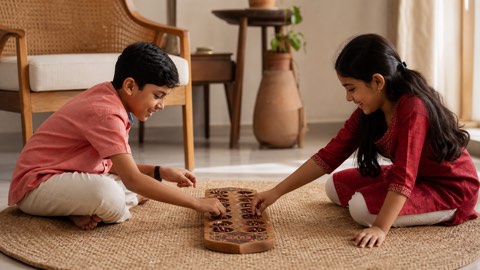
Board games with rules, and the rule that whoever explains it must be listened to.
When listening is not the problem
Check hearing. A child with glue ear after repeated infections hears intermittently and is described as inattentive for months. Any doubt at all deserves a hearing test rather than more instruction.
Check the language: a child working in a medium of instruction they do not fully follow will look like a child who does not listen.
Check attention more broadly: if inattention shows up in every setting, has lasted six months or more, and is well beyond what classmates manage, that is worth a proper assessment rather than a game.
And check the volume of instructions. A child given fifty a day tunes out; a child given ten clear ones follows most of them.
Frequently asked questions
She listens to the teacher and not to me.
Common, and it usually means school gives clearer, shorter instructions with immediate consequences. Copy the structure: one instruction, eye contact, wait, follow through.
Do I have to repeat everything ten times?
Not if you close the loop: give it once, wait, then go and help rather than repeating. Repetition teaches that the first nine times do not count.
Is counting to three a good technique?
It works because it is a clear, consistent warning with a known ending. It stops working the moment you count to three and nothing happens.
He argues with every instruction.
Give fewer, hold the ones that matter, and offer choices where you can. A child who controls nothing argues about everything.
Reviewed by
- Nakul Phatak — CEO, theAsianparent India & IndonesiaHead of theAsianparent India; father of one
- Roshni Chugani — Head of Marketing, theAsianparent India & Singapore12 years in the mother-and-baby space; mother of two
Published by: theAsianparent editorial team
Related articles
 35 activities for four-year-olds, sorted by what they build
 Improving a child's concentration without pressure or punishment
 Sequencing activities
 Activities that build fine-motor skills, birth to three
- Activities that build gross-motor skills, birth to three
 How much physical activity does a preschooler need?