A father's role during pregnancy, labour and the first weeks

There is a great deal for a father to do, and almost none of it is announced. Here is the practical list, trimester by trimester.
During the pregnancy
Go to the appointments. Not all of them if work makes it impossible, but the dating scan, the anomaly scan and at least one routine visit — it changes how informed you are and how included she feels.
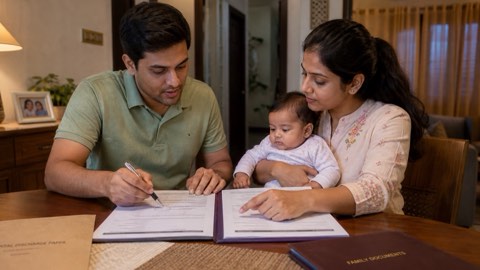
Take a category of work permanently: the appointments diary, the paperwork and insurance, the hospital research, the shopping. Owning something removes mental load in a way that helping when asked does not.
Learn the warning signs — bleeding, severe headache with visual changes, sudden swelling, reduced movements, leaking fluid — and know the route to the hospital and the number for 108.
Handle the family. Managing visitors, deflecting advice and holding the line on decisions you have made together is a job that otherwise falls on a pregnant woman.
And do the physical things: the heavy lifting, the stairs, the standing in queues, the cooking when the smell of it makes her ill.
In labour
Find out in advance whether your hospital allows a birth companion, because policies vary widely in India and it may influence where you deliver.
Your job is not medical. It is: timing contractions, knowing what she wanted, speaking when she cannot, keeping the room calm, and physical support — counter-pressure on the lower back, water, cold cloth, a hand to hold.
Advocate for the two things most often lost in a busy ward: immediate skin-to-skin and the first feed within the hour. Say it on arrival and again when the baby is born.
Do not commentate, do not phone people mid-labour, and do not argue with staff. If something concerns you, ask a question calmly.
And if a caesarean becomes necessary, ask whether you can be present, and ask for skin-to-skin in theatre or recovery.


The first weeks
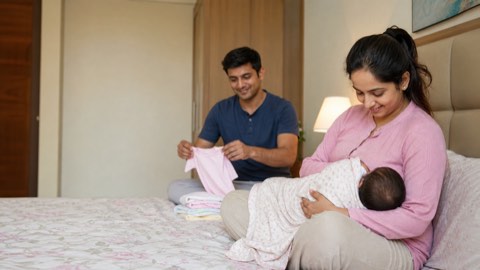
Do the nights you can. If she is breastfeeding, you can still do everything else: changing, settling, bringing the baby to her, returning the baby afterwards. That halves the waking time.
Feed her. A breastfeeding woman needs food and water constantly and often cannot get up to fetch either.
Be the gatekeeper: visitors limited, hands washed, no one with a cough, and the mother's rest protected against everyone's enthusiasm.
Take the older child if there is one, and take the paperwork — birth registration within 21 days, insurance, adding the baby to the policy.
Learn the baby yourself rather than being an assistant. Bath, settle, change, walk — do them alone, so both of you are competent and she can leave the house.
And watch her mood. Postpartum depression affects roughly one Indian mother in five, and partners usually notice first. Saying 'you have seemed low for weeks, shall we talk to the doctor' is one of the most useful sentences available.
Your own head
Paternal postnatal depression is real, affects a significant minority of new fathers, and usually shows as irritability, withdrawal, working late or drinking rather than sadness.
It rarely gets asked about. If you recognise yourself, tell your doctor or call Tele-MANAS on 14416 — free, confidential, and it answers fathers.
Talk to other fathers. The isolation of early parenthood is discussed for mothers and almost never for men, and it is real.
Frequently asked questions
I get no paternity leave.
India has no statutory paternity leave in the private sector (central government employees get 15 days). Ask HR anyway — many companies now offer it and few employees ask. Use annual leave for the first fortnight if that is the only route.
I feel useless in the labour room.
Almost every father does. The useful jobs are small and real: water, pressure on the back, timing, speaking for her, and staying calm.
She does not want me to do things my way.
Common in the early weeks and worth naming gently. Agree the safety-critical items and let the rest be done differently — a father who is corrected constantly stops trying, which serves nobody.
What is the single most useful thing?
Protect one block of her sleep, every day, without being asked.
Reviewed by
- Nakul Phatak — CEO, theAsianparent India & IndonesiaHead of theAsianparent India; father of one
- Roshni Chugani — Head of Marketing, theAsianparent India & Singapore12 years in the mother-and-baby space; mother of two
Published by: theAsianparent editorial team