Fathers: what involvement actually means, and why it changes everything

'Helping' is the wrong word. A father is a parent, not an assistant — and children with involved fathers do measurably better on almost everything.
Why it matters
Children with involved fathers show better cognitive and language development, fewer behaviour problems, better school outcomes, and better mental health in adolescence. The effect holds across cultures and income levels.
The mother benefits too, measurably: rates of postpartum depression are lower where the partner is genuinely involved, and her return to work, sleep and health all improve.
And the father benefits most of the things he is told he is protecting by staying at the office — the relationship he will have with his adult children is built in these years, not later.
What involvement looks like in practice
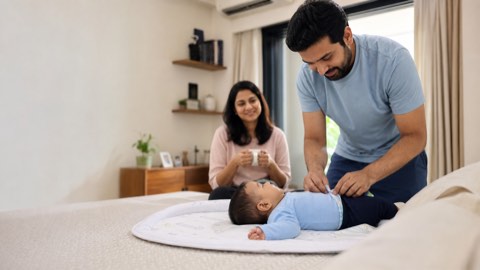
In the newborn weeks: nappy changes, burping, bathing, settling, night shifts (a bottle of expressed milk or taking the baby after a feed so the mother sleeps), skin-to-skin time, and being the one who manages visitors and the household.
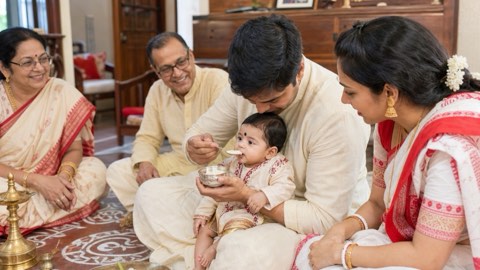
Through infancy and toddlerhood: doing the routine tasks alone rather than as an assistant. Feeding, bathing and bedtime done solo build a relationship a weekend playtime cannot — and they build the child's confidence that either parent will do.
Through childhood: school meetings, doctor visits, homework, knowing the teachers' names and the friends' names, and being reachable in an emergency. Fathers who never attend a parent-teacher meeting are invisible to the school and, eventually, to the child's daily life.
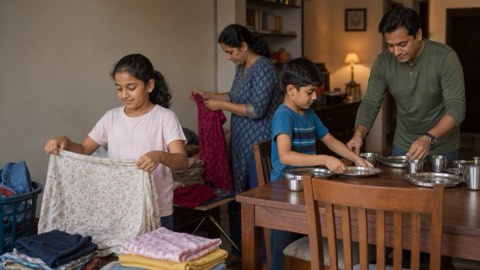
Take the mental load, not just the tasks. Knowing when the vaccination is due, when the fees are payable, that the school shoes are too small — that background management is exhausting precisely because it is invisible, and it usually sits entirely with mothers.
The obstacles, honestly
Work culture: long hours, commutes, and workplaces where a man leaving for a child's illness is judged. India has no statutory paternity leave in the private sector (central government employees get 15 days), so many fathers get days rather than weeks. Ask HR what exists; some employers now offer paternity leave and flexible arrangements that nobody uses because nobody asks.
Gatekeeping at home: mothers and grandmothers correcting a father's nappy technique or taking the crying baby back within seconds. Competence needs practice; a father left to do it his way, imperfectly, becomes capable in a fortnight.
The script: men in many Indian families were not raised to see caregiving as their work, and there are often no models in the household. That is a reason it is hard, not a reason it cannot change.
The father's own wellbeing
Paternal postnatal depression is real — it affects a significant minority of new fathers, is linked to sleep loss, financial pressure and the partner's depression, and typically shows as irritability, withdrawal, working late and drinking rather than sadness.
It rarely gets named because nobody asks. If you are a father recognising yourself here, tell your doctor or call Tele-MANAS on 14416 — it is free, confidential and answers fathers too.
Fathers also need their own support: friends who are also parents, a way to talk about the change in identity, and permission to admit that early parenthood is hard. Silence is the default and it is a bad one.
Frequently asked questions
I work twelve hours a day. How can I be involved?
Choose one daily routine that is reliably yours — bath, bedtime, morning breakfast — and protect it absolutely. Consistency matters far more than duration, and one daily ritual outperforms a weekend outing.
My wife says I do not do enough, but I do a lot.
Try listing the mental load, not the tasks: who notices the school form, books the doctor, remembers the medicine, plans the birthday, knows the shoe size. If the answer is mostly her, that is what the complaint is about.
The baby only wants his mother. Where do I fit in?
That is common, especially with a breastfed baby, and it changes with contact. Take the routines that do not involve feeding — bath, massage, walks, settling — and do them alone, daily. Preference follows familiarity.
My father was not like this and I do not know how.
Nobody starts knowing. Do the tasks badly first, take instruction without taking it as criticism, and hold your own relationship with the child rather than reporting to your wife about it.
Reviewed by
- Nakul Phatak — CEO, theAsianparent India & IndonesiaHead of theAsianparent India; father of one
- Roshni Chugani — Head of Marketing, theAsianparent India & Singapore12 years in the mother-and-baby space; mother of two
Published by: theAsianparent editorial team