Day care, nanny or grandparents: comparing the three honestly

Every Indian family solves childcare with one of three answers, and each has a real cost that nobody mentions until you are in it.
The comparison
Costs vary enormously by city; the table gives the shape of the decision rather than figures, which date quickly.
| Day care / crèche | Nanny or ayah at home | Grandparents | |
|---|---|---|---|
| Cost | Monthly fee, often the middle option | Usually the highest, plus food and often accommodation | Usually free, with real hidden costs |
| Reliability | Open regardless of one person's illness | Fails entirely when she is ill or leaves | Depends on their health and other commitments |
| Supervision | Multiple adults, visible, some regulation | One adult, unobserved — needs the most verification | Family, trusted, and hard to correct |
| Child's illness | Cannot attend when ill; more illnesses in the first year | Can stay home; fewer infections | Can stay home; risk to older carers |
| Socialisation | Other children daily, structure | One-to-one, needs playdates arranged | One-to-one, often plus cousins |
| Flexibility | Fixed hours, late-pickup charges | Most flexible | Flexible until it is taken for granted |
| Main hidden cost | Infections in the first year; rigid timings | Turnover, and the transition each time | Their health, their freedom, and family friction |
What decides it in practice
Age of the child. Under one, one-to-one care at home is often gentler and involves fewer infections. From around two, day care's other children and structure become a genuine benefit.
Your work pattern. Fixed hours suit day care; unpredictable or long hours need a nanny or family.
Your support system. Grandparents in the same city change the maths completely, and their availability is not permanent — plan for what happens when it ends.
Money, honestly. In many Indian cities a full-time nanny costs more than a crèche, and the difference across a year is significant.
Most families end up combining: grandparents for the gaps, a crèche for structure, a part-time ayah for the evenings. That is a sensible answer rather than a compromise.
The hidden costs, said plainly
Day care: expect a year of frequent infections when a child first joins group care. It is normal immune development and it is genuinely disruptive to a working parent.
Nanny: the turnover. Each departure means a new stranger, a new verification, and a child forming an attachment again. See our guide on what to do when a trusted nanny leaves.
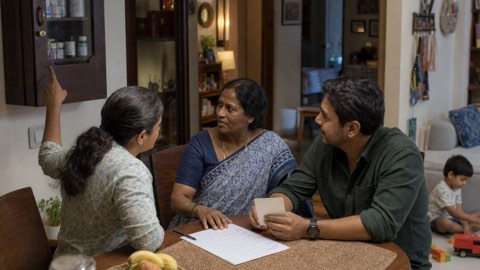
Grandparents: the unacknowledged workload. Lifting a toddler and managing a school run is physically demanding, and older carers rarely say no. It also creates friction over methods, which needs handling explicitly rather than resentfully.
And for all three: nobody replaces you. Whatever the arrangement, protect a daily window that belongs to the child.
Frequently asked questions
Is day care bad for a baby under one?
Not inherently. Quality of care matters more than setting — consistency of the adult, warmth, and responsiveness. A good crèche beats an indifferent nanny.
We can only afford one option.
Then judge on safety and reliability first, and arrange socialisation separately. A child with one steady warm carer and a park visit is doing fine.
My in-laws expect to be the carers and I am uneasy.
Have the conversation about specifics — hours, rules, safety updates — rather than about trust. Most disagreements here are about method and are solvable in writing.
How do I verify a nanny properly?
Identity documents, two previous employers actually called, police verification through the state portal, and no sole charge in the first weeks. Our domestic-help guide has the full checklist.
Reviewed by
- Nakul Phatak — CEO, theAsianparent India & IndonesiaHead of theAsianparent India; father of one
- Roshni Chugani — Head of Marketing, theAsianparent India & Singapore12 years in the mother-and-baby space; mother of two
Published by: theAsianparent editorial team