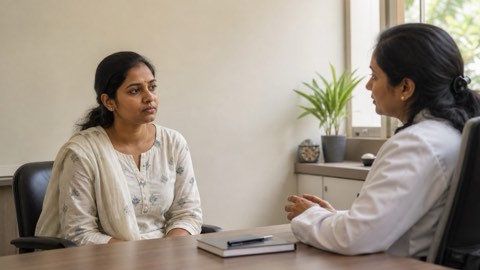
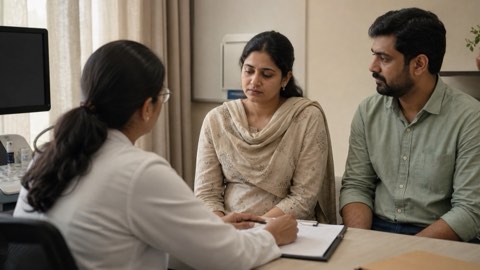
Creating a smoke-free home during pregnancy

A smoke-free home is the single most useful thing a household can do for a pregnancy, and it is a negotiation rather than a rule — particularly in a joint family.
Why the balcony is not enough
Smoke does not stay where it was made. It moves through doorways, along corridors, through gaps around doors, and back in through the same window it went out of.
Opening a window, using a fan, or smoking in another room reduces exposure but does not remove it. There is no ventilation arrangement that makes indoor smoking safe.
Third-hand smoke is the part most people have not heard of: the residue that settles into sofas, curtains, carpets, bedding, clothing and skin, and continues to release compounds for weeks. A baby who crawls, touches and mouths everything is exposed to it directly.
Smoking outside the flat, away from doors and windows, changing the outer layer of clothing and washing hands before holding the baby is the version that genuinely works.
Car interiors are the worst enclosed space of all, and a car should be entirely smoke-free regardless of open windows.
Setting the rule so it holds
Make it about the house and everyone in it, not about one person's habit. 'Nobody smokes inside this flat' is easier to hold than a rule aimed at a specific relative.
Announce it once, calmly, with the pregnancy as the reason, and set the date it starts. Rules that arrive gradually get negotiated away gradually.
Remove every ashtray from inside the house and put one outside. Objects carry rules better than reminders do.
Decide in advance what happens with guests, because that is where it collapses. A polite line agreed between the two of you — 'we're keeping the house smoke-free now, there's a chair outside' — works better than an awkward silence and a decision made in front of everyone.
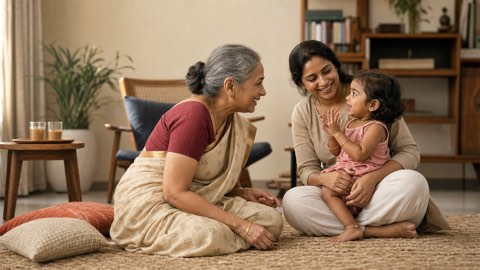
In a joint family, get the senior member on side first if you can. A rule supported from the top is enforced; a rule imposed from below is argued with.
Expect to repeat it. Household rules take a few weeks to become normal, and one exception restarts the clock.
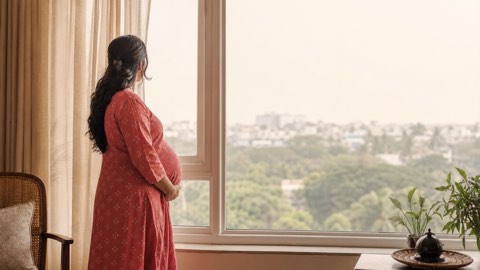
Shared, rented and difficult situations
In a rented flat, ask about the previous tenants. Third-hand smoke residue persists in walls, fittings and curtains — a deep clean, washing all soft furnishings, and painting where possible makes a real difference before a baby arrives.
In a shared building, smoke travels between flats through shared ventilation, stairwells and balconies. Sealing gaps around the front door and using the room furthest from the source helps; it does not solve it.
If the smoker is a landlord, a domestic worker, or a relative you cannot direct: focus on your own room and the baby's, keep those absolutely smoke-free, and keep windows on the opposite side.
If the smoking is part of a wider situation you cannot control — a partner who reacts badly to being asked, or a household where you have no standing — that is worth telling your doctor about directly. It is more common than it is discussed, and there are people whose job it is to help.
For public spaces, COTPA prohibits smoking in most enclosed public places in India, including restaurants and workplaces. You are entitled to ask, and to leave.
When to see a doctor
Tell your obstetrician if you are exposed to smoke at home or at work. It is relevant to how your growth scans are interpreted.
Go to hospital immediately for bleeding, severe abdominal pain, leaking fluid, or reduced or changed fetal movements.
After the birth, see a doctor for a baby with a persistent cough, wheeze, repeated chest infections or ear infections — all of which are more common with household smoke exposure.
This article is general information, not medical advice, and has not been reviewed by a clinician.
This article is general information, not medical advice, and is no substitute for personal medical advice. For any decision about your or your child's health, please consult your doctor.
Frequently asked questions
Is smoking near an open window fine?
No. Smoke re-enters, and residue settles indoors regardless.
Does an air purifier solve it?
No. Purifiers remove some particles and do not remove the gases, and they do nothing about residue on surfaces.
My father-in-law has smoked in this house for forty years.
Start with the baby's room and your bedroom as absolutely smoke-free, get your partner to make the request rather than you, and frame it as a house rule for the baby rather than a comment on him.
What about incense, mosquito coils and cooking smoke?
Also worth reducing. Mosquito coils and biomass cooking smoke are significant indoor air pollutants in Indian homes and affect the same outcomes.
Sources
Every clinical figure on this page is taken from the guidelines below. Where our numbers and your doctor's differ, ask which guideline they follow.
- WHO. WHO recommendations for the prevention and management of tobacco use and second-hand smoke exposure in pregnancy (2013)Backs the core claims that second-hand smoke exposure during pregnancy is harmful and that no level of indoor smoke exposure is safe for pregnant women.
- CDC. Smoking During Pregnancy (2023)Supports the claims that secondhand smoke exposure in pregnancy is associated with adverse outcomes, and that smoking in another room or near an open window does not adequately protect pregnant women or infants.
- NICE. Tobacco: preventing uptake, promoting quitting and treating dependence (NG209) (2023)Supports the recommendation that pregnant women should be asked about smoke exposure at home and at work, and that this information is clinically relevant to antenatal monitoring.
- NHS. Stop smoking in pregnancy (2023)Supports the advice to tell your obstetrician about smoke exposure at home or work, and backs the emergency warning signs listed (bleeding, severe abdominal pain, leaking fluid, reduced or changed fetal movements) as reasons to go to hospital immediately.
Reviewed by
- Nakul Phatak — CEO, theAsianparent India & IndonesiaHead of theAsianparent India; father of one
- Roshni Chugani — Head of Marketing, theAsianparent India & Singapore12 years in the mother-and-baby space; mother of two
Published by: theAsianparent editorial team