The fussy eater: why toddlers stop eating and what actually fixes it

Almost every toddler in India is described as a fussy eater by someone in the family. Most are eating exactly as much as they need. Here is how to tell the difference, and how to stop the war.
Why appetite falls after the first birthday
Growth slows dramatically after twelve months — a baby triples its birth weight in year one and adds only two or three kilos in year two. Less growth needs less fuel, so the child who ate everything at ten months now picks. This is biology, not defiance.
Toddlers also discover the word no, prefer familiar foods (neophobia peaks between two and four years), eat one big meal and two token ones, and can live entirely on one food for a week. All normal.
The real measure is not the plate but the child: growing along the chart, active, alert, sleeping and playing normally. A thriving child is eating enough, whatever the grandmother's assessment.
Why force-feeding backfires
Force-feeding — pinning, distracting with the phone, chasing around the house with a katori, the 'one more bite for mama' bargain — teaches a child to ignore their own hunger signals and to associate meals with conflict. It also, reliably, makes them eat less over time.
The rule that works is the division of responsibility: parents decide WHAT is served, WHEN and WHERE. The child decides WHETHER to eat and HOW MUCH. That is the whole method, and it takes nerve to hold for the first fortnight.
The screen habit deserves its own warning: a child fed in front of a phone eats without noticing, does not learn fullness, and later cannot eat without a screen. It buys quiet today and creates a much harder problem next year.

What actually works
Structure: three meals and two snacks at roughly fixed times, and nothing but water in between. Constant grazing and milk on demand are the commonest hidden cause of no appetite at meals — cap milk at around 400-500 ml a day after one year.
Serve small: a big plate intimidates; a small portion with the option of more feels manageable. Include one food you know they accept alongside the new thing, and keep offering rejected foods without comment — it can take ten or fifteen exposures.
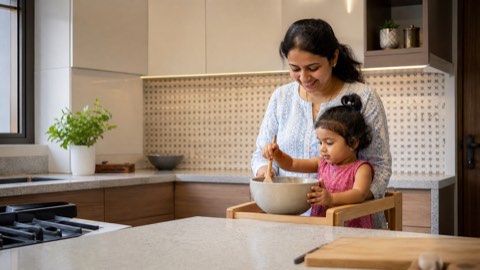
Let them serve themselves, eat with their hands, and get messy. Eat together as a family — children copy eating, they do not obey it. And drop the running commentary: no praise for eating, no anger for refusing. Boring is the goal.
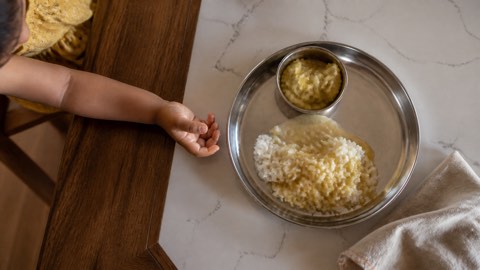
Make food available in forms they can win: dal poured over rice, vegetables inside a paratha or chilla, paneer cubes to pick up, fruit cut small. Hiding vegetables is fine as a supplement, but keep offering the visible version too, so acceptance can eventually happen.
When it is more than fussiness
See the doctor if: weight is falling off the growth chart or static for months; the child eats fewer than about ten foods in total and drops more over time; every meal causes gagging, choking or vomiting; there is pain, difficulty swallowing, or a rash and tummy trouble with particular foods; or the child is pale, lethargic and irritable, which points at anaemia.
Anaemia deserves special mention because it is so common in Indian toddlers and because it itself kills appetite — a tired, pale, poorly-eating toddler needs a haemoglobin test before any more mealtime strategy. Excess milk (over about 500 ml a day) is a frequent cause: it fills the stomach and blocks iron absorption.
Frequently asked questions
My child eats well for the grandmother but not for me
what am I doing wrong? — Usually nothing except caring more. Children perform for tension; the calmer adult gets the better meal. Try handing over some meals entirely, and stop watching each bite.
Is a tonic or appetite syrup useful?
Not as a first move. Most appetite syrups do little, some contain steroids or antihistamines, and none fix the underlying pattern. Get iron and vitamin D checked instead, and fix the milk-and-grazing structure — that is what usually changes things.
He only eats rice and curd. Should I let him?
Serve it as part of a plate that also has dal and a vegetable, without pressure, and keep the rest of the menu appearing. Restrictive phases pass if they are not fought over. Add ghee, and use the accepted food as a vehicle: dal-rice, vegetable khichdi, curd with grated vegetables.
How do I get the family to stop force-feeding?
Quote the doctor and give an alternative job: 'the doctor said not to force, but he eats much better sitting with you.' Assign the grandmother the role of the fun eating companion rather than the enforcer. Consistency across adults matters more than which method wins.
Sources
Every clinical figure on this page is taken from the guidelines below. Where our numbers and your doctor's differ, ask which guideline they follow.
- WHO. Infant and Young Child Feeding: Model Chapter for Textbooks for Medical Students and Allied Health Professionals (2009)Supports the claim that growth slows significantly after the first year, that responsive (non-forced) feeding is recommended, and that children should be allowed to self-regulate intake rather than being force-fed.
- AAP. Preventing Obesity and Eating Problems: Division of Responsibility in Feeding (HealthyChildren.org) (2022)Supports the division-of-responsibility principle (parents decide what, when, and where; the child decides whether and how much), the structure of three meals and two snacks, and the advice against force-feeding as it undermines hunger self-regulation.
- ICMR. Dietary Guidelines for Indians (2024)Supports the advice to offer a varied plate including dal, rice, vegetables, and ghee-enriched foods for toddlers, and the recommendation to limit repeated milk intake that may suppress appetite and impair iron absorption in young children.
Reviewed by
- Nakul Phatak — CEO, theAsianparent India & IndonesiaHead of theAsianparent India; father of one
- Roshni Chugani — Head of Marketing, theAsianparent India & Singapore12 years in the mother-and-baby space; mother of two
Published by: theAsianparent editorial team