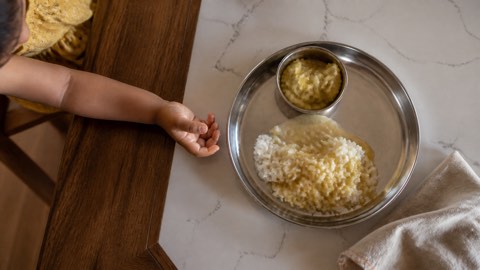
Ten easy, healthy Indian recipes children actually eat

Ten recipes, organised by when you need them rather than by ingredient. Quantities are for two children; allergens are marked on each.
Breakfast
1. Vegetable oats chilla — 15 minutes. Mix 1 cup powdered oats, 1/2 cup besan, 1 grated carrot, 2 tbsp finely chopped coriander, 1/4 tsp ajwain, salt, and water to a pouring batter. Rest 10 minutes. Cook on a tawa with 1/2 tsp oil per chilla until golden both sides. Makes 4. Contains: gluten (oats may be cross-contaminated), and besan is a legume. Swap: replace besan with rice flour for a lighter version.
2. Ragi banana pancakes — 15 minutes. Mash 1 ripe banana, whisk with 1 cup ragi flour, 1/2 cup curd, 1/2 tsp baking soda, 2 tbsp jaggery powder and milk to a thick batter. Cook small pancakes on low heat with ghee. Makes 8 small. Contains: dairy. Ragi is one of the best calcium and iron sources in an Indian kitchen. Swap: coconut milk for dairy-free.
3. Paneer and vegetable paratha — 20 minutes. Crumble 100g paneer, mix with 1/2 cup grated bottle gourd or carrot squeezed dry, 1/4 tsp jeera powder, salt, and a pinch of chilli if they take it. Stuff into whole-wheat dough, roll and cook with ghee. Makes 4. Contains: dairy, gluten. Swap: mashed rajma or crumbled tofu for the paneer.
Lunchbox
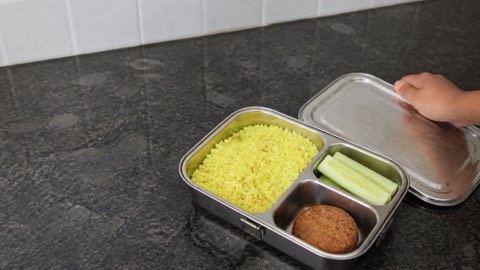
4. Vegetable pulao with peas and paneer — 25 minutes. Sauté 1 tsp jeera in 1 tbsp ghee, add 1 chopped onion, 1 cup mixed chopped vegetables and 1/2 cup peas, then 1 cup soaked rice and 1.75 cups water with salt. Cook covered 12 minutes, rest 5. Fold in 50g cubed paneer. Serves 2. Contains: dairy. Packs well and stays good until lunch in an insulated dabba.
5. Moong dal and vegetable idli — 20 minutes plus batter. To 2 cups idli batter add 1/2 cup cooked moong dal, 1 grated carrot and 2 tbsp chopped coriander. Steam 12 minutes. Makes 12 small. Contains: none of the common allergens. The added dal roughly doubles the protein of a plain idli.
6. Rajma and cheese wrap — 15 minutes. Mash 1 cup cooked rajma with 1/2 tsp jeera powder, salt and a squeeze of lemon. Spread on a chapatti, add 2 tbsp grated cheese and finely chopped cucumber, roll tightly and cut in half. Makes 2. Contains: dairy, gluten. The lemon is not optional — vitamin C substantially improves the iron absorption from the rajma.
After school, no-cook, and cook-with-me
7. Roasted chana and peanut chaat — 10 minutes, after school. Mix 1 cup roasted chana, 1/4 cup roasted peanuts, 1 chopped tomato, 1/4 chopped onion, coriander, lemon and a pinch of chaat masala. Serves 2. Contains: peanuts. Swap: roasted makhana for a nut-free version.
8. Curd with fruit and til — 5 minutes, no cook. Whisk 1 cup thick curd with 1 tsp jaggery powder, top with chopped banana or pomegranate and 1 tsp roasted til. Serves 2. Contains: dairy, sesame. Sesame is one of the best non-dairy calcium sources available cheaply in India.
9. Sprouts and cucumber salad — 10 minutes, no cook. Toss 1 cup sprouted moong with 1 chopped cucumber, 1 chopped tomato, lemon, salt and coriander. Serves 2. Contains: none of the common allergens. For young children, steam the sprouts 3 minutes first — raw sprouts carry a higher risk of foodborne illness.
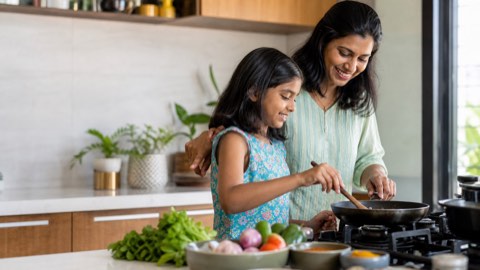
10. Banana and date energy balls — 10 minutes, no cook, children can make this one. Blend 10 deseeded dates with 1/2 cup roasted oats, 2 tbsp desiccated coconut and 1 tbsp peanut butter. Roll into balls with clean hands. Makes 12. Contains: peanuts, oats. Children of five and up can do the entire recipe apart from the blending. Swap: sunflower seed butter for nut-free.
Storage: cooked items keep one day refrigerated; energy balls keep a week. Reheat thoroughly rather than warming.
Note on photography: these recipes have been written and quantities set out for testing, and this page currently carries no original photographs. It has not been reviewed by a dietitian.
Frequently asked questions
My child will not eat vegetables in any of these.
Reduce the visible vegetable rather than removing it, keep offering, and do not make it a condition. Acceptance often takes ten or more calm exposures.
Can these be made ahead?
Chilla and paratha dough, idli batter, sprouts and energy balls all keep. Pulao and wraps are better fresh.
Are these suitable for a lunchbox in Indian heat?
Curd-based items and cut fruit are not, without a cold pack. Pulao, paratha, idli and wraps are.
What about nut allergies at school?
Recipes 7 and 10 contain peanuts. Both have swaps listed, and many Indian schools now ask for nut-free boxes — check yours.
Sources
Every clinical figure on this page is taken from the guidelines below. Where our numbers and your doctor's differ, ask which guideline they follow.
- WHO. Complementary feeding: Ensuring nutritional adequacy for young children (2023)Backs the page's broader emphasis on dietary diversity, inclusion of legumes (rajma, moong dal, chana), and iron-rich foods in children's diets.
- IAP. IAP Guidelines on Feeding of Normal Infants, Children and Adolescents (2016)Supports the promotion of traditional Indian ingredients (ragi, curd, legumes, whole grains) as nutritionally appropriate foods for Indian children, and the principle of repeated non-pressured exposure to encourage vegetable acceptance.
- ICMR. Dietary Guidelines for Indians (2024)Supports the recipes' use of ragi as a calcium and iron source, sesame as a non-dairy calcium source, and the pairing of vitamin C (lemon) with plant-based iron foods such as rajma and sprouts to enhance absorption.
- WHO. Guideline: Daily iron supplementation in infants and children (2016)Provides additional backing for the page's consistent pairing of iron-containing foods (legumes, ragi, sprouts) with enhancers of absorption, consistent with WHO guidance on maximising dietary iron bioavailability in children.
Reviewed by
- Nakul Phatak — CEO, theAsianparent India & IndonesiaHead of theAsianparent India; father of one
- Roshni Chugani — Head of Marketing, theAsianparent India & Singapore12 years in the mother-and-baby space; mother of two
Published by: theAsianparent editorial team