Car seats in India: the law, the types, and installing one properly

A baby in a lap is not restrained — in a crash they become a projectile, and the adult holding them cannot hold on. This is the one purchase where the physics does not negotiate.
What the law says
The Motor Vehicles (Amendment) Act made child restraints and helmets for children a legal requirement, with rules requiring children under four on a two-wheeler to wear a helmet and be secured with a safety harness, and a speed limit of 40 km/h for that journey.
Enforcement is patchy, and the physics is not. Whatever the traffic police do or do not check, an unrestrained child in a collision at city speeds is the injury that fills paediatric emergency rooms.
For cars, use a rear-facing infant seat from the first journey home from hospital, and never place a rear-facing seat in front of an active airbag.
Choosing by stage
Infant seat, rear-facing, birth to about 12-15 months or until the child outgrows the height or weight limit: the safest configuration there is, because it spreads crash forces across the whole back and supports the head and neck.
Convertible seat: rear-facing as long as possible — many now allow rear-facing to two years or beyond, and every extra month rear-facing is a genuine safety gain — then forward-facing with a five-point harness.
Booster seat from around four years and 15-18 kg, until the adult belt fits properly: the lap belt low across the hips, the shoulder belt across the collarbone rather than the neck. Most children need a booster until around ten to twelve years.
Buy new where possible, check for a recognised safety certification, and never use a seat that has been in a crash or whose history you do not know.
Installing it right
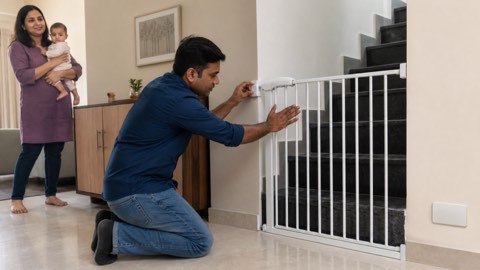
The commonest mistakes: a loose base (it should not move more than about 2.5 cm side to side at the belt path), a harness that is too loose (you should not be able to pinch a fold of webbing at the shoulder), the chest clip too low (it belongs at armpit level), and bulky winter clothing under the harness, which leaves dangerous slack in a crash.
Rear-facing seats need the correct recline angle so a newborn's head does not fall forward — most seats have an indicator line.
The back seat is the safest place for every child under thirteen. If your car has ISOFIX anchors, use them; otherwise thread the seat belt exactly as the manual shows.
Read the manual, and if possible have the fit checked by someone who has installed one before. A correctly fitted average seat beats a badly fitted expensive one.
When to see a doctor
After any crash, however minor, a child should be assessed if they have any pain, drowsiness, vomiting, marks from the harness, or a head impact — and any loss of consciousness, repeated vomiting, unequal pupils or fluid from the nose or ears is an emergency, 108.
Also: babies should not sleep for long periods in a car seat outside the car, because the semi-upright position can compromise breathing in newborns. Move a sleeping baby to a flat surface when you arrive.
This article is general information, not medical advice, and is no substitute for personal medical advice. For any decision about your or your child's health, please consult your doctor.
Frequently asked questions
Nobody in our family uses a car seat and everyone survived.
Survivorship, not safety. Crash injuries in children are far commoner than families think, and the ones prevented by restraints are the severe ones.
Can a baby travel on a two-wheeler?
Infants and small children should not. For older children, the law requires a helmet and safety harness under four and a speed limit of 40 km/h, and the child must be able to hold on and reach the footrests.
We only travel short distances.
Most crashes happen close to home at moderate speeds. Short trips are exactly where restraints get skipped and where the injuries occur.
The baby screams in the car seat.
Common at first. Check the recline and harness fit, put the baby in when calm, use a sunshade, and have an adult sit alongside in the back. It almost always improves within a few weeks of consistent use.
Sources
Every clinical figure on this page is taken from the guidelines below. Where our numbers and your doctor's differ, ask which guideline they follow.
- WHO. Global Status Report on Road Safety 2023 (2023)Backs the page's core premise that unrestrained children in crashes sustain severe injuries, and that child restraints are an evidence-based intervention reducing crash-related child injury and death.
- AAP. Car Safety Seats: Information for Families (2023)Backs the rear-facing from first journey home recommendation, keeping children rear-facing as long as possible, the five-point harness on forward-facing seats, booster seat use until the adult belt fits properly, children under 13 in the back seat, the 2.5 cm base-movement limit, harness fit checks (pinch test), chest clip at armpit level, and the caution against bulky clothing under the harness.
- NICE. Head injury: assessment and early management (NG232) (2023)Backs the post-crash child assessment guidance: that pain, drowsiness, vomiting, harness marks, or head impact warrant assessment, and that loss of consciousness, repeated vomiting, unequal pupils, or fluid from nose or ears constitutes an emergency.
Reviewed by
- Nakul Phatak — CEO, theAsianparent India & IndonesiaHead of theAsianparent India; father of one
- Roshni Chugani — Head of Marketing, theAsianparent India & Singapore12 years in the mother-and-baby space; mother of two
Published by: theAsianparent editorial team