Your baby's first Diwali: keeping it joyful and safe

A baby's first Diwali is mostly about managing three things — noise, smoke and sleep — so the rest of it can be enjoyed.
Noise
Babies startle at sudden loud sounds, and firecrackers at close range are genuinely loud enough to be uncomfortable. Keep the baby indoors during the peak hours, in a room away from the street side, with windows closed.
White noise, a fan, or soft music in the room takes the edge off the bangs. Earmuffs made for infants exist and work; cotton wool stuffed into a baby's ears does not, and can be dangerous.
If you take the baby out to see lights, go early in the evening before the crackers start, and skip the crowds entirely in the first months.
Smoke and air quality
Diwali week has some of the worst air of the Indian year in many cities, and small lungs are the most affected. Keep windows shut on the worst evenings, run an air purifier if you have one, and avoid taking a baby out during and immediately after cracker hours.
Indoor smoke matters too: burning agarbatti, camphor and diyas in a closed room around a baby adds up. Ventilate between pujas, and keep the baby out of the smokiest room.
Babies with any history of wheezing, bronchiolitis or a preterm birth need extra care this week — talk to your paediatrician in advance about what to watch for and what to do.
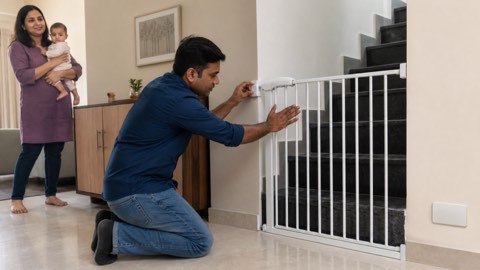
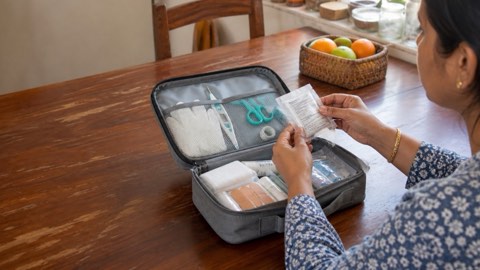
Diyas, sparklers and burns
Diyas at floor level are exactly at crawling height. Put them on high, stable surfaces, well away from curtains and out of reach, and never leave a lit diya in a room where a baby is unsupervised.
Nobody holds a baby and a sparkler at once, and no child under about ten should handle crackers without an adult's hands on the situation. Keep a bucket of water where crackers are lit.
If a burn happens: cool under running water for twenty minutes, do not apply toothpaste, haldi, oil or ice, cover with a clean cloth, and go to hospital for anything larger than the baby's palm or on the face, hands or genitals.
Sleep, visitors and the photographs
Sleep will suffer. Keep the routine's shape even if the timings slip, protect at least one good nap, and expect a couple of unsettled nights afterwards — it passes.
Visitors: ask that anyone with a cough stays away, that hands are washed, and that nobody kisses the baby's face. Festival season and cold-and-flu season overlap.
The photographs are the part you keep. Take them early in the evening, before the baby is overtired, in natural light or lamplight rather than with a flash close to the eyes. Traditional outfits are best worn for twenty minutes and then swapped for cotton — most festival wear is scratchy and hot.
When to see a doctor
Same-day or emergency: any burn beyond a small superficial one; difficulty breathing, fast breathing, chest sucking in or wheezing; a fit; or any fever in a baby under three months. Call 108 for breathing difficulty.
Also same-day: persistent coughing or wheezing after cracker exposure, an eye injury or eye irritation that does not settle with rinsing, or a baby who is unusually drowsy or refusing feeds.
This article is general information, not medical advice, and is no substitute for personal medical advice. For any decision about your or your child's health, please consult your doctor.
Frequently asked questions
Can we take our two-month-old to the family gathering?
A short daytime visit in a small group is reasonable; a crowded evening event during cracker hours is not, especially in the first eight weeks.
Is it safe to apply kajal for the festival photos?
Not in the eyes. Traditional kajal is a common cause of eye irritation and some preparations have been found to contain lead. A dot behind the ear or on the cheek does the same cultural job safely.
The whole building bursts crackers. What can we do?
Close the windows, move the baby to the innermost room, use white noise, and plan the evening feed and sleep before the peak hour. Talking to neighbours about timing sometimes helps more than expected.
My baby has been coughing since Diwali night.
Get it checked if it comes with fast breathing, wheeze, fever or poor feeding. Post-Diwali respiratory trouble in small children is common and worth taking seriously rather than waiting out.
Sources
Every clinical figure on this page is taken from the guidelines below. Where our numbers and your doctor's differ, ask which guideline they follow.
- NHS. Burns and scalds – Treatment (2022)Supports the burn first-aid advice to cool the burn under cool running water for twenty minutes, not to apply toothpaste, butter, oil, or ice, and to seek emergency care for burns on the face, hands, or genitals or any burn larger than a small superficial one.
- NIH. Lead in Traditional Eye Cosmetics (Kajal/Kohl) – MedlinePlus / NCBI literature (2012)Supports the claim that traditional kajal is a common cause of eye irritation and that some preparations have been found to contain lead, and therefore should not be applied in or near a baby's eyes.
Reviewed by
- Nakul Phatak — CEO, theAsianparent India & IndonesiaHead of theAsianparent India; father of one
- Roshni Chugani — Head of Marketing, theAsianparent India & Singapore12 years in the mother-and-baby space; mother of two
Published by: theAsianparent editorial team