Summer with small children: heat, dehydration and the Indian season plan

Indian summers are dangerous for small children in ways that are easy to miss. Here is the practical season plan, from hydration to heatstroke.
Hydration first
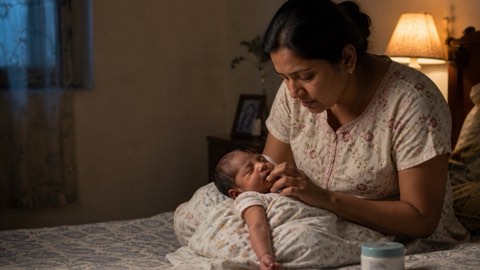
Babies under six months need only breastmilk or formula, more often rather than water — breastmilk is over 80% water and adjusts to the heat. Do not give water to a baby under six months even in May; it fills the stomach, displaces milk and carries infection risk.
From six months, offer water regularly through the day in addition to milk feeds. For older children, water on the table at every meal, a bottle that goes everywhere, and prompts — children rarely ask until they are already thirsty.
Good hot-weather drinks: plain water, nimbu pani, chaas, coconut water, aam panna, and ORS during illness or heavy sweating. Skip cold drinks and packaged juices, which are sugar loads that do not hydrate as well.
Watch the output: fewer wet nappies, dark strong-smelling urine, dry mouth, no tears, sunken eyes, and lethargy are dehydration signs and need action.
Heat illness — the signs that matter
Heat exhaustion: heavy sweating, pale clammy skin, tiredness, dizziness, headache, nausea, muscle cramps. Move to a cool place, remove excess clothing, sponge with cool water, give fluids or ORS, and rest. It usually settles within thirty minutes.
Heatstroke is an emergency: a very high temperature, hot skin that may be dry (sweating can stop), confusion, drowsiness, rapid breathing, a fit, or unconsciousness. Call 108, move the child to shade, remove clothing, and cool aggressively with water and fanning while help comes. Heatstroke kills, and children overheat faster than adults.
The highest-risk situation, and the one that recurs every summer: a child left in a parked car. Temperatures inside rise to lethal levels within minutes even with a window cracked. Never, for any duration.
Skin, sun and clothing
Prickly heat (ghamoriyan): tiny red bumps in the neck folds, chest and back. The treatment is cooling, not powder — light loose cotton, fewer layers, cool baths, a fan (not blowing directly on a small baby), and drying the folds thoroughly.
Sun: keep babies under six months out of direct sun entirely — shade, a hat, and light long sleeves. For older children, avoid direct exposure between 11 a.m. and 4 p.m., use a broad-spectrum sunscreen on exposed skin, and reapply. Sunburn on a small child is a burn and a same-day matter if it blisters.
Clothing: loose, light-coloured cotton, one layer for babies indoors. Overdressing a baby in summer 'to prevent a cold' is a genuine cause of heat rash and overheating.
Food, water and the season's illnesses
Food poisoning and diarrhoea peak in summer. Freshly cooked hot food, no leftovers reheated for babies, boiled or filtered water, no cut fruit or juices from street vendors for small children, and refrigeration of anything kept.
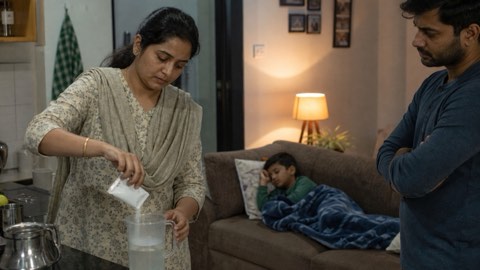
Keep ORS sachets in the house from March. Diarrhoea plus heat dehydrates a small child dangerously fast — see our diarrhoea and ORS guide for the full treatment.
Cooling safely: fans are fine; air conditioning is fine at a moderate temperature (around 24-26°C) with the airflow not blowing directly on the child, and a baby dressed in a light layer. Coolers raise humidity and need clean water changed regularly — stagnant water breeds mosquitoes. Never leave a baby alone near a cooler or a bucket.
When to see a doctor
Emergency, 108: a child who is confused, drowsy, unresponsive or having a fit in the heat; very high temperature with hot skin; a child rescued from a hot car; or severe breathlessness.
Same-day: signs of dehydration (no urine for six to eight hours, dry mouth, sunken eyes, lethargy); vomiting that prevents fluids; diarrhoea with dehydration; any fever in a baby under three months; blistering sunburn; or a heat rash that becomes infected with pus and swelling.
This article is general information, not medical advice, and is no substitute for personal medical advice. For any decision about your or your child's health, please consult your doctor.
Frequently asked questions
Is air conditioning bad for babies?
No, used sensibly. A moderate temperature, no direct draught, a light layer of clothing on the baby, and a clean filter. Overheating is a far greater risk to a small baby than a cool room.
Can I give my six-month-old cold drinks or ice cream in summer?
Not cold drinks or packaged juices at any age in early childhood. From six months, water and, after one year, small amounts of curd-based lassi and homemade ice options are fine. Cold food does not cause infection, but sugar and packaged drinks displace better nutrition.
My child gets prickly heat every summer despite powder.
Powder is the problem as much as the solution — it cakes and blocks. Reduce layers, use cool water baths twice a day, dry the folds properly, and use a light calamine if the doctor advises. It clears when the skin cools.
How much water should a five-year-old drink in summer?
Roughly a litre and a half to two litres across the day in Indian summer heat, more with activity — but the practical measure is urine that is pale rather than dark. Send a full bottle to school and ask whether they are allowed to refill it.
Sources
Every clinical figure on this page is taken from the guidelines below. Where our numbers and your doctor's differ, ask which guideline they follow.
- WHO. Infant and young child feeding – Key facts (2023)Backs the claim that babies under six months need only breastmilk or formula and should not be given water, and that exclusive breastfeeding is recommended for the first six months.
- NHS. Heat exhaustion and heatstroke (2022)Backs the first-aid sequence for heat exhaustion and heatstroke, the note that heat exhaustion usually resolves within 30 minutes with cooling and fluids, and the instruction to call emergency services and cool aggressively for heatstroke.
- WHO. The Treatment of Diarrhoea: A Manual for Physicians and other Senior Health Workers (4th revision) (2005)Backs the recommendation to keep ORS sachets at home, use ORS during diarrhoea and heavy sweating, and the warning that diarrhoea combined with heat dehydrates young children dangerously fast.
Reviewed by
- Nakul Phatak — CEO, theAsianparent India & IndonesiaHead of theAsianparent India; father of one
- Roshni Chugani — Head of Marketing, theAsianparent India & Singapore12 years in the mother-and-baby space; mother of two
Published by: theAsianparent editorial team