Newborn skin care: what is normal, what needs a doctor, and what to skip

Newborn skin arrives wrinkled, peeling and blotchy, then settles. Here is what each of those looks like, the two-minute care routine that is all it needs, and the customs to retire.
The normal newborn skin timetable
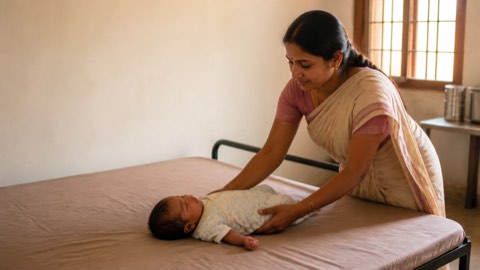
Peeling in the first two weeks is standard — the skin sheds its last womb layer, sometimes in sheets around the ankles and wrists. It needs no treatment beyond the normal oil massage; peeling is not dryness that failed.
Milia — tiny white pinhead spots on the nose and cheeks — are blocked pores that clear themselves in weeks. Baby acne, red pimply patches on the cheeks around weeks two to six, is your hormones leaving the baby's system. Both are hands-off: no creams, no squeezing, no besan.
Mongolian spots, the blue-grey patches on the back and bottom, are common in Indian babies and fade over years. Stork bites (pink marks on eyelids and nape) fade too. Anything raised, growing fast, or bleeding gets shown to the doctor.
The routine that is actually enough
Bath two or three times a week is plenty for a newborn in cool weather; daily in Indian summers is fine. Warm water, a mild baby cleanser or none at all, five minutes, and dry the folds — neck, armpits, groin, behind the knees, where sweat rash starts.
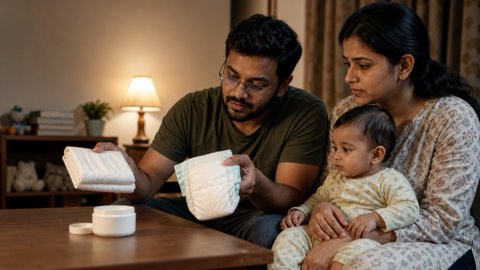
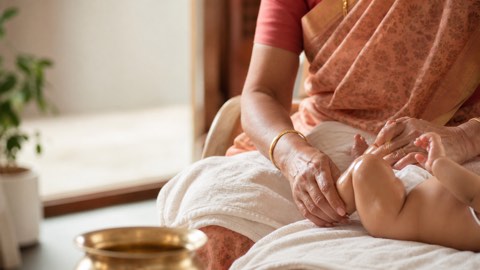
Moisturise while the skin is still damp — a plain baby lotion or the massage oil (coconut works well). Fragrance-free and simple beats medicated and expensive; adult products, antiseptic soaps and talc are all wrong for baby skin. Talc especially: babies inhale the cloud, and it does nothing a dry towel cannot.
Clothes: soft cotton, washed in mild detergent, rinsed twice, sun-dried. Overdressing is the commonest cause of heat rash in India — the rule is one light layer more than an adult is comfortable in, not three.
Read next
The common rashes and what they mean
Heat rash (ghamoriyan): tiny red prickly bumps in skin folds and the neck, in hot weather or an over-wrapped baby. Fix the temperature, not the skin — lighter clothes, a fan (not blowing directly), cool baths. It clears in days.
Cradle cap: yellow greasy scales on the scalp. Harmless. Massage a little oil in an hour before the bath, loosen gently with a soft brush, wash out. Never pick at it; it resolves by itself over months anyway.
Fungal rash in the neck and groin folds — bright red, sharply edged, sometimes with small satellite spots — needs a doctor's antifungal cream, not more powder. And any rash with fever, blisters, pus, or a rash that does not fade when pressed with a glass, goes to a doctor the same day.
Traditions to keep and drop
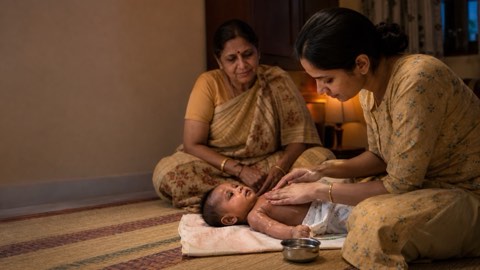
Keep: the daily oil massage (see our malish guide), sun exposure in small early-morning doses for vitamin D as your doctor advises, and old soft cotton clothes handed down — worn cotton is kinder to newborn skin than new fabric.
Drop kajal in the eyes. It is the single most common cause of preventable eye irritation and infection in Indian babies, many traditional preparations still carry lead, and no eye needs decoration. The nazar dot on the cheek or behind the ear, if the family insists, does the cultural job without touching the eye.
Drop also: besan and haldi scrubbing to lighten skin (colour is genetic, scrubbing damages the barrier, and the fairness goal deserves retirement), oil poured into ears or nose, and any 'skin whitening' baby product — those are marketing preying on prejudice.
When to see a doctor
Same-day: any rash with fever, a rash that does not blanch when pressed, blisters or pus, rapidly spreading redness, a baby who is unusually sleepy or feeding poorly with a rash, or yellowing of skin and eyes that deepens or reaches the palms and soles. Any fever in a baby under three months is a same-day hospital matter regardless of skin.
Within days: nappy rash that has not improved in three days of good care, a fungal-looking fold rash, cradle cap that spreads to the face and body, or dry cracked eczema-type patches — all have simple prescription fixes.
This article is general information, not medical advice, and is no substitute for personal medical advice. For any decision about your or your child's health, please consult your doctor.
Frequently asked questions
My baby's skin looks darker than at birth
did something go wrong? — Nothing. Most babies' skin settles a shade or two from their newborn colour over the first months, and that colour is genetic. No oil, ubtan or cream changes it, and the ones that claim to are selling a prejudice, not a product.
Can I use the family's home-made ubtan on a newborn?
Wait until the skin is a few months old and the ingredients are simple (besan, milk, a little haldi), and use it as a gentle paste, never a scrub. Skip it entirely on broken skin, eczema or a newborn's face. The daily oil massage delivers the same ritual with less risk.
Is talcum powder really that bad?
It is unnecessary and inhalable, which is enough reason to skip it. If you want dryness in the folds, dry them properly with a soft towel after the bath. If a rash needs treatment, it needs cream, not dust.
How much sun does a baby need for vitamin D?
Ask your paediatrician — most Indian babies are prescribed vitamin D drops precisely because sunlight alone is unreliable and midday sun is unsafe. If sunning is done, keep it to early morning, brief, and never in the eyes.
Sources
Every clinical figure on this page is taken from the guidelines below. Where our numbers and your doctor's differ, ask which guideline they follow.
- WHO. WHO recommendations on newborn health: Guidelines approved by the WHO Guidelines Review CommitteeBacks the guidance that newborn skin care should be minimal and gentle, that bathing should be delayed and kept brief, and that plain warm water is appropriate for newborn cleansing.
- NICE. Postnatal care (NG194)Backs the guidance that bathing two to three times a week is sufficient for newborns, that plain water or mild cleansers should be used, and that any rash accompanied by fever or a non-blanching rash requires same-day medical attention.
- NHS. Meningitis — symptoms (NHS.uk)Supports the specific warning to seek same-day emergency care for a rash that does not fade (blanch) when pressed with a glass, as this is a recognised sign of meningococcal disease.
- IAP. IAP Standard Treatment Guidelines: Neonatal Skin CareSupports India-specific guidance including that Mongolian spots are common in Indian newborns, that kajal (kohl) should be avoided due to lead content and risk of eye infection, and that oil massage is an accepted routine care practice with coconut oil as an appropriate choice.
- NHS. Baby baths and washing your babySupports guidance on using warm water and mild or no cleanser, bathing in short sessions, thoroughly drying skin folds to prevent rash, and the hands-off approach to cradle cap with oil loosening before washing.
- IAP. IAP Guidelines on Newborn CareSupports India-specific advice including the prevalence of Mongolian spots in Indian newborns, the recommendation against kajal use due to lead content and infection risk, and the importance of recognising non-blanching rashes and fever in neonates as same-day emergencies.
Reviewed by
- Nakul Phatak — CEO, theAsianparent India & IndonesiaHead of theAsianparent India; father of one
- Roshni Chugani — Head of Marketing, theAsianparent India & Singapore12 years in the mother-and-baby space; mother of two
Published by: theAsianparent editorial team