Losing weight after delivery: the honest timeline

Nine months on, nine months off is roughly the honest version — and about half of Indian women carry some weight beyond that, which is ordinary rather than a failure.
What actually happens, and when
The first weeks bring a quick drop — the baby, the placenta, the fluid — and then it slows sharply. Most of the remaining change happens between three and twelve months, gradually.
The abdomen takes longest, and it is not only fat: the uterus takes about six weeks to shrink, and the abdominal muscles that separated during pregnancy (diastasis) take months of correct rehabilitation to come back together. That is why a flat stomach does not return with dieting alone.
Breastfeeding uses several hundred calories a day and helps somewhat, though appetite rises to match and sleep loss works against you. It is not a weight-loss method.
Roughly half of Indian mothers retain some weight at a year, and the strongest predictors are how much was gained in pregnancy and how much sleep and support there is afterwards — not willpower.
Eating well while feeding a baby
A breastfeeding mother needs more food, not less. Severe restriction affects energy, mood and sometimes supply, and it is the reason most postpartum crash diets end in a binge.
What works: protein at every meal (dal, curd, paneer, eggs, meat or fish), whole grains instead of refined, vegetables and fruit, and portion sense rather than elimination. Keep the iron and calcium supplements going — anaemia is extremely common after delivery and it makes everything harder.
Keep the traditional postpartum foods — gond ladoo, panjiri, methi — as part of the day rather than the whole day. They are calorie-dense by design, which is right for recovery and easy to overdo for months.
The easy wins: water instead of sweet drinks, a real breakfast, and food that does not require decisions at 3 a.m. Sleep-deprived people eat what is nearest, so what is nearest is the actual intervention.
Avoid: crash diets, meal-replacement shakes, weight-loss teas and any supplement while breastfeeding. Most are unregulated and some pass into milk.

Exercise, in the right order
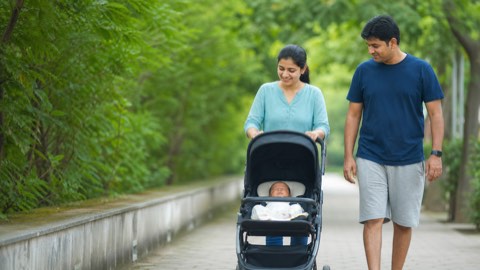
Walking from the first days, building gradually. Pelvic-floor exercises as soon as you are comfortable, and deep-core breathing work in the early weeks — these come before anything else.
Structured exercise after the six-week check clears you, later after a caesarean. Then strength work and low-impact cardio, and high-impact activity only once the pelvic floor and core are rehabilitated — leaking urine during exercise is the signal to step back rather than push on.
Crunches and planks early make diastasis worse. See our exercise-after-delivery guide for the sequence.
Strength training is the most useful thing most postpartum women are not doing: it rebuilds what pregnancy softened and makes carrying a growing toddler possible.
When to see a doctor
Get checked if: weight is not shifting at all despite reasonable eating and activity, alongside fatigue, hair loss, cold intolerance or low mood — postpartum thyroid problems are common and treatable. Ask for thyroid function, haemoglobin, vitamin D and B12.
Also see a doctor for: an abdominal gap that is not closing by six months, leaking urine or a feeling of heaviness in the vagina, ongoing pelvic or back pain, or a preoccupation with weight that is affecting eating or mood — postpartum depression and eating difficulties often present exactly this way. Tele-MANAS on 14416 is free and confidential.
This article is general information, not medical advice, and is no substitute for personal medical advice. For any decision about your or your child's health, please consult your doctor.
Frequently asked questions
Everyone comments on my weight at family gatherings.
A short line and a change of subject is enough: 'I'm well, thanks.' You owe no explanation for a body that produced a person nine months ago.
Do belly binders help?
For comfort in the early weeks, sometimes. For fat loss or closing a muscle gap, no — and tight binding pushes down on a pelvic floor that is already recovering.
Can I diet if I am breastfeeding?
Gradual, sensible eating yes; aggressive restriction no. Aim for slow loss with adequate protein, and expect it to take months rather than weeks.
How soon can I start the gym?
After clearance at the six-week check, and start with the pelvic floor and core rather than where you left off. Going straight back to old routines is how leaking and back pain start.
Sources
Every clinical figure on this page is taken from the guidelines below. Where our numbers and your doctor's differ, ask which guideline they follow.
- WHO. Infant and young child feeding: Model chapter for textbooks for medical students and allied health professionals (2009)Backs the claim that breastfeeding uses extra calories and that breastfeeding mothers need increased nutritional intake rather than restriction.
- NICE. Weight management before, during and after pregnancy (PH27) (2010)Backs the claims that most postpartum weight loss occurs between three and twelve months, that gestational weight gain is a strong predictor of retention, and that crash diets are inappropriate after delivery; also supports gradual return to activity after the postnatal check.
Reviewed by
- Nakul Phatak — CEO, theAsianparent India & IndonesiaHead of theAsianparent India; father of one
- Roshni Chugani — Head of Marketing, theAsianparent India & Singapore12 years in the mother-and-baby space; mother of two
Published by: theAsianparent editorial team