The mother's own nutrition: iron, calcium and the meals that get skipped

Indian households feed the baby carefully and the mother last. Here is what her body actually needs during recovery and breastfeeding — and the deficiency that quietly affects half of Indian mothers.
What she actually needs
A breastfeeding mother needs roughly 500 extra calories a day, plenty of fluid, and a solid protein intake — dal, curd, paneer, eggs, meat or fish at every meal. Recovery from birth needs protein too; it is the nutrient most often short in Indian women's diets.
Iron: blood loss at delivery on top of pregnancy demand leaves many women depleted. Continue the IFA supplement as prescribed, and keep the iron-rich foods going — ragi, dals, greens, gud, chana, dates, eggs and meat — paired with vitamin C and away from tea.
Calcium and vitamin D: breastmilk draws calcium continuously, and if the diet is short, it comes from the mother's bones. Two to three dairy servings a day plus the prescribed supplements, and vitamin D testing where fatigue and aches persist.
Fluids: drink to thirst, keep water beside the feeding chair, and do not restrict water — an old confinement rule with no basis and real consequences for a feeding mother.
The traditional postpartum kitchen, assessed
Much of it is excellent. Gond ladoo, panjiri, methi, ajwain water, harira, dry fruits, ghee and jaggery deliver calories, iron, fibre and warmth to a body that needs all four. Enjoy them, and let the household feed you.
The parts to modify: extreme restriction lists that remove vegetables, fruit and whole categories of food for forty days; very high ghee-and-sugar intake where gestational diabetes was present (ask at the postnatal check); and any rule that leaves the mother eating less than the rest of the household.
The parts to drop: water restriction, and the practice of the mother eating last and least. In many homes she gets what remains after everyone else, which is precisely backwards during recovery and lactation.
There is no evidence-based list of foods that must be avoided while breastfeeding. Only drop a specific food if your baby demonstrably reacts to it, and re-test later with the doctor's advice.


Anaemia — the deficiency behind the exhaustion
Anaemia is extremely common in Indian mothers, and its symptoms are routinely dismissed as normal new-mother tiredness: exhaustion that rest does not fix, breathlessness on climbing stairs, palpitations, pallor, dizziness, poor concentration and low mood.
It also has real consequences: slower recovery, more infections, worse mood, and less capacity to cope with an already demanding period.
Get haemoglobin tested at the six-week check and again if symptoms persist. Treatment doses of iron run for three months or more; take them between meals with something citrus, expect black stools, and do not stop when you feel better — stores take months to refill. Severe anaemia sometimes needs intravenous iron, which is quick and effective.
Also worth testing when exhaustion persists: thyroid function, vitamin D and vitamin B12 — all commonly deficient and all easily corrected.
Eating when there is no time
The practical problem is not knowledge but logistics: a mother with a newborn cannot cook, and often cannot even sit to eat. Plan for it: batch cooking, a relative or paid help for the first weeks, a tiffin service, or simple one-pot meals.
Keep one-handed food within reach of the feeding chair — dry fruits, roasted chana, banana, boiled eggs, nuts, laddoos, a water bottle. Feeding sessions are long and hunger during them is intense.
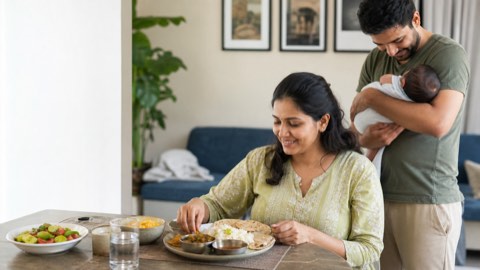
Eat with the household rather than after it, and let someone else hold the baby while you do. This is the single change that most improves a new mother's nutrition, and it is a household decision rather than a dietary one.
When to see a doctor
Get tested for: persistent exhaustion, breathlessness, palpitations, dizziness, pallor, hair loss or poor recovery. Same-day: fainting, chest pain, severe breathlessness, heavy bleeding, or fever — and any of the postpartum warning signs in our first-forty-days guide. Do not skip the six-week postnatal check; haemoglobin, blood pressure, mood and contraception all belong there.
This article is general information, not medical advice, and is no substitute for personal medical advice. For any decision about your or your child's health, please consult your doctor.
Frequently asked questions
Do I need to avoid 'gassy' foods while breastfeeding?
There is no standard avoid-list. Occasionally a baby reacts to a specific food, most commonly cow's milk protein, and that is worth a two-week trial with your doctor's guidance. Blanket restriction leaves the mother undernourished for no benefit.
Will eating more make more milk?
Supply is driven by how often and effectively milk is removed, not by ladoos. Good nutrition protects the mother's own stores and energy — which matters — but frequency of feeding is the lever for supply.
Can I diet to lose weight while breastfeeding?
Not aggressively. Gradual loss with balanced eating and gentle exercise is fine; severe restriction affects energy, mood and sometimes supply. Wait until feeding is established and go slowly.
Is chai bad for a breastfeeding mother?
Two or three cups a day is fine for the baby. The problem is timing: chai with or right after meals blocks iron absorption, which matters enormously in a population where anaemia is this common. Keep it an hour away from meals and away from the iron tablet.
Sources
Every clinical figure on this page is taken from the guidelines below. Where our numbers and your doctor's differ, ask which guideline they follow.
- WHO. Infant and young child feeding: Model Chapter for textbooks for medical students and allied health professionals (2009)Backs the claim that breastfeeding mothers require additional caloric and nutrient intake, and that breastmilk supply is driven by frequency of milk removal rather than maternal dietary volume.
- WHO. Guideline: Nutritional care and support for patients with tuberculosis / Daily iron and folic acid supplementation in adult women and adolescent girls (2016)Backs the recommendation to continue iron-folic acid supplementation postnatally, the three-month or longer treatment course for iron deficiency anaemia, and the advice to take iron between meals with vitamin C to aid absorption.
- ICMR. Dietary Guidelines for Indians (2024)Backs the recommended food sources of iron (ragi, dals, greens, jaggery, chana, dates, eggs, meat), the two-to-three dairy servings for calcium, the avoidance of tea with iron-rich meals, and the roughly 500 extra calories per day requirement for lactating women.
- NICE. Postnatal care (NG194) (2021)Backs the recommendation for a six-week postnatal check covering haemoglobin, blood pressure, mood and contraception, and the clinical recognition that postpartum exhaustion, breathlessness, pallor and dizziness may indicate anaemia rather than normal new-mother tiredness.
Reviewed by
- Nakul Phatak — CEO, theAsianparent India & IndonesiaHead of theAsianparent India; father of one
- Roshni Chugani — Head of Marketing, theAsianparent India & Singapore12 years in the mother-and-baby space; mother of two
Published by: theAsianparent editorial team