Discipline without hitting: what to do instead, and why it works better

Most Indian adults were smacked and most turned out fine, which is why the argument is so hard to win. Here is the evidence, and — more usefully — what to do instead when a child will not listen.
Why hitting fails, even when it seems to work
It works in the moment, which is why it survives. A slap stops the behaviour instantly and rewards the adult. What it does not do is teach the child what to do instead, and the effect fades fast — which is why families who smack usually smack more and more over time.
The research is unusually consistent: physical punishment predicts more aggression, more defiance, poorer mental health and a worse parent-child relationship, and no better long-term behaviour. In India, corporal punishment is also banned in schools under the Right to Education Act — a rule worth knowing if your child is being hit at school.
It also teaches the wrong lesson at exactly the wrong age: that big people solve problems with their hands, and that the person who loves you is the person who hurts you when angry. Children who are hit hit other children more.
What to do instead, by age
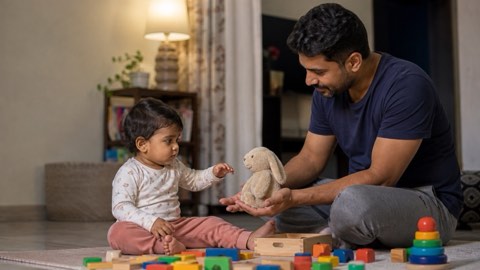
Under two: distraction and prevention do almost all the work. Move the child, move the object, say 'no' briefly and firmly, and offer something else. Explanations do not land yet.
Two to five: short clear rules, immediate consequences that relate to the behaviour ('the crayons go away if we draw on the wall'), calm-down time sitting with an adult rather than isolating punishment, and lavish attention for the behaviour you want. Give warnings and choices to reduce power struggles.
Six to twelve: logical consequences agreed in advance (screen time lost for the evening if homework is not done), family rules written on the fridge, and repair rather than punishment — apologising, fixing what was broken, doing something to make it right.
Teenagers: negotiate rules jointly, keep the few that matter absolutely (safety, honesty about where they are), and use conversation over control. Punishment has diminishing returns at this age; relationship is the only real lever left.
The three habits that reduce misbehaviour most
Attention for the good stuff. Children need attention and will take it in whatever form is available; if the only reliable way to get a parent's full focus is to break something, that is what happens. Ten minutes a day of undivided, child-led time reduces problem behaviour more than most punishments.
Consistency across adults. In joint families, a child who is refused by the mother and granted by the grandmother learns to route around the rule. Agree the handful of rules that all adults will hold, and settle disagreements away from the child.
Predictable routines. Most 'bad behaviour' in small children is hunger, tiredness or transitions. Fixing the schedule fixes the behaviour more reliably than any consequence.
When you have already hit, and what to say to the family
Almost every parent has lashed out at some point. What matters next is repair: 'I hit you. I was angry and that was wrong. Hitting is not okay, including when I do it.' Children learn accountability by watching adults model it, and the relationship recovers.
If it is happening often, treat it as a signal about you rather than the child — exhaustion, stress, anger you cannot regulate, or your own childhood pattern repeating. Our guide on parental anger has practical steps, and Tele-MANAS on 14416 is free and confidential.
With relatives, avoid the ideological argument. Try: 'the doctor told us hitting makes it worse at this age and we are trying something else — can you help us with it?' Then give them a role: the calm one, the story-teller, the one who notices good behaviour. Most grandparents accept a job more happily than a lecture.
Frequently asked questions
I was beaten as a child and I turned out fine.
Many did, and that is a real observation, not an argument for continuing. Plenty of people also survive things we no longer do. The relevant question is whether an alternative works better and costs less, and on that the evidence is clear.
My child only listens when I raise my hand. What else is there?
Because the alternatives have not been built yet — clear rules, consistent consequences, and attention for good behaviour take a few weeks to take effect. The transition period is genuinely hard; hold it and the shouting drops.
Is time-out a good method?
Better than hitting, and better still when used as calm-down time with an adult nearby rather than isolation as punishment. For young children, one minute per year of age is a rough guide, and reconnecting warmly afterwards matters more than the minutes.
A teacher hit my child at school. What can I do?
Corporal punishment is prohibited in Indian schools. Raise it in writing with the class teacher and principal, ask what action is being taken, and escalate to the school management or the local education authority if needed. Tell your child clearly that it was wrong and not their fault.
Reviewed by
- Nakul Phatak — CEO, theAsianparent India & IndonesiaHead of theAsianparent India; father of one
- Roshni Chugani — Head of Marketing, theAsianparent India & Singapore12 years in the mother-and-baby space; mother of two
Published by: theAsianparent editorial team