
How much physical activity does a preschooler need?

Three hours of movement a day is the guideline for a preschooler. Most Indian urban children get a fraction of it, and it shows up as sleep and behaviour problems.
The guideline
For three-to-five-year-olds, international guidance is at least 180 minutes — three hours — of physical activity spread across the day, with at least 60 minutes of it energetic. Under-threes need at least 180 minutes of any activity.
Three hours sounds impossible until you count what qualifies: walking to the shop, running in a corridor, dancing, climbing at a park, helping sweep, chasing a sibling, playing in a courtyard. It is not a gym session.
The same guidance caps sedentary screen time at about an hour a day at this age and says no child should be restrained — in a pram, a high chair, a car seat — for more than an hour at a stretch while awake.
Why it matters at this age
Sleep. Children who move enough fall asleep faster and wake less. A large share of preschool bedtime battles are movement debts being paid at 10 p.m.
Behaviour and attention: an under-exercised preschooler in a flat is restless, and it is read as a discipline problem.
Motor skills — running, jumping, throwing, balancing — which are learnt in these years and are harder to acquire later. They also decide whether a child enjoys sport at ten.
Bone and muscle development, healthy weight, and — through outdoor play in daylight — a genuine reduction in the risk of short-sightedness, which is rising sharply in Indian cities.
Getting it in a city flat
Indoors: pillow paths, obstacle courses, balloon volleyball, dancing, animal walks, freeze games, and climbing on safe furniture. Twenty minutes twice a day covers a lot.
The building: corridors, stairs (supervised), the compound, the terrace where it is safe and enclosed.
Outdoors: the park at the cooler ends of the day, cycling, ball games, and walking rather than being carried or driven for short distances.
Chores count: sweeping, carrying, watering plants, washing the bike. Preschoolers take them seriously and they move constantly while doing them.
And be honest about the pram and the phone. A child who is wheeled everywhere and handed a screen when they get restless is not being given the chance to move.
When to see a doctor
See a doctor if a child: tires far more easily than peers, becomes breathless or blue around the lips with ordinary play, complains of chest pain or palpitations with exertion, falls frequently or is markedly clumsy compared with other children, walks persistently on toes, or has stopped doing something they could do before.
Also worth checking: pallor and fatigue, which usually mean anaemia — very common in Indian children and a frequent reason a child does not want to move.
This article is general information, not medical advice, and is no substitute for personal medical advice. For any decision about your or your child's health, please consult your doctor.
Frequently asked questions
Is structured class exercise better than free play?
At this age, free play is better and cheaper. A dance or sport class is fine as one part of the week, not as the whole answer.
It is too hot or too polluted to go out.
Then indoor movement and timing: early morning or after sunset, and indoor games on the worst days. Check the local air quality index in winter in northern cities.
My child prefers to sit and draw.
Fine, and still make movement part of the day rather than a negotiation — build it into the routine, like a walk after dinner, so it is not a battle each time.
Is a walker or jumper good exercise for a baby?
No. Walkers delay walking and cause injuries; floor time is what builds movement. See our guide on walkers.
Sources
Every clinical figure on this page is taken from the guidelines below. Where our numbers and your doctor's differ, ask which guideline they follow.
- WHO. WHO Guidelines on Physical Activity, Sedentary Behaviour and Sleep for Children under 5 Years of Age (2019)Backs the core activity targets: at least 180 minutes of physical activity for under-threes; at least 180 minutes (including 60 minutes of energetic activity) for three-to-five-year-olds; no restraint for more than one hour at a stretch; and the approximately one-hour cap on sedentary screen time for this age group.
- WHO. Guidelines on Physical Activity and Sedentary Behaviour (2020)Supports the broader framing that regular physical activity in early childhood promotes healthy weight, bone and muscle development, and motor skill acquisition.
- UNICEF. Early Childhood Development: Physical Activity and Play (2023)Supports the page's emphasis on free play (rather than structured classes) as the primary and most appropriate form of physical activity for preschool-aged children, and the importance of outdoor play for overall development.
- NIH. Iron-Deficiency Anaemia in Children (MedlinePlus) (2023)Supports the page's note that pallor and fatigue in Indian preschoolers frequently indicate anaemia, which can reduce a child's desire and ability to be physically active.
- ICMR. Dietary Guidelines for Indians (ICMR-NIN) (2024)Supports the reference to anaemia being very common in Indian children, consistent with ICMR surveillance data on nutritional deficiencies in Indian paediatric populations.
Reviewed by
- Nakul Phatak — CEO, theAsianparent India & IndonesiaHead of theAsianparent India; father of one
- Roshni Chugani — Head of Marketing, theAsianparent India & Singapore12 years in the mother-and-baby space; mother of two
Published by: theAsianparent editorial team
Related articles
 35 activities for four-year-olds, sorted by what they build
 Improving a child's concentration without pressure or punishment
 Screen time for under-fives
 Traditional Indian games every child should learn
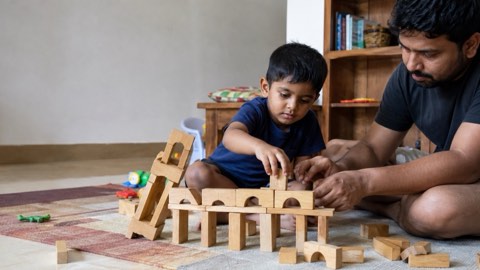 What children actually learn from blocks and construction play
 10 nature-walk activities for young children