First-trimester screening in India: the double marker and NIPT

The eleven-to-fourteen-week window carries the tests that worry people most, largely because nobody explains what a screening result is.
What it is
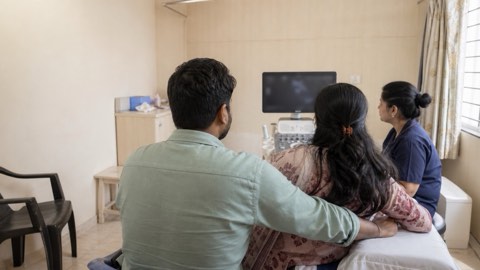
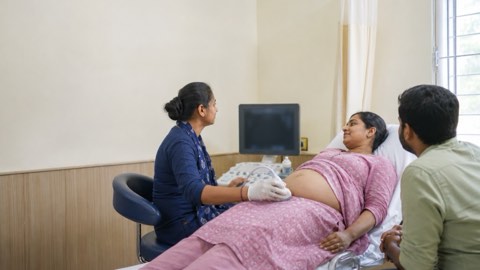
First-trimester combined screening is done between roughly 11 and 13 weeks plus 6 days. It has two parts: an ultrasound measuring nuchal translucency — the fluid at the back of the baby's neck — plus nasal bone and other markers, and a blood test measuring two hormones, free beta-hCG and PAPP-A. That blood test is the 'double marker'.
The two are combined with your age and the baby's measurements to produce a risk figure for Down syndrome (trisomy 21), Edwards syndrome (trisomy 18) and Patau syndrome (trisomy 13).
The result is a probability, not a diagnosis: something like 1 in 1200, or 1 in 90. A cut-off separates 'low risk' from 'high risk' or 'screen positive' — the exact line varies by programme and lab (the UK's NHS uses 1 in 150; many Indian labs use 1 in 250), so read the one printed on your own report.
If you miss the window, the quadruple marker test between about 15 and 20 weeks screens for the same conditions plus neural tube defects, with somewhat lower accuracy for trisomy 21.
NIPT, and what it adds
Non-invasive prenatal testing analyses fragments of placental DNA in the mother's blood, from about 10 weeks. It is far more accurate for trisomy 21 than combined screening, and it is still a screening test rather than a diagnosis.
It is offered privately across Indian cities and costs substantially more than the double marker — typically many thousands of rupees, varying by city and laboratory.
NIPT does not replace the nuchal translucency scan, which also picks up structural problems the blood test cannot see. Where cost allows, the usual sequence is the scan plus either the double marker or NIPT.
Sex chromosomes are part of what NIPT can detect, and Indian laboratories are legally barred under the PCPNDT Act from reporting the baby's sex. A laboratory offering to tell you is breaking the law.
A high-risk result
It does not mean the baby has the condition. Most women with a screen-positive combined result go on to have babies without any chromosomal problem — the test is designed to over-refer rather than miss cases.
The next step is genetic counselling, and then either NIPT (if not already done) or a diagnostic test.
Diagnostic tests give a definite answer: chorionic villus sampling from about 11 to 14 weeks, or amniocentesis from about 15 to 16 weeks. Both carry a small risk of miscarriage — around one in 200 or lower in experienced hands — and both are the only way to know for certain.
Ask for the numbers in writing, ask what the background risk for your age is for comparison, and ask for time. Nothing in this sequence has to be decided the same day.
You can also decline screening entirely, and that is a legitimate choice — some parents would not change anything based on the result and prefer not to spend the pregnancy on it.
When to see a doctor
Book the scan within the 11 to 13+6 week window; outside it the combined test cannot be done and the quadruple marker becomes the option instead.
Ask for genetic counselling before deciding on a diagnostic test, not after.
Same-day, at any point: bleeding, severe abdominal pain, fever, or leaking fluid — and after CVS or amniocentesis, add heavy bleeding, strong cramping or fever to that list.
This article is general information. Your obstetrician will advise which tests fit your specific history and age.
This article is general information, not medical advice, and is no substitute for personal medical advice. For any decision about your or your child's health, please consult your doctor.
Frequently asked questions
Is the double marker test compulsory?
No. It is offered, and you may decline. Many parents take it for information; some decline because it would not change their decisions.
What does 1 in 300 mean?
That out of 300 pregnancies with this result, about one would be affected and roughly 299 would not. Compare it with the background risk at your age, which your doctor can give you.
Is NIPT worth the money?
It is considerably more accurate than the double marker for trisomy 21 and it costs a great deal more. It is most often recommended after a high-risk combined result, or from the start where age or history raises the prior risk.
Can they tell me the baby's sex?
No. Sex determination is illegal in India under the PCPNDT Act, whichever test is used, and no laboratory or doctor may disclose it.
Sources
Every clinical figure on this page is taken from the guidelines below. Where our numbers and your doctor's differ, ask which guideline they follow.
- WHO. WHO recommendations on antenatal care for a positive pregnancy experienceBacks the article's framing of first-trimester combined screening (nuchal translucency ultrasound plus serum markers) as an offered screening option, not a compulsory diagnostic procedure, and supports the principle that women may decline screening.
- NICE. Antenatal care (NG201)Supports the article's description of first-trimester combined screening at 11+0 to 13+6 weeks using nuchal translucency, free beta-hCG and PAPP-A to produce risk figures for trisomy 21, 18 and 13; the 1 in 150 screen-positive threshold used by NICE differs from the 1 in 250 figure stated on this page — see conflicts.
- RCOG. Amniocentesis and Chorionic Villus Sampling (Green-top Guideline No. 8)Supports the article's statements on CVS timing (11–14 weeks), amniocentesis timing (from 15 weeks), and the quoted procedural miscarriage risk of approximately 1 in 200 or lower in experienced centres.
- ACOG. Screening for Fetal Chromosomal Abnormalities (Practice Bulletin No. 226)Supports the article's claims that NIPT analyses cell-free placental DNA from approximately 10 weeks, is more accurate than combined screening for trisomy 21, remains a screening rather than diagnostic test, and does not replace nuchal translucency scanning.
Reviewed by
- Nakul Phatak — CEO, theAsianparent India & IndonesiaHead of theAsianparent India; father of one
- Roshni Chugani — Head of Marketing, theAsianparent India & Singapore12 years in the mother-and-baby space; mother of two
Published by: theAsianparent editorial team