Pregnancy week 13: first trimester complete — the easiest stretch begins

The first trimester's final step. Behind you: three months of nausea and fear. Ahead: pregnancy's most comfortable stretch — the one they call the honeymoon period.
A third of the road behind
Thirteen of forty — a third of the journey done, and the hardest third at that: the organ-building weeks, the nausea, the fear that shadowed every twinge.
What follows is, by the textbooks' own admission, the easiest phase. Nausea gone for most, energy back, the bump still light enough to ignore — and somewhere in it, the first flutter of movement.
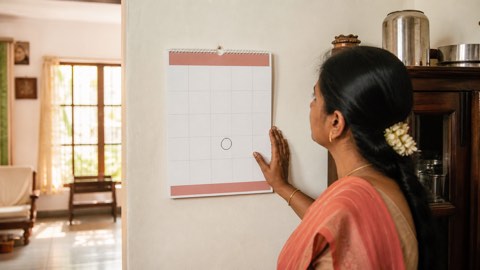
So this week's real work is planning: whatever needs travelling, fixing, organising or celebrating sits easiest in the second trimester. Draft the list now; start next week.
Your baby this week
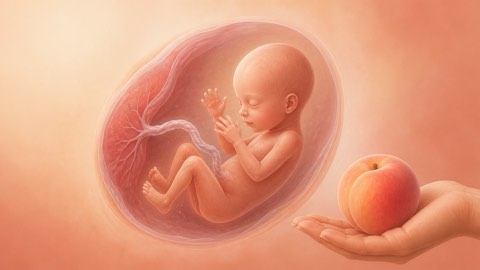
The baby is peach-sized — seven-plus centimetres, about twenty-five grams. Head-to-body proportions are improving quickly.
This week's loveliest construction: fingerprints. The whorls no one else on earth will ever share form in week thirteen.
Vocal cords are forming — the first cry in rehearsal. The intestines have completed their move into the abdomen, and the pancreas has started making insulin.
Read next
Changes in your body
Energy's return is the week's headline. Food looks good again, the afternoon fog lifts, and the household says 'the colour is back'.
Breast heaviness eases but growth continues — the old bras genuinely retire now. A well-fitted, wire-free bra is these months' cheapest comfort.
Increased white discharge is normal from here — the body's own infection defence. Green-yellow colour, itching or odour is different — that's for the doctor; plain white needs no treatment.
What to do this week
Draft the second-trimester list: travel (weeks 14-28 are the window), any household projects, and hospital-shortlisting if the delivery hospital isn't fixed.
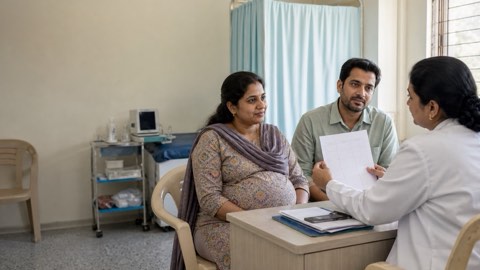
Book the next routine visit — second-trimester visits typically run monthly. Weight, BP, urine every time; that trio is the visit, and that's normal.
If calcium was prescribed, take it apart from iron — they blunt each other's absorption. Common pairing: iron by day, calcium at night.
Start shifting sleep to the side — from the second trimester, side-sleeping (especially left) beats lying flat on the back. One thin pillow between the knees and one behind the back does what expensive pregnancy pillows do.
Week 13 at a glance
The week's essentials in one place. Your doctor may adjust these for your situation.
| Item | In week 13 |
|---|---|
| Main event | First trimester complete — a third of the road done |
| Baby's size | Peach — about 7.5 cm, 25 g |
| Formed this week | Fingerprints; vocal cords |
| Possible symptoms | Energy back, more discharge, growing breasts |
| Plan | Travel, hospital choice, projects — all second trimester |
| Tablet timing | Iron and calcium at different hours |
| New habit | Side sleeping — pillow between the knees |
When to see a doctor at once
The standing list applies — bleeding, worsening pain, high fever, urinary burning. Discharge that is green-yellow, frothy or foul, or itches and burns, is an infection — treated in pregnancy as a necessity, not an option.
One new watch from here: one-sided calf swelling, redness and tenderness — clot risk (DVT) rises in pregnancy and this is its language. If seen, no massage — same-day doctor.
This article is general information only and no substitute for personal medical advice. The person who can advise you knowing your health, your medicines and your previous pregnancies is your obstetrician, or the doctor at your nearest health centre.
Work out your due date
Enter the first day of your last period and your cycle length — your estimated due date, this week's count and the anomaly scan window all appear right here.
It is only an estimate — most babies aren't born on the exact date. A first-trimester scan dates a pregnancy more accurately; in the end, your doctor's date is the one that counts.
Frequently asked questions
People count trimesters differently
12, 13, 14 weeks? — The books themselves split hairs; it's just where the boxes are drawn. Ours: 1-13, 14-27, 28-40. Whatever your doctor uses is yours.
Which tests remain now?
Two big ones: the anomaly scan at 18-22 weeks and the sugar test (GTT) at 24-28. Between them, the monthly weight-BP-urine routine. Rh-negative mothers add the week-28 injection.
Can I keep religious fasts?
Long waterless fasts don't suit pregnancy — food and water both need regularity. Keep the phalahari version if faith calls, and clear it with the doctor. Most priests counsel the exemption anyway.
My mind still braces at every scan
normal? — Very, especially after a previous loss. The numbers are on your side now, but minds don't run on numbers. If the fear starts blocking daily life, tell the doctor — mental health is part of antenatal care too.
Sources
Every clinical figure on this page is taken from the guidelines below. Where our numbers and your doctor's differ, ask which guideline they follow.
- WHO. WHO Recommendations on Antenatal Care for a Positive Pregnancy Experience (2016)Backs the routine antenatal visit schedule (weight, blood pressure, urine at each visit) and the importance of treating vaginal infections during pregnancy as a clinical necessity.
- NICE. Antenatal Care (NG201) (2021)Supports the recommended anomaly scan window of 18–21 weeks, routine monthly antenatal visits in the second trimester with weight/BP/urine checks, and clinical assessment of abnormal vaginal discharge (green-yellow, frothy, malodorous) as requiring treatment in pregnancy.
- MoHFW. Pradhan Mantri Surakshit Matritva Abhiyan — Antenatal Care Guidelines (2016)Supports the routine second-trimester antenatal monitoring of weight, blood pressure, and urine, and backs the gestational diabetes screening (GTT) at 24–28 weeks and anti-D injection at 28 weeks for Rh-negative mothers.
- ICMR. Nutrient Requirements and Recommended Dietary Allowances for Indians (ICMR-NIN) (2020)Supports the advice to take iron and calcium supplements at separate times during pregnancy, as concurrent intake reduces absorption of both nutrients.
Reviewed by
- Nakul Phatak — CEO, theAsianparent India & IndonesiaHead of theAsianparent India; father of one
- Roshni Chugani — Head of Marketing, theAsianparent India & Singapore12 years in the mother-and-baby space; mother of two
Published by: theAsianparent editorial team