Pregnancy week 4: implantation — and two lines on the strip

The period date came and went — and the strip shows two lines. This week the embryo settles into the uterus and the body announces the pregnancy for the first time.
The morning of two lines
This week's landmark is the morning you waited for — the missed period, and a second line rising on the strip. Faint, perhaps, but a line is a line.
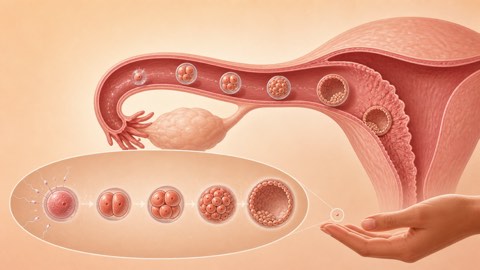
In the science's words, implantation has happened — the embryo reached the uterus and embedded in its soft lining. On settling, it began making a hormone: hCG. That hormone reaches urine, and the strip reads exactly that.
From here the count is no longer just paperwork. As week four closes you are genuinely pregnant — and for the next thirty-six weeks, this household's story has changed a little.
Your baby this week
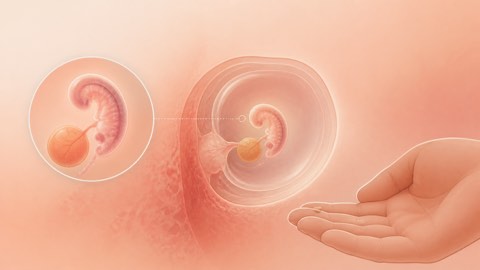
The embryo is poppy-seed sized — about a millimetre. But three layers have formed in it, and those three build the whole body: outer for brain, nerves and skin; middle for heart, bones and muscle; inner for lungs, gut and stomach.
The neural tube — future brain and spinal cord — starts forming this very week. Every folic acid instruction existed for this tube; it closes over the next two weeks.
Around the embryo the amniotic sac is forming, and the outer layer is sending roots into the uterus — those roots become the placenta. For now the baby feeds directly from the uterine lining.
Read next

Changes in your body
With hCG, the first symptoms can arrive — heavy, tender breasts, mild fatigue, frequent urination. And many women feel nothing at all. Both are normal; a lack of symptoms is not a weak pregnancy.
Implantation sometimes brings a day or two of light spotting — pinkish or brown, far lighter than a period. Not alarming. But bleeding on the scale of a period is worth telling the doctor about.
The mind's weather is as real as the body's. Joy, fear, disbelief, the whether-to-tell dilemma — all at once. At minimum, bring your husband along; this news is not for carrying alone.
What to do this week
The moment the test is positive: book the first antenatal visit. Registering early gets every later test on schedule. In the public system this is also where the Mother and Child Protection (MCP) card is made — guard that card; the next nine months are recorded on it.
Continue folic acid — these are the neural tube's decisive final weeks. The doctor will schedule iron and calcium at the first visit.
List every medicine you already take and carry the list to the first visit — thyroid, diabetes, BP, epilepsy, skin, painkillers, everything. Some need switching in pregnancy, and that call is the doctor's, not the chemist's.
'Don't tell anyone for three months' is custom, not law. But do tell two people: your husband, and one person you trust. If anything goes wrong, someone to talk to should exist.
Week 4 at a glance
The week's essentials in one place. Your doctor may adjust these for your situation.
| Item | In week 4 |
|---|---|
| Main event | Implantation — the embryo settles into the uterus |
| Baby's size | Poppy seed — about 1 mm |
| New in the body | hCG — the hormone the test reads |
| Possible symptoms | Tender breasts, fatigue, light spotting — or nothing |
| Do now | Test, book the first visit, list your medicines |
| Keep going | Folic acid 400 mcg daily |
| Public system | Registration and the MCP card — PHC/anganwadi |
When to see a doctor at once
Sharp one-sided pain low in the belly, pain reaching the shoulder, dizziness or fainting — with a positive test, that combination goes to hospital the same day. An ectopic pregnancy looks exactly like this, and it does not wait.
Bleeding like a period or heavier, with strong cramps, is a same-day call. Light spotting for a day or two is common — the difference is volume and pain, and when in doubt, calling costs nothing.
This article is general information only and no substitute for personal medical advice. The person who can advise you knowing your health, your medicines and your previous pregnancies is your obstetrician, or the doctor at your nearest health centre.
Work out your due date
Enter the first day of your last period and your cycle length — your estimated due date, this week's count and the anomaly scan window all appear right here.
It is only an estimate — most babies aren't born on the exact date. A first-trimester scan dates a pregnancy more accurately; in the end, your doctor's date is the one that counts.
Frequently asked questions
The second line is very faint
is it real? — A faint line is a positive; it just means hCG is still low. Repeat in two-three days with first-morning urine — the line should darken.
Positive test but no symptoms
something wrong? — No. Many women feel nothing at four weeks, and some never get nausea at all. Symptoms are not a measure of the pregnancy's strength.
When do I see the doctor
now or later? — Book now. The first detailed check usually falls at six-eight weeks, but existing medicines, a previous miscarriage or a medical condition can mean being called earlier.
Must I give up tea and coffee?
No. Stay within one-two cups a day. Tobacco, gutkha and alcohol are the zero-limit items — and that's for all nine months.
Sources
Every clinical figure on this page is taken from the guidelines below. Where our numbers and your doctor's differ, ask which guideline they follow.
- WHO. WHO recommendations on antenatal care for a positive pregnancy experience (2016)Backs the page's instruction to book the first antenatal visit as soon as the test is positive, and the principle that early registration keeps all subsequent scheduled tests on track.
- ICMR. Nutrient Requirements and Recommended Dietary Allowances for Indians (2020)Supports the page's advice that iron and calcium supplements will be scheduled at the first antenatal visit, consistent with Indian dietary reference values and supplementation recommendations in pregnancy.
- WHO. Guideline: Daily iron and folic acid supplementation in pregnant women (2012)Backs the page's repeated instruction to continue folic acid through week four and beyond, specifically because these are the decisive weeks for neural tube closure.
- NHS. Foods to avoid in pregnancy (2023)Supports the page's advice to limit caffeine to one-two cups a day during pregnancy and that tobacco and alcohol are zero-limit items for all nine months.
Reviewed by
- Nakul Phatak — CEO, theAsianparent India & IndonesiaHead of theAsianparent India; father of one
- Roshni Chugani — Head of Marketing, theAsianparent India & Singapore12 years in the mother-and-baby space; mother of two
Published by: theAsianparent editorial team