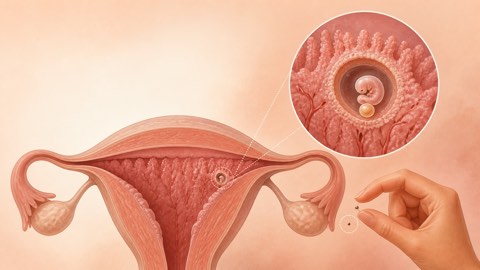
Pregnancy week 3: fertilisation done — one cell starts the journey

Nothing shows on the outside, but the biggest event has already happened inside — fertilisation. A single cell now divides and travels toward the uterus.
What happened, nobody can feel
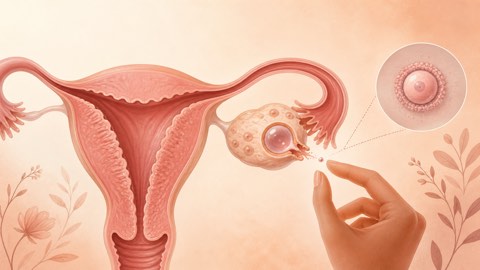
This week's event is too small for any instrument to see and too large for anything to be the same afterwards. In the fallopian tube, egg and sperm have met — fertilisation is done.
What exists is a single cell, thousands of times smaller than a sesame seed. In it, your genes and your husband's have joined, half and half: looks, height, eye colour, a good many habits — much was settled in that instant.
You will feel none of it. No nausea, no fatigue, nothing — those belong to later weeks. This week passes silently, and its silence is normal.
Your baby this week
After fertilisation the cell begins dividing — one to two, two to four, four to eight. In three-four days it's a mulberry-like cluster science calls a morula.
That cluster floats down the tube toward the uterus — a four-to-five-day journey. By arrival it has hollowed into a fluid-filled ball, the blastocyst, over a hundred cells strong.
Two destinies are already assigned in that ball: the inner clump becomes the baby; the outer shell becomes the placenta — the organ that will feed and breathe for the baby for nine months.
Read next
Changes in your body
Your body hasn't received the news yet. Hormones are unchanged, the cycle is on schedule, and a pregnancy test would find nothing — hCG production hasn't begun.
Some women later swear they 'felt it'. The truth is nothing perceptible happens this week — what's felt is hope, which is a precious thing in its own right.
Next week's end brings implantation and the first faint possibilities. This week's only job is continuing what you've already been doing.
What to do this week
Folic acid daily — more important now than ever. The tube that forms the brain and spine closes over the coming weeks, and folic acid is what that process needs.
Live as if already pregnant — because you may be. Alcohol and tobacco at zero, no new medicines unasked, and if an X-ray comes up, say 'possible pregnancy' first.
Measure the caffeine — a cup or two of tea or coffee is fine, more isn't. And drop raw and undercooked food (raw egg, undercooked meat, unboiled milk) from here.
Don't rush the test. A test this week reads negative even if you've conceived. Waiting until the missed period is the correct move.
Week 3 at a glance
The week's essentials in one place. Everything is internal — nothing shows yet.
| Item | In week 3 |
|---|---|
| Main event | Fertilisation — egg and sperm have met |
| Baby's size | One cell growing past a hundred; invisible to the eye |
| Where | Travelling the tube toward the uterus |
| Sex | Already decided — by the sperm's X/Y; testing is a crime |
| Your symptoms | None — and that is normal |
| Pregnancy test | Not yet — after the missed period |
| Keep going | Folic acid, full meals, no unasked medicines |
When to see a doctor at once
Nothing warns this week — what's happening is below the threshold of feeling. One thing only: no medicine, home remedy or 'cleansing kadha' without asking the doctor from here on — the pregnancy's most delicate foundations are laid in exactly these weeks.
Sharp, worsening one-sided pain low in the belly — especially with a previous ectopic pregnancy — is worth showing the same day. There's no reason to suspect anything yet, but that symptom is never one to sit on.
This article is general information only and no substitute for personal medical advice. The person who can advise you knowing your health, your medicines and your previous pregnancies is your obstetrician, or the doctor at your nearest health centre.
Work out your due date
Enter the first day of your last period and your cycle length — your estimated due date, this week's count and the anomaly scan window all appear right here.
It is only an estimate — most babies aren't born on the exact date. A first-trimester scan dates a pregnancy more accurately; in the end, your doctor's date is the one that counts.
Frequently asked questions
Can fertilisation be felt?
No. Neither fertilisation nor the cell divisions. Even the body gets the news only next week, at implantation.
When are twins decided?
Either two eggs release and both fertilise (fraternal), or one embryo splits in its first days (identical). Both are this fortnight's events.
Does travel or housework this week cause harm?
Ordinary life does no harm; the embryo's journey is well protected. This just isn't the week to take up heavy new workouts or high-impact sport.
Any way to know earlier?
A blood hCG test reads two-three days before a home strip, with limits of its own. The cheapest reliable method remains the same: wait for the missed period.
Sources
Every clinical figure on this page is taken from the guidelines below. Where our numbers and your doctor's differ, ask which guideline they follow.
- WHO. WHO recommendations on antenatal care for a positive pregnancy experience (2016)Backs the page's advice to take folic acid daily in early pregnancy to support neural tube closure forming the brain and spine.
- ICMR. Dietary Guidelines for Indians (2024)Supports the page's recommendation to limit caffeine to one or two cups of tea or coffee and to avoid raw or undercooked foods such as raw egg, undercooked meat, and unboiled milk during early pregnancy.
- NICE. Antenatal care (NG201) (2021)Supports the advice to avoid alcohol and tobacco entirely, to avoid new medicines without medical consultation, and to wait until after a missed period before taking a pregnancy test.
- RCOG. Ectopic Pregnancy — Patient Information Leaflet (2016)Backs the page's warning that sharp, worsening one-sided lower abdominal pain — especially with a history of ectopic pregnancy — requires same-day medical attention.
- MoHFW. Pradhan Mantri Surakshit Matritva Abhiyan — Antenatal Care Guidelines (2016)Supports the page's general framing of early antenatal precautions including folic acid supplementation, avoidance of alcohol and tobacco, and the importance of consulting an obstetrician or nearest health centre doctor.
Reviewed by
- Nakul Phatak — CEO, theAsianparent India & IndonesiaHead of theAsianparent India; father of one
- Roshni Chugani — Head of Marketing, theAsianparent India & Singapore12 years in the mother-and-baby space; mother of two
Published by: theAsianparent editorial team