
Second-hand and third-hand smoke around pregnant women and babies

A non-smoker in a smoking household is not unaffected. The measurable effects on birth weight and on infant illness are well documented, and so is the residue nobody thinks about.
What second-hand smoke does
In pregnancy: exposure to other people's smoke is associated with lower birth weight, a higher risk of preterm birth, and an increased risk of stillbirth. The effect is smaller than smoking directly and it is real and measurable.
After birth: babies exposed to household smoke have more chest infections, more wheezing and asthma, more ear infections, and a higher risk of sudden infant death.
The risk of sudden infant death rises with household smoking whether or not anyone smokes in the same room as the baby, and it rises further with bed-sharing in a household where someone smokes.
Children in smoking households also have more hospital admissions in the first years and are more likely to start smoking themselves later.
In India this matters more than the smoking rates alone suggest, because household exposure is common and often not counted — bidis, hookah at gatherings, and smoking indoors during winter.
Third-hand smoke
Third-hand smoke is the residue left after the smoke has cleared: nicotine and other compounds that settle into upholstery, curtains, carpets, bedding, car interiors, walls, hair and clothing.
It persists for weeks to months and is not removed by airing a room. It can react with indoor air to form new compounds, some of which are of concern.
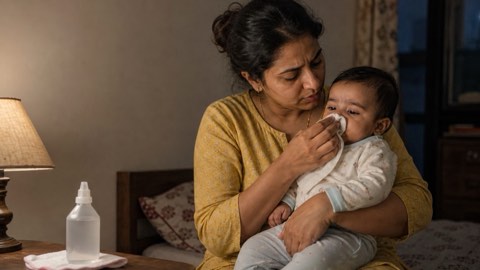
It matters most for babies precisely because of how babies behave — on the floor, hands on everything, everything in the mouth, held against a shoulder.
The practical implications: a smoker holding a baby should change the outer layer of clothing and wash their hands and face first; a car in which anyone has smoked needs deep cleaning; and soft furnishings in a previously smoked-in home should be washed or replaced before a baby arrives.
Nothing here is a reason to keep a smoking grandparent away from a baby. It is a reason to have a specific, unembarrassing routine that everyone follows.
Reducing it in an Indian home
Smoking outside the house entirely, away from doors and windows, is the change that does most of the work.
A dedicated outdoor shirt or shawl left by the door, and hands and face washed before holding the baby.
A completely smoke-free car, with no exceptions for open windows.
Nobody smokes in the room where the baby sleeps, ever, and the baby sleeps in their own space rather than in a bed shared with a smoker.
At family functions, keep the baby away from hookah entirely — an hour near a hookah is a substantial exposure.
And look at the other indoor smoke too: mosquito coils, incense burned in closed rooms, and unvented cooking smoke are significant contributors to the same problems in Indian homes, and are easier to change than a relative's habit.
When to see a doctor
Tell your obstetrician about household smoke exposure so growth is monitored appropriately.
Go to hospital immediately for bleeding, severe abdominal pain, leaking fluid, or reduced or changed fetal movements.
See a doctor for a baby with: persistent cough, wheeze, fast or laboured breathing, repeated chest or ear infections, or poor weight gain. Urgently for a baby who is breathing fast, drawing in beneath the ribs, or has blue lips — call 108 if travel is difficult.
This article is general information, not medical advice, and has not been reviewed by a clinician.
This article is general information, not medical advice, and is no substitute for personal medical advice. For any decision about your or your child's health, please consult your doctor.
Frequently asked questions
Is it safe if they smoke on the balcony and come back in?
Better than smoking inside, and not fully safe because of residue on clothing, hair and skin. Change the outer layer and wash hands before holding the baby.
Does one cigarette in the house matter?
Occasional exposure is less than daily exposure. The reason for a total rule is that partial rules erode quickly.
What about hookah at weddings?
Hookah produces a large volume of smoke and the exposure is significant. Keep babies and pregnant women well away from it.
My mother-in-law smoked through all her pregnancies and everyone was fine.
Common, and it does not tell you about risk. Plenty of people are exposed and unaffected; the risk is a raised probability, not a certainty.
Sources
Every clinical figure on this page is taken from the guidelines below. Where our numbers and your doctor's differ, ask which guideline they follow.
- WHO. WHO recommendations for the prevention and management of tobacco use and second-hand smoke exposure in pregnancy (2013)Backs the claims that second-hand smoke exposure in pregnancy is associated with lower birth weight, preterm birth, and stillbirth, and that the effect is real and measurable even without direct smoking.
- CDC. Health Effects of Secondhand Smoke (2024)Backs the claims that babies exposed to household smoke have more chest infections, wheezing, asthma, and ear infections, and that children in smoking households have more hospital admissions.
Reviewed by
- Nakul Phatak — CEO, theAsianparent India & IndonesiaHead of theAsianparent India; father of one
- Roshni Chugani — Head of Marketing, theAsianparent India & Singapore12 years in the mother-and-baby space; mother of two
Published by: theAsianparent editorial team