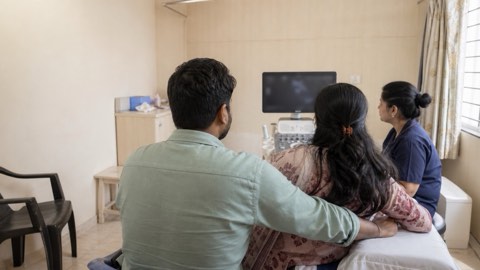
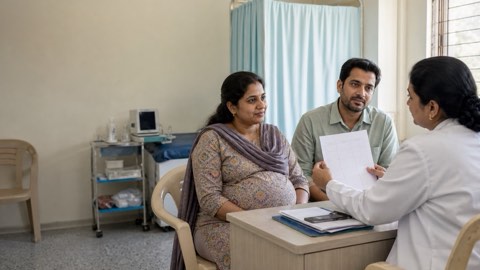
The 10-week ultrasound: a recognisable baby

Ten weeks is when a scan starts to look like a baby rather than a shape — head, body, arms, legs, and a great deal of movement.
What is visible
A fetus of roughly 30 to 40 mm — about the size of a strawberry — with a clearly formed head, body, arms and legs, and fingers and toes that are separating.
Vigorous movement, often startling to watch. The heart rate is around 150 to 170 and beginning to settle from its peak.
The placenta is visible and taking over from the yolk sac, and the umbilical cord is established.
External genitalia are beginning to differentiate and are not reliably distinguishable — and in India, looking for them at any stage is a criminal offence.
What becomes possible now
NIPT — non-invasive prenatal testing — can be done from about ten weeks. It is a maternal blood test that analyses fetal DNA and screens for common chromosomal conditions with high detection rates. It is a screening test rather than a diagnosis, it is available privately in Indian cities at a cost, and a positive result is confirmed with an invasive test.
Chorionic villus sampling, a diagnostic test, is done from about 11 to 14 weeks where indicated.
The NT scan and double marker follow at 11 to 14 weeks and are the standard combined screening most women have.
Discuss with your obstetrician what you would do with each possible result before booking any of it — that question matters more than the test itself.
When to see a doctor
Go to hospital immediately for heavy bleeding, severe or one-sided abdominal pain, fainting or dizziness, shoulder-tip pain, or fever with pelvic pain. Call 108 if you cannot travel quickly.
Same-day: bleeding, severe or one-sided pain, fever, or vomiting that prevents keeping fluids down.
This article is general information, not medical advice, and is no substitute for personal medical advice. For any decision about your or your child's health, please consult your doctor.
Frequently asked questions
Is ten weeks too early for the NT scan?
Yes. The nuchal measurement window is 11 to 14 weeks, and doing it earlier gives an unreliable result.
Should we have NIPT?
Worth discussing if you are over 35, have a raised risk on other screening, or want the information and can manage the cost. It is optional, and the decision is about what you would do with the result.
The scan showed a small subchorionic bleed.
Common, usually resolves, and monitored with a repeat scan. See our guide on subchorionic bleeding.
When will I stop feeling so sick?
For most women nausea eases between weeks twelve and fourteen. If it is severe or you are losing weight, that is hyperemesis and needs treatment.
Sources
Every clinical figure on this page is taken from the guidelines below. Where our numbers and your doctor's differ, ask which guideline they follow.
- WHO. WHO recommendations on antenatal care for a positive pregnancy experience (2016)Backs the page's framing of first-trimester ultrasound for fetal assessment, combined screening including NT scan, and the general antenatal care pathway described.
- NICE. Antenatal care (NG201) (2021)Supports the 11–14 week window for the NT scan and combined screening (NT plus biochemistry/double marker), and that NIPT is a screening test requiring confirmatory invasive testing for a positive result.
- NICE. Ectopic pregnancy and miscarriage: diagnosis and initial management (NG126) (2019)Supports the emergency warning signs listed on the page — heavy bleeding, severe or one-sided abdominal pain, shoulder-tip pain, and fainting or dizziness — as features requiring immediate hospital attendance to exclude ectopic pregnancy or miscarriage.
Reviewed by
- Nakul Phatak — CEO, theAsianparent India & IndonesiaHead of theAsianparent India; father of one
- Roshni Chugani — Head of Marketing, theAsianparent India & Singapore12 years in the mother-and-baby space; mother of two
Published by: theAsianparent editorial team