Your child at 1: what the whole year brings

Between one and two a baby becomes a person with opinions: walking, talking, refusing food, and testing every rule in the house.
What changes this year
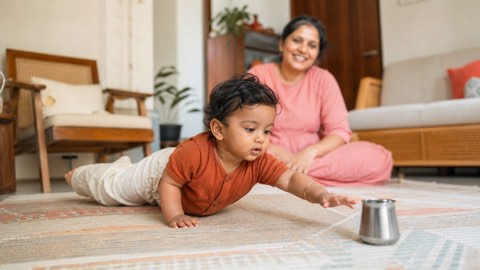
Movement: from first steps to running, climbing, and stairs. Most children walk between nine and eighteen months, and by two are running and jumping.
Language: from one or two words at twelve months to fifty or more with two-word phrases by twenty-four. Understanding runs well ahead of speech throughout.
Eating: growth slows sharply after the first birthday and appetite drops with it. This is normal and it alarms almost every family. Three meals, two snacks, milk capped at 400-500 ml a day.
Behaviour: tantrums begin and build toward their peak at eighteen months to three years, driven by big wants and no capacity to manage the feelings.
Health and vaccines
Boosters fall between 16 and 24 months: DPT, OPV and the second Measles-Rubella dose. Private schedules add hepatitis A, varicella and typhoid in this window.
Ask at the one-year and two-year checks for weight, height and head circumference to be plotted, and for the curve to be explained. Ask about haemoglobin — toddler anaemia is very common in India and shows as tiredness, pallor and poor eating.
Deworming is generally advised twice yearly from a year, free through the Anganwadi and school programme. And the first dental visit belongs around the first birthday.
Read next

Food, sleep and safety
Food: family meals chopped small, three meals plus two snacks, water between. Cow's milk from twelve months in a cup, capped. Bottles out between twelve and eighteen months. Still no added salt or sugar for a while, no chai, no whole nuts.
Sleep: 11-14 hours in 24. Two naps become one somewhere between fourteen and eighteen months. Protect the nap — an overtired toddler sleeps worse at night, not better.
Safety changes with mobility: balcony grilles and furniture near railings, buckets of water emptied, hot vessels off the floor, cleaning fluids and medicines locked high, and furniture secured to the wall. Our baby-proofing guide has the room-by-room list.
When to see a doctor
Same-day at any age: fast or laboured breathing, the chest sucking in, blue lips; a fit; a child who is floppy, drowsy or hard to wake; dehydration or no urine for eight hours; a rash that does not fade when pressed; repeated forceful or green vomiting; blood in stool or vomit; severe abdominal pain; or a head injury with vomiting, drowsiness or confusion. Call 108 for breathing difficulty.
This year specifically: not walking by 18 months, no words by 18 months, no two-word phrases by 24 months, no pointing or gestures, no pretend play, no response to their name, no interest in other children, or walking only on toes.
And at any age, the loss of a skill a child already had needs assessment rather than a wait.
This article is general information, not medical advice, and is no substitute for personal medical advice. For any decision about your or your child's health, please consult your doctor.
Frequently asked questions
She has stopped eating since her birthday.
The commonest question of the year, and it is biology: growth slows, so appetite falls. Check the milk volume, keep meals structured, and judge by the growth chart rather than the plate.
When should I start toilet training?
When the readiness signs appear, usually between eighteen months and three years. Starting before them trains you rather than the child.
How much screen time?
None beyond video calls before eighteen months to two years, then very limited and co-viewed. Never at meals.
Is playschool necessary at this age?
No. A child at home with responsive adults and some other children to play with is not behind anyone.
Sources
Every clinical figure on this page is taken from the guidelines below. Where our numbers and your doctor's differ, ask which guideline they follow.
- IAP. IAP Immunization Timetable 2020Backs the page's schedule of booster doses (DPT, OPV, second Measles-Rubella dose) between 16 and 24 months, and the private-schedule additions of hepatitis A, varicella and typhoid in the same window.
- WHO. WHO Child Growth StandardsSupports the recommendation to plot weight, height and head circumference at one- and two-year checks and interpret the growth curve, and the framing that growth slows after the first birthday causing appetite to drop.
- AAP. Bright Futures / AAP Developmental Milestones: 12 and 24 MonthsBacks the developmental milestones cited for movement (walking 9–18 months, running and jumping by 2), language (1–2 words at 12 months, 50+ words and two-word phrases by 24 months), and the red-flag list (not walking by 18 months, no words by 18 months, no two-word phrases by 24 months, loss of skills).
- MoHFW. National Deworming Day – Operational GuidelinesSupports the advice that deworming is recommended twice yearly from one year of age and is available free through the Anganwadi and school programme under the National Deworming Day initiative.
- WHO. Guideline: Sugars intake for adults and childrenSupports the dietary guidance to avoid added sugar for toddlers, complementing the page's instruction on no added salt or sugar and limiting cow's milk to 400–500 ml a day capped in a cup from twelve months.
Reviewed by
- Nakul Phatak — CEO, theAsianparent India & IndonesiaHead of theAsianparent India; father of one
- Roshni Chugani — Head of Marketing, theAsianparent India & Singapore12 years in the mother-and-baby space; mother of two
Published by: theAsianparent editorial team