Your child at 2: the year of talking, tantrums and toilet training

Two to three is the loudest year and the most transformative: a child who speaks in phrases at the start is holding conversations by the end.
What changes this year
Language explodes: from around fifty words and two-word phrases at two, to short sentences, questions and being understood by strangers most of the time by three.
Movement: running, jumping with both feet, climbing confidently, pedalling a tricycle, and beginning to manage stairs alone.
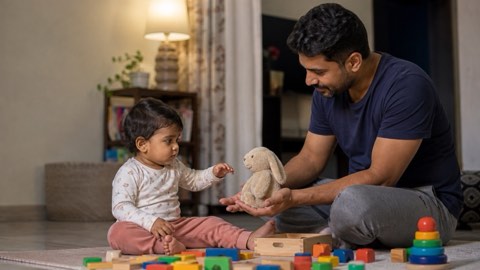
Play: pretend play becomes elaborate — shops, kitchens, doctors — and children move from playing beside others toward playing with them. Sharing begins to be possible near the end of this year, not the start.
Behaviour: tantrums peak and then begin to fade as language grows. 'No' and 'mine' are the year's vocabulary.
Toilet training and independence
Most children train somewhere in this year. Wait for the readiness signs — dry for two hours, telling you, interest in the toilet, able to pull pants down — then use underwear rather than pull-ups, offer the potty at regular points, and expect accidents without comment.
Night dryness is a separate, later milestone that cannot be trained; many children are not dry at night until four or five, and bedwetting to seven is common.
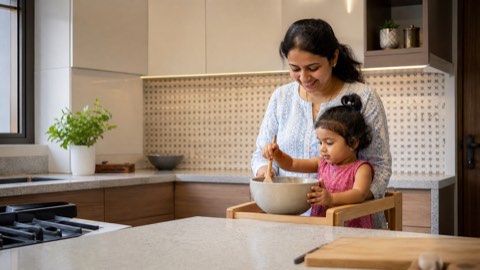
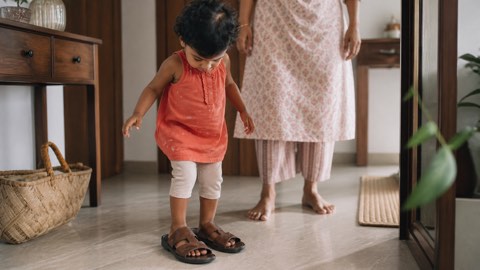
Independence: dressing with help, washing hands, feeding themselves, carrying their plate. Let them do the slow version; it builds cooperation as much as competence.
Read next

Food, sleep and health
Food: family meals, three plus two, milk capped at 400-500 ml. Fussy eating peaks now — keep serving without pressure and without a running commentary. Iron matters: dal, ragi, egg, greens, gud and chana in rotation.
Sleep: 11-14 hours including one afternoon nap, which usually continues to around three. Bedtime resistance is normal; a fixed short routine handles most of it.
Health: the two-year check with growth plotted, developmental screening, haemoglobin, and deworming twice a year. Brushing twice daily, done by you — a rice-grain smear of fluoride toothpaste at this age, a pea-sized amount from three.
Screens: about an hour a day of good content from two, watched together, none at meals or in the hour before bed.
When to see a doctor
Same-day at any age: fast or laboured breathing, the chest sucking in, blue lips; a fit; a child who is floppy, drowsy or hard to wake; dehydration or no urine for eight hours; a rash that does not fade when pressed; repeated forceful or green vomiting; blood in stool or vomit; severe abdominal pain; or a head injury with vomiting, drowsiness or confusion. Call 108 for breathing difficulty.
At two to three specifically: fewer than fifty words or no two-word phrases at two, speech that no one outside the family understands at three, no pretend play, no interest in other children, not running or climbing, walking only on toes, or the loss of any skill.
And at any age, the loss of a skill a child already had needs assessment rather than a wait.
This article is general information, not medical advice, and is no substitute for personal medical advice. For any decision about your or your child's health, please consult your doctor.
Frequently asked questions
The tantrums are constant. Is this normal?
Yes, this is the peak. Prevention — sleep, food, warnings before transitions, limited choices — does more than any response technique.
He is not toilet trained and playschool wants him to be.
Talk to the school rather than rushing him. Good schools expect accidents from two- and three-year-olds.
Should he be in playschool at two?
Optional. It offers other children, space and structure; a home with those does the same job. Our starting-playschool guide covers choosing one.
She only eats three foods.
Common at this age. Keep offering the rest without pressure alongside what she accepts, and check haemoglobin if she is pale or tired.
Sources
Every clinical figure on this page is taken from the guidelines below. Where our numbers and your doctor's differ, ask which guideline they follow.
- WHO. WHO Child Growth Standards and the Identification of Severe Acute Malnutrition in Infants and ChildrenSupports the recommendation that growth be plotted at the two-year health check, consistent with WHO growth monitoring guidance for children under five.
- AAP. Caring for Your Baby and Young Child: Birth to Age 5 — Developmental MilestonesSupports the language milestones (approximately 50 words and two-word phrases at two, short sentences understood by strangers by three), motor milestones (running, jumping, climbing, pedalling), pretend play emergence, and the developmental red flags listed for ages two to three.
- WHO. Guideline: Intermittent Deworming Programmes in ChildrenSupports the recommendation for deworming twice a year in children, consistent with WHO guidance on periodic preventive chemotherapy for soil-transmitted helminths.
- WHO. Sleep duration recommendations for children — WHO guidelines on physical activity, sedentary behaviour and sleep for children under 5 years of ageSupports the sleep recommendation of 11–14 hours (including a nap) for children aged one to two years, which WHO specifies for ages 1–2; the page applies this to the two-to-three age range.
Reviewed by
- Nakul Phatak — CEO, theAsianparent India & IndonesiaHead of theAsianparent India; father of one
- Roshni Chugani — Head of Marketing, theAsianparent India & Singapore12 years in the mother-and-baby space; mother of two
Published by: theAsianparent editorial team