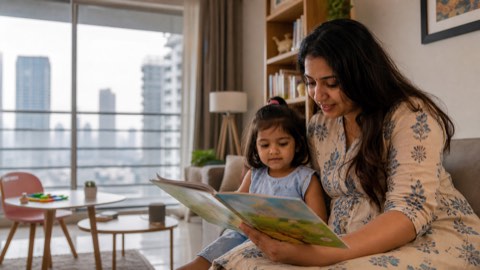
Your toddler at 17 months: pretend play and the first two-word phrases

Seventeen months brings the beginning of imagination — feeding a doll, driving a block along the floor — which is a bigger developmental step than it looks.
Where a 17-month-old is
Pretend play begins in earnest: feeding a doll, putting a toy to sleep, stirring an empty pot, holding a block to the ear as a phone. It marks the ability to hold an idea separate from what is in front of them.
Speech: many children have ten to twenty-five words and some begin joining two — 'more milk', 'papa gone'. Others are still using few words and plenty of gestures, which remains within range until eighteen months.
Movement: running, walking backwards, climbing onto furniture, carrying large objects, and beginning to kick and throw with intent.
Feeding a toddler who eats nothing
The pattern is normal: eats well one day and almost nothing the next, prefers one food for a fortnight, refuses what they loved last week.
Structure fixes most of it: three meals and two snacks at fixed times, nothing but water between, milk capped at 400-500 ml a day, and no grazing. Constant snacking and milk on demand are the commonest reasons a toddler has no appetite at meals.
Eat together where possible, serve the same food, and stop commenting on how much is eaten. Children eat more when nobody is watching the plate.
Iron matters: dal, ragi, egg, greens, gud and chana in rotation, with a vitamin-C food alongside. Get haemoglobin checked if the child is pale, tired or eating poorly.
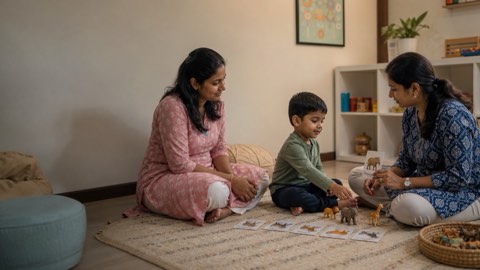
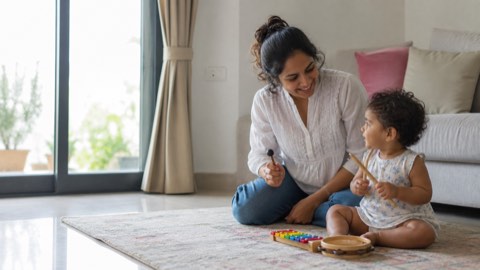
Language and play
Follow their attention rather than directing it: name what they are looking at, wait five seconds after speaking, and respond to any attempt — a sound, a gesture, a look — then expand it. 'Ball.' 'Yes, big red ball.'
Read daily, sing with actions, and play back-and-forth games. Turn-taking is the foundation of conversation.
Resist doing everything before they ask. Small kind gaps — pausing, looking expectant — create the need to communicate that drives speech.
When to see a doctor
Same-day at any age: fast or laboured breathing, the chest sucking in, blue lips; a fit; a child who is floppy, drowsy or hard to wake; no urine for six to eight hours or signs of dehydration; a rash that does not fade when pressed; repeated forceful or green vomiting; blood in stool or vomit; a swollen tender abdomen; or a head injury with vomiting or drowsiness. Call 108 for breathing difficulty.
At 17 months specifically: no words at all, no pointing or showing, no pretend play, not responding to their name, no interest in other children, loss of words previously used, or walking only on toes persistently.
And at any age, the loss of a skill a child already had — words, walking, waving, eye contact — needs an assessment rather than a wait.
This article is general information, not medical advice, and is no substitute for personal medical advice. For any decision about your or your child's health, please consult your doctor.
Frequently asked questions
He understands everything but says nothing.
Good comprehension is reassuring, and expressive delay still benefits from assessment. If there are no words by eighteen months, book a hearing test and a speech assessment rather than waiting.
We speak three languages at home. Is that the reason?
No. Multilingualism does not cause speech delay, and removing a language costs family connection for no gain. Get the assessment.
She eats only rice and curd.
Serve it as part of a plate that also has dal and a vegetable, without pressure, and keep the rest appearing. Restrictive phases pass if they are not fought over.
Is a soother still okay?
Aim to phase it out by around two to reduce the effect on teeth and speech. Start with the daytime ones and keep it for sleep only.
Sources
Every clinical figure on this page is taken from the guidelines below. Where our numbers and your doctor's differ, ask which guideline they follow.
- WHO. Guidelines on physical activity, sedentary behaviour and sleep for children under 5 years of age (2019)Backs the page's framing of structured feeding, responsive interaction, and active play as foundations of healthy toddler development in the second year of life.
- WHO. Complementary feeding: family foods for breastfed children (2000)Supports the advice on iron-rich foods (legumes, greens, eggs) with vitamin-C to enhance absorption, a structured meal pattern, and a milk cap of approximately 400–500 ml/day to preserve appetite for solid foods.
- ICMR. Dietary Guidelines for Indians (2024)Supports the page's iron-rich food rotation (dal, ragi, egg, greens, jaggery, chana) and the recommendation to pair these with a vitamin-C source to improve iron bioavailability in toddler diets.
Reviewed by
- Nakul Phatak — CEO, theAsianparent India & IndonesiaHead of theAsianparent India; father of one
- Roshni Chugani — Head of Marketing, theAsianparent India & Singapore12 years in the mother-and-baby space; mother of two
Published by: theAsianparent editorial team