Screen time for under-fives: what the guidance says and how to make it stick

The phone is the most effective babysitter ever invented, and the under-fives are exactly the age it costs the most. Here is the honest picture and a workable plan.
What the guidance actually says
Under 18 months: no screen time apart from video calls with family. 18 months to 2 years: only high-quality content, watched together with an adult who talks about it. 2 to 5 years: about an hour a day of good content, co-viewed where possible. Indian paediatric guidance follows the same lines.
The reason is not that screens are evil; it is displacement. Every hour on a screen is an hour not spent in the back-and-forth conversation, physical play and boredom that build language, attention and problem-solving in exactly these years.
Under-twos in particular do not learn from video the way they learn from people — the research is consistent. A responsive human, however tired, teaches more in ten minutes than an educational video does in an hour.
The habits that cost most
Feeding with a phone. It is close to universal in Indian homes and it does two kinds of damage at once: the child eats without registering fullness, and mealtime conversation — a major source of language — disappears. Children fed this way commonly cannot eat without a screen a year later.
Screens as the tantrum stopper. Handing over a phone to end a meltdown teaches that big feelings are managed by numbing them, and it removes the practice of calming down. It is understandable at the end of a long day and worth replacing with anything else.
Background television. A TV on in the room reduces the amount and quality of talk between adults and children even when nobody is watching. Off when not being watched is a small change with a measurable effect.
Screens in the last hour before bed, and screens in the bedroom. Both delay sleep and shorten it, and toddler sleep is already the scarcest resource in most households.

Cutting back without a war
Set the boundaries by time and place rather than by negotiation each day: no screens at meals, none in the bedroom, none in the hour before bed, and a fixed window on fixed days. Written on the fridge, agreed by all adults including grandparents.
Reduce gradually if usage is high — cutting from three hours to none in one day guarantees a week of misery. Take off thirty minutes at a time, and fill the gap with something active before the complaining starts.
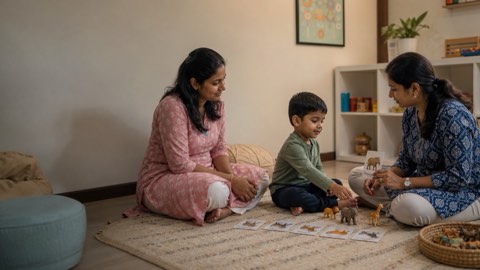
Replace, do not just remove: blocks, dough, water play, drawing, boxes, running, cooking together, helping with chores, and — crucially — being allowed to be bored. Boredom is where imaginative play is born; it looks like nothing happening and it is not.
Model it. Children in homes where adults are constantly on phones do not accept screen limits, and they are right to notice. Put your own phone in another room for a defined hour a day; it changes the household's air.
When screens are genuinely useful
Video calls with grandparents and a travelling parent are interactive and worth keeping — that is conversation, not consumption.
Long journeys, illness, and hospital waits are exactly what exceptions are for. Use them without guilt and go back to the rule afterwards; children accept 'that was for the train' better than adults expect.
For working parents and those without help, a screen is sometimes what makes dinner get cooked. Choose slow, gentle, ad-free content over fast-cut videos and autoplay feeds, watch some of it with them, and keep the window predictable. A managed habit is a completely different thing from an unlimited one.
Frequently asked questions
My child learned English rhymes and letters from videos. Isn't that learning?
Recitation is not language. Children who recite from screens often have weaker conversational language, which is the skill that matters for school. Sing the same rhymes with them yourself and you get both.
How do I stop the grandparents handing over the phone?
Give them a better role rather than a rule: they are unbeatable at stories, songs, walks and telling the child about the family. Ask directly for those, and keep one shared rule — no phone at meals — for everyone.
Is TV better than a phone?
Marginally: a TV is at a distance, usually shared, and less likely to be swiped for hours. A phone or tablet held close is more immersive and more habit-forming. Neither belongs at meals or in the bedroom.
My child has speech delay and heavy screen use
what first? — Remove the screens first, hard, and increase face-to-face talk, reading and play — many families see quick improvement. Do this alongside, not instead of, a hearing test and a proper speech assessment.
Reviewed by
- Nakul Phatak — CEO, theAsianparent India & IndonesiaHead of theAsianparent India; father of one
- Roshni Chugani — Head of Marketing, theAsianparent India & Singapore12 years in the mother-and-baby space; mother of two
Published by: theAsianparent editorial team