Your toddler at 15 months: the vaccination visit and the word explosion's start

Fifteen months brings the booster visit and a vocabulary that is about to take off — usually a few weeks after you have started worrying about it.
Where a 15-month-old is
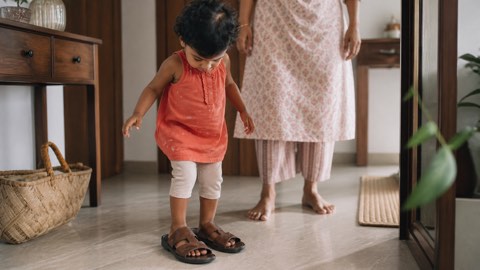
Walking well, often running unsteadily, climbing onto sofas and out of cots. Cot-climbing is the signal to drop the mattress to its lowest setting or move to a floor bed.
Words: often five to fifteen, growing week by week, with a lot of pointing and naming. Many children are still saying very little and understanding everything, which is within normal range.
Play: stacking three or four blocks, posting shapes, scribbling, and imitating everything you do — sweeping, wiping, talking on a phone. Pretend play is beginning.
The booster visit
The national schedule places boosters between 16 and 24 months: DPT booster, OPV booster, and the second dose of Measles-Rubella. Many private schedules also give hepatitis A, varicella and typhoid around this window.
Take the MCP card, keep it even if the child has a runny nose, and ask for weight and height to be plotted while you are there.
The second MR dose matters. One dose is not reliable protection, and measles outbreaks in India consistently trace to partially vaccinated children.


Food, sleep and the climbing
Three meals, two snacks, family food chopped small. Appetite still varies hugely day to day. Keep milk capped and iron-rich food frequent — dal, ragi, egg, greens — since toddler anaemia is very common in India and shows as tiredness, pallor and poor eating.
One nap for many now, of about one and a half to two and a half hours after lunch. Total sleep around 11-14 hours.
Climbing changes safety: secure bookshelves and televisions to the wall, keep chairs away from balconies and windows, and never leave a bucket of water accessible. A child who can climb can reach the kitchen counter.
When to see a doctor
Same-day at any age: fast or laboured breathing, the chest sucking in, blue lips; a fit; a child who is floppy, drowsy or hard to wake; no urine for six to eight hours or signs of dehydration; a rash that does not fade when pressed; repeated forceful or green vomiting; blood in stool or vomit; a swollen tender abdomen; or a head injury with vomiting or drowsiness. Call 108 for breathing difficulty.
At 15 months specifically: not walking independently, no words at all, no pointing or showing you things, not following a simple instruction, no pretend play, or not making eye contact.
And at any age, the loss of a skill a child already had — words, walking, waving, eye contact — needs an assessment rather than a wait.
This article is general information, not medical advice, and is no substitute for personal medical advice. For any decision about your or your child's health, please consult your doctor.
Frequently asked questions
He climbs out of the cot.
Drop the mattress to the lowest level; if he still climbs, move to a floor mattress and baby-proof the room properly, because he will be out of it at night either way.
Only three words at fifteen months.
Watch understanding and gestures rather than the count. If there are no words and no gestures by eighteen months, arrange a hearing test and a speech assessment rather than waiting.
Is the second MR dose necessary if the first was given?
Yes. Two doses are needed for reliable protection.
She refuses vegetables entirely.
Common. Keep serving them without comment alongside accepted food, hide some in khichdi and parathas, and keep offering the visible version. Acceptance follows repeated exposure, often after ten or more tries.
Sources
Every clinical figure on this page is taken from the guidelines below. Where our numbers and your doctor's differ, ask which guideline they follow.
- IAP. IAP Recommended Immunization Schedule for Children Aged 0 through 18 Years — India, 2023–24 (2023)Backs the references to private-schedule vaccines (hepatitis A, varicella, typhoid) given around the 15–18 month window, and the two-dose requirement for measles-rubella protection.
- WHO. Measles vaccines: WHO position paper – April 2017 (2017)Backs the claim that one MR dose is not reliable protection and that two doses are needed, and that measles outbreaks trace to partially vaccinated children.
- AAP. Sleep Duration Recommendations (HealthyChildren.org) / AAP Sleep Guidelines (2022)Backs the recommendation of approximately 11–14 total hours of sleep per day for toddlers at this age.
- ICMR. Dietary Guidelines for Indians (ICMR-NIN), 2024 (2024)Backs the guidance on iron-rich complementary foods (dal, ragi, egg, green leafy vegetables) for toddlers and the high prevalence of toddler anaemia in India reflected in feeding recommendations.
Reviewed by
- Nakul Phatak — CEO, theAsianparent India & IndonesiaHead of theAsianparent India; father of one
- Roshni Chugani — Head of Marketing, theAsianparent India & Singapore12 years in the mother-and-baby space; mother of two
Published by: theAsianparent editorial team