The vaccination schedule for the first year, explained visit by visit

Nothing in the first year protects your baby like the vaccine card. Here is the whole first-year schedule made plain — what happens at each visit, why each dose matters, and how the government and private schedules fit together.
The one-paragraph case for the card
Vaccines are the reason Indian children no longer die routinely of diseases their grandparents can name — polio, tetanus, diphtheria, measles. Each dose teaches the immune system an enemy in advance. The schedule's timing is designed around when maternal protection fades and when disease risk peaks — which is why 'we'll do it later, the baby is small' has it backwards: the schedule exists because the baby is small.
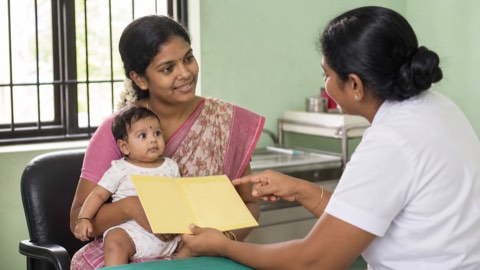
Every dose goes on the MCP (Mother and Child Protection) card or the immunisation card — the same card that tracked the pregnancy. It is the baby's first official document in practice: school admissions ask for it, and every doctor visit starts with it. Photograph every page after every visit.
The full national schedule is free at government facilities — Anganwadi, PHC, government hospitals — under the Universal Immunisation Programme; the ASHA worker will tell you the village or ward's session day. Private paediatricians run the same core schedule plus some additional vaccines; both roads are good roads.
Visit by visit: birth to six months
At birth (before hospital discharge): BCG against severe childhood tuberculosis (the one that leaves the little shoulder scar), the birth dose of Oral Polio Vaccine (OPV), and the first Hepatitis B dose. If a home birth skipped these, they're given at first contact — go early.
At 6, 10 and 14 weeks — the big three visits: each brings the Pentavalent vaccine (one injection covering five diseases — diphtheria, pertussis/whooping cough, tetanus, Hepatitis B and Hib meningitis), OPV drops, Rotavirus drops against severe infant diarrhoea, and the pneumococcal vaccine (PCV) against pneumonia and meningitis per the state's schedule (commonly 6 and 14 weeks, booster at 9 months). One visit at 14 weeks also brings the injectable polio dose (IPV) alongside the drops.
Private-schedule additions in this stretch commonly include extra IPV doses and combination injections that reduce the number of pokes — the diseases covered are the same core set. What matters is one complete schedule, either system, on time.
Visit by visit: nine months to one year
At 9 months, a milestone visit: the first dose of Measles-Rubella (MR) vaccine, the PCV booster, and — in programme states — the Japanese Encephalitis vaccine and the first Vitamin A dose. Measles in infancy is a genuinely dangerous disease; the 9-month visit is not one to drift.
Around 12 months, on the private schedule: Hepatitis A and often the first typhoid conjugate dose — worth taking where budget allows, since both diseases are everyday Indian realities. The government schedule's next anchor is at 16-24 months (the MR second dose and the DPT and polio boosters), so the card stays active into toddlerhood.
Two rules cover every miss: first, a missed dose is caught up, never abandoned — the schedule resumes from where it stopped, no restarting, and no dose is ever 'too late to bother'. Second, mild illness — a cold, a little cough, even low-grade fever — is NOT a reason to postpone; tell the doctor and they'll usually vaccinate anyway. The commonest cause of an incomplete card is postponement that became forgetting.
Side effects, honestly
The normal aftermath: soreness or a small hard lump at the injection site, crankiness, and mild fever for a day or two — the immune system audibly doing its homework. Comfort, feeds, and doctor-approved paracetamol if needed. The BCG spot has its own famous timeline: a small sore that appears after weeks, oozes, crusts and scars — that is the vaccine working, not an infection to treat.
The rare-but-real list — high fever, a fit, continuous inconsolable crying for hours, or any breathing difficulty or facial swelling shortly after a dose — follows the fever rules: same-day doctor, 108 for anything that looks like an emergency. Serious vaccine reactions are genuinely rare; the diseases they prevent are not.
What does not belong in the decision: WhatsApp-forwarded vaccine scares. The claims linking vaccines to autism were fraudulent and are among the most thoroughly debunked in medicine. The card protects your child and, through herd immunity, the newborn next door who is too young for her own doses yet.
The chart, printable
The full schedule as a chart — tick off doses as they're given, and keep it with the MCP card.
The full schedule prints on one A4 sheet — fridge-door sized. There is space to write the child's name and date of birth. Per the National Immunization Schedule — Ministry of Health & Family Welfare (MoHFW).
When to see a doctor at once
Same-day after any vaccination: fever above 39°C or any fever in a baby under three months (see our fever guide for the full rule), a fit, hours of inconsolable crying, marked swelling spreading from the injection site, or any breathing difficulty or facial swelling — the last two are 108 emergencies. And bring the card to every illness visit: 'what has the baby had?' is the first question good care asks.
This article is general information, not medical advice, and is no substitute for personal medical advice. For any decision about your or your child's health, please consult your doctor.
Frequently asked questions
Government free vaccines or private paid ones
which are better quality? — The same vaccines against the same diseases, held to the same regulatory standard; government stock protects crores of children a year. Private adds convenience, combination shots (fewer pokes) and some extra vaccines (Hepatitis A, typhoid, varicella, flu). Money buys comfort and coverage breadth, not better copies of the core doses.
So many injections in one visit
can we split them across weeks to be gentle? — Splitting feels kinder and isn't: it multiplies visits, delays protection, and each 'we'll come next week' risks becoming a gap. Babies handle multiple simultaneous vaccines well — the immune system meets more antigens crawling on the floor than in any clinic visit. Take the schedule as designed.
We missed the 10-week visit by a month
restart the series? — Never restart; just resume. The earlier doses still count, whatever the gap. Go in with the card, and the doctor or ANM will slot the catch-up — this is routine for them, so skip the embarrassment that keeps families away.
Is the OPV given in pulse polio campaigns extra, on top of the schedule?
Yes — the National Immunisation Day drops are additional insurance doses, and every child under five takes them regardless of the card being complete. Extra OPV is safe; the campaigns are how India stays polio-free. Open the door for the booth team, card complete or not.
Sources
Every clinical figure on this page is taken from the guidelines below. Where our numbers and your doctor's differ, ask which guideline they follow.
- IAP. IAP Recommended Immunization Schedule for Children Aged 0 Through 18 Years — India (2023–24) (2023)Backs the private-schedule additions described — Hepatitis A and typhoid conjugate around 12 months, combination shots reducing injection count, additional IPV doses, and varicella/flu referenced in the Q&A — and the catch-up rule that missed doses resume rather than restart.
- WHO. Immunization coverage fact sheet and position papers on individual vaccines (2023)Backs the principles that vaccination schedule timing is designed around fading maternal immunity and peak disease-risk windows, that mild illness (cold, low-grade fever) is not a contraindication to vaccination, and that missed doses should be caught up without restarting.
- UNICEF. Immunization — Every child deserves protection (2023)Backs the herd-immunity rationale cited in the article — that a fully vaccinated child also protects newborns too young to have received their own doses yet.
Reviewed by
- Nakul Phatak — CEO, theAsianparent India & IndonesiaHead of theAsianparent India; father of one
- Roshni Chugani — Head of Marketing, theAsianparent India & Singapore12 years in the mother-and-baby space; mother of two
Published by: theAsianparent editorial team