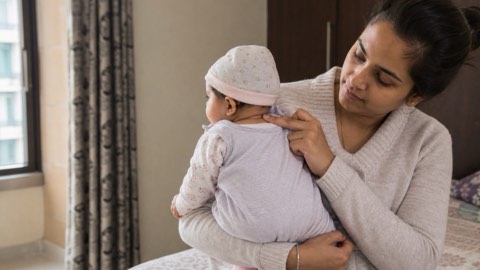
Cough and cold in babies: home care that works and medicines to avoid

A small child catches six to eight colds a year, and every one of them is treated at home. Here is what actually helps, what to keep out of the house, and the breathing signs that change everything.
Why so many colds, and what they look like
Six to eight colds a year is normal for a small child, and more once playschool starts — the immune system is meeting the world's viruses one at a time and building its library. Frequent colds in an otherwise thriving, growing child are not weak immunity; they are immunity under construction.
A typical cold: a couple of days of runny nose and sneezing, a few days of thick green or yellow discharge (colour does not mean bacteria and does not mean antibiotics), a cough that hangs around after everything else, and a low fever early on. Total run: seven to ten days, with the cough sometimes lingering two to three weeks.
Babies breathe mainly through the nose, so a blocked nose in a small baby is a feeding problem more than a comfort problem — which is why nose care, not cough medicine, is where treatment goes.
Home care that actually works
Saline nose drops are the workhorse: two drops in each nostril, wait a minute, then gently clear with a bulb syringe if needed — especially before feeds and before sleep. Available at every chemist for a few rupees, safe at any age, and the single most useful item in the cupboard.
Steam and humidity: sitting in a steamy bathroom with the hot tap running is safe. Direct steam inhalation over a bowl is a serious scald risk for small children — never leave a child near hot water, and skip it altogether for babies. Keep the room comfortably humid rather than dry and over-air-conditioned.
Fluids, small frequent feeds, and an elevated head end for sleep (raise the mattress head slightly — never a pillow under a baby's head). Honey soothes cough in children over one year — a teaspoon at bedtime — but never before the first birthday, under any circumstances.
For fever, comfort and paracetamol at the weight-correct dose from your doctor. And keep the household smoke-free — indoor cigarette smoke, mosquito coils burning near a baby, and kitchen smoke all worsen and prolong a child's cough.
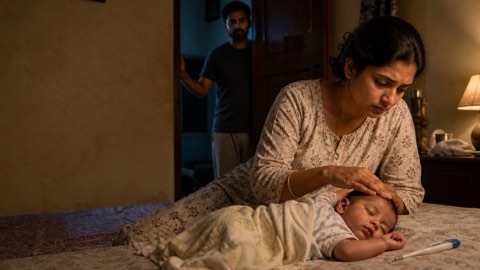

The medicines to keep out of the house
Over-the-counter cough and cold syrups should not be given to children under two years, and are best avoided under four to six. They do not shorten a cold, they carry real risks in small children, and India's chemist counters hand them out freely — the refusal has to come from you.
Antibiotics do nothing for viral colds, which is what almost all of them are. Demanding a course, or repeating one left in the cupboard from the last illness, drives antibiotic resistance and gives your child diarrhoea for their trouble. A doctor who says 'no antibiotic needed' is doing their job well.
Also skip: adult vapour rubs and balms applied under a baby's nose or on the chest of a very small baby (camphor and menthol preparations are not for infants — check the age on the label), and nasal decongestant drops beyond a couple of days.
When to see a doctor
Straight to hospital, 108 if needed: fast breathing (count it — over 60 breaths a minute under 2 months, over 50 from 2-12 months, over 40 from 1-5 years, counted for a full minute in a calm child), the chest sucking in below the ribs with each breath, grunting, blue lips or tongue, a child too breathless to feed or speak, or one who cannot be roused properly.
Same-day doctor: any fever in a baby under three months; fever above 39°C or lasting more than three days; wheezing or a barking cough with noisy breathing; ear pain or discharge; refusing all feeds; no wet nappy for six to eight hours; or a cough lasting beyond three weeks. Also, a cold that seemed to improve and then suddenly worsened.
This article is general information, not medical advice, and is no substitute for personal medical advice. For any decision about your or your child's health, please consult your doctor.
Frequently asked questions
Green mucus means infection and antibiotics, doesn't it?
No. Colour changes are a normal part of a viral cold's course and say nothing about bacteria. The things that make a doctor consider antibiotics are the pattern and the examination — fever returning after improvement, ear findings, chest findings — not the colour of the tissue.
Should I stop bathing my child during a cold?
No. A warm bath in a warm room is fine and often helps a blocked nose. What matters is not getting chilled afterwards — dry quickly, dress warmly.
Does cold weather or ice cream cause colds?
Viruses cause colds. Cold weather makes people crowd indoors where viruses spread, which is why winter looks guilty. Ice cream does not cause infection, though it may irritate an already sore throat.
My child gets a cold every month since starting playschool
is something wrong with his immunity? — Almost certainly not, if he is growing well, active between colds, and recovering each time. Real immune deficiency looks different: failure to grow, repeated pneumonias or deep infections, unusual infections, thrush that will not clear. Show the growth chart to your paediatrician if you are worried — that chart answers this question better than any tonic.
Sources
Every clinical figure on this page is taken from the guidelines below. Where our numbers and your doctor's differ, ask which guideline they follow.
- WHO. Pocket Book of Hospital Care for Children: Guidelines for the Management of Common Childhood Illnesses (2013)Backs the fast-breathing thresholds cited for emergency referral: >60 breaths/min under 2 months, >50 from 2–12 months, and >40 from 1–5 years as signs of severe pneumonia requiring urgent care.
- NHS. Common cold (2023)Backs the description of a typical cold's course (runny nose, thick coloured discharge, cough, low fever lasting 7–10 days), that green/yellow mucus does not indicate bacterial infection requiring antibiotics, and saline drops and fluids as appropriate home management.
Reviewed by
- Nakul Phatak — CEO, theAsianparent India & IndonesiaHead of theAsianparent India; father of one
- Roshni Chugani — Head of Marketing, theAsianparent India & Singapore12 years in the mother-and-baby space; mother of two
Published by: theAsianparent editorial team