Newborn sleep: what is normal, what is safe, and how to survive it

A newborn sleeps sixteen hours a day and somehow nobody in the house sleeps at all. Here is what is normal, the short list of safety rules that are non-negotiable, and how the first three months actually get survived.
What newborn sleep actually looks like
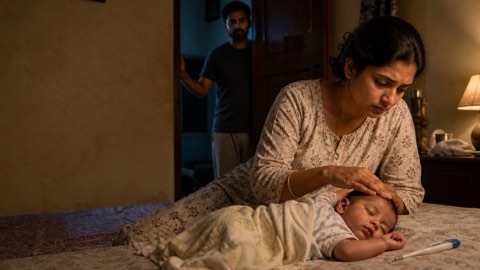
A newborn sleeps fourteen to seventeen hours a day — in pieces of two to four hours, around the clock, with no idea that night exists. This is not a problem to fix; it is how newborns are built. The stomach is tiny, feeds are two-three hourly, and sleep happens between them.
Newborn sleep is also noisy and restless by design — grunts, squeaks, twitches, half-cries that settle on their own. Half their sleep is active sleep, the phase that matters most for the growing brain. A squirming, sighing baby is usually a sleeping baby; wait a moment before picking up.
A day-night rhythm is not born, it is learned — the body clock starts organising around six to eight weeks and settles over months. The survival plan below speeds it along; nothing makes a two-week-old sleep through the night, and no product that claims to is telling the truth.
The safe-sleep rules — the non-negotiable list
On the back, every sleep — nights and naps. Back-sleeping is the single strongest protection against sudden infant death (SIDS), and the old fear that a back-sleeping baby will choke is wrong: healthy babies protect their airway better on the back. Side-sleeping is not a safe compromise; it rolls to the stomach.
A firm, flat surface with nothing around the face: no pillow, no soft quilt, no positioners, no toys, and the face never covered. In an Indian winter, warm the baby with clothing layers or a sleep sack, not loose heavy blankets. Nothing hangs near the cot.
Same room, own surface, for at least the first six months — the baby's cot or a firmly-mattressed palna next to your bed. Room-sharing protects; the risky version is a sleeping adult and a tiny baby sharing soft bedding, especially if any adult smokes, has taken alcohol or sedating medicine, or is exhausted to the point of not waking. If the family chooses bed-sharing, do it the careful way: firm mattress, baby on the back beside the mother (not between two adults, not near pillows or gaps), no smoking in the house.
The traditional deep-sleep aids need one check each: a gently rocking cradle is fine for settling but the baby still sleeps on the back; swaddling is fine if snug at the chest, loose at the hips and stopped once the baby tries to roll; and nothing — no honey, no ghutti, no gripe water, no 'sleep drops' — is ever given to make a baby sleep.
Fixing day-night confusion
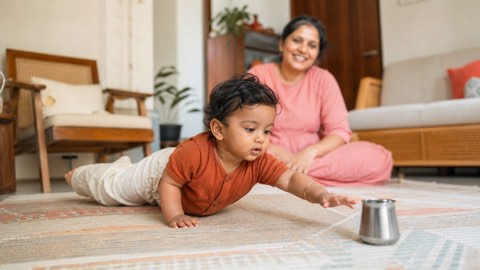
Teach the difference by acting it. Daytime: light, noise, activity — feeds in bright rooms, normal household sounds, chat and play after feeds. Night-time: dim, dull, boring — feed and change in low light, no play, no conversation, straight back down. Babies learn the contrast within weeks.
Get morning daylight on the baby (not direct sun in the eyes) — light is what sets the body clock. An evening routine, started even at six-eight weeks — malish or a wipe-down, feed, dim room, same order nightly — becomes the signal that the long sleep is coming.
Watch wake windows: a newborn manages only 45-90 minutes awake before overtiredness sets in, and an overtired baby fights sleep harder. Yawns, glazed staring, fussing and fist-rubbing mean the window is closing — settle the baby then, not an hour later.
Surviving the first three months
Sleep when the baby sleeps is easy to say and hard to do — but its cousin is doable: protect one adult sleep block. Split the night in shifts if there are two of you; hand the baby to the grandmother for one morning stretch; treat any offered pair of trusted hands as sleep, not as hosting.
Lower the bar on everything else. The first three months are a survival season, not a housekeeping season — food can be simple, visitors can wait, and the reply to 'is the baby sleeping through?' is 'no, because babies don't.'
Mother's sleep is a health item, not a luxury — sleep deprivation feeds low mood, and the postpartum weeks are already vulnerable ones. If the nights are broken and the mood is sinking, read our postpartum mental health guide and say it out loud to someone — including, if needed, Tele-MANAS at 14416, free and confidential.
When to see a doctor at once
Sleep itself is rarely the emergency — but go the same day if the baby is unusually hard to wake, limp, refusing feeds, breathing fast or with effort during sleep, or if a baby under three months has any fever. A marked change from your baby's normal pattern — suddenly sleeping far more and feeding far less — is a same-day question, not a lucky break.
This article is general information, not medical advice, and is no substitute for personal medical advice. For any decision about your or your child's health, please consult your doctor.
Frequently asked questions
My baby only sleeps when held and wakes the moment we put him down
trapped forever? — No; newborns surface briefly as they're transferred and settle faster into a warmed spot. Put the baby down drowsy-but-awake sometimes, wait out the first squirms, and accept that some held naps are simply the season. The habit loosens as the months pass.
Is a mosquito net safe over the cot?
Yes — a properly fitted net over the cot is good practice in most of India. The rules still apply inside it: firm flat surface, baby on the back, no loose cloth near the face, and the net taut and out of the baby's reach.
When do babies sleep through the night?
'Sleeping through' for a baby means a five-six hour stretch, and most reach that somewhere between three and six months — with plenty of normal exceptions and regressions after. Anyone promising a trained-through newborn is selling something.
The baby sleeps all day and parties all night
is something wrong? — Nothing is wrong; the womb ran on the opposite schedule (your daytime walking rocked the baby to sleep). Run the day-bright/night-boring plan consistently and the clock flips within a few weeks.
Sources
Every clinical figure on this page is taken from the guidelines below. Where our numbers and your doctor's differ, ask which guideline they follow.
- WHO. WHO Guidelines on physical activity, sedentary behaviour and sleep for children under 5 years of age (2019)Backs the claim that newborns (0–3 months) require 14–17 hours of sleep per 24 hours distributed across the day.
- NHS. How to reduce the risk of sudden infant death syndrome (SIDS) (2023)Supports the advice on back-sleeping, firm mattress, no pillows or quilts near the face, room-sharing for the first six months, avoiding bed-sharing when an adult smokes or has consumed alcohol or sedating medication, and using layers or a sleep sack instead of loose heavy blankets in cold weather.
Reviewed by
- Nakul Phatak — CEO, theAsianparent India & IndonesiaHead of theAsianparent India; father of one
- Roshni Chugani — Head of Marketing, theAsianparent India & Singapore12 years in the mother-and-baby space; mother of two
Published by: theAsianparent editorial team
Parents' Choice Awards 2026
Brands nominated and voted for by Indian parents.