Vomiting in children: what to do at home and when it is serious

Most vomiting is a stomach bug that ends in a day. The danger is not the vomiting itself — it is the fluid that leaves with it.
The common causes
Viral gastroenteritis is the usual one — vomiting for a day or so, often followed by diarrhoea, sometimes with fever. Food poisoning behaves similarly and comes on faster after a suspect meal.
In babies, small possets after feeds are reflux rather than illness and need no treatment if the baby is gaining weight and comfortable. Our reflux guide covers the difference.
Other causes worth knowing: a urinary infection (very often presents as vomiting with fever and nothing else in small children), an ear infection, coughing hard enough to vomit, motion sickness, and — importantly — a head injury, appendicitis or an obstruction, which are the ones that must not be missed.
Rehydrating at home
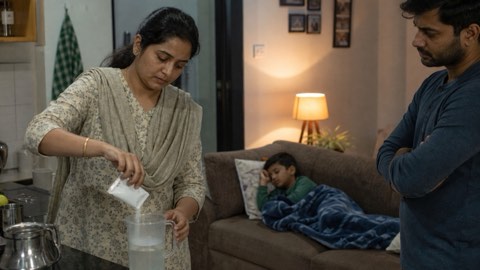
The method that works is small and constant: a teaspoon of ORS every one to two minutes for a small child, more for an older one. A glass at once comes straight back up; a spoonful every minute stays down and adds up to the same volume.
Wait ten to fifteen minutes after a vomit, then start the spoonfuls again. Breastfeeding continues throughout, in short frequent feeds.
Mix ORS exactly as directed — one sachet in one litre of clean boiled-and-cooled water. Do not make it 'stronger'. Avoid cold drinks, packaged juices and sugary drinks, which worsen fluid loss.
Food can wait a few hours but not a day: once vomiting settles, offer bland easy things — khichdi, curd rice, banana, toast, dal-rice. The old advice to starve the gut is wrong and delays recovery.
Anti-vomiting medicines are not for routine use in children. Some are unsafe in this age group and they can mask a serious cause. Use them only if a doctor prescribes them for your child.
The vomits that are different
Projectile vomiting in a baby under three months, forceful and after most feeds, with a hungry baby who is not gaining weight, needs assessment for pyloric stenosis — it is treatable and needs surgery.
Green or yellow-green (bile-stained) vomit at any age is an emergency: it can indicate a bowel obstruction.
Vomit with blood, or that looks like coffee grounds, is an emergency.
Vomiting after a head injury, or with severe headache, drowsiness, a stiff neck or a fit, is an emergency. So is vomiting with severe abdominal pain, particularly pain that has moved to the lower right — appendicitis in children is frequently missed early.
When to see a doctor
Emergency, 108 or straight to hospital: green vomit, blood in vomit, vomiting after a head injury, severe abdominal pain, a swollen rigid abdomen, a child who cannot be roused, a fit, difficulty breathing, or signs of severe dehydration — sunken eyes, no urine for eight hours, very dry mouth, floppy or unusually drowsy.
Same-day: any vomiting in a baby under three months, vomiting that will not stop for more than 12 hours, inability to keep any fluid down, fever with vomiting, vomiting with burning urination or back pain, or a child who has become listless.
This article is general information, not medical advice, and is no substitute for personal medical advice. For any decision about your or your child's health, please consult your doctor.
Frequently asked questions
My child vomits and then wants to eat immediately.
Wait fifteen minutes, start with sips of ORS, and if that stays down for half an hour, offer something bland and small. Feeding a full meal straight after usually produces a second vomit.
Can I give a home remedy
ajwain water, lemon, ginger? — Small sips of clear fluids are fine for older children, and ORS is what actually replaces what has been lost. Nothing goes to a baby under six months except breastmilk or formula.
How do I know it is not just reflux?
Reflux is effortless posseting in a comfortable, growing baby. Vomiting is forceful, the baby is unsettled, and other symptoms usually come with it.
When can they go back to school?
Once there has been no vomiting for 24 hours and they are eating and drinking normally. Handwashing at home matters — most of these bugs go round the whole family.
Sources
Every clinical figure on this page is taken from the guidelines below. Where our numbers and your doctor's differ, ask which guideline they follow.
- WHO. The Treatment of Diarrhoea: A Manual for Physicians and Other Senior Health Workers (2005)Backs the core ORS rehydration method — giving small, frequent amounts rather than large volumes at once, continuing breastfeeding throughout illness, and the instruction to mix one ORS sachet in exactly one litre of clean water without concentration changes.
- WHO. Pocket Book of Hospital Care for Children: Guidelines for the Management of Common Childhood Illnesses (2013)Backs the emergency dehydration signs listed on the page — sunken eyes, no urine, very dry mouth, floppiness/drowsiness — as criteria requiring urgent hospital assessment.
- NICE. Diarrhoea and vomiting caused by gastroenteritis in under 5s: diagnosis and management (CG84) (2009)Backs the advice that anti-vomiting medicines are not for routine use in children, that early refeeding with an appropriate diet (rather than gut rest) should begin once rehydration is established, and that breastfeeding should continue throughout illness.
Reviewed by
- Nakul Phatak — CEO, theAsianparent India & IndonesiaHead of theAsianparent India; father of one
- Roshni Chugani — Head of Marketing, theAsianparent India & Singapore12 years in the mother-and-baby space; mother of two
Published by: theAsianparent editorial team