Baby massage (malish): the tradition, the technique and the safety rules

Malish is one Indian tradition modern medicine broadly applauds — touch, warmth and attention, daily. Here is how to do it well: the oils, the strokes, the safety rules, and the myths gently retired.
Why malish earns its place
The daily oil massage is one of the Indian baby routine's best inheritances. Skin-to-skin touch calms babies measurably — settling breathing and heart rate, often improving sleep and digestion — and the ritual builds a daily block of one-on-one attention that both baby and masseur come to love.
What malish does not do is also worth saying at the start: it does not shape the nose, lengthen the limbs, straighten the legs, or thicken the hair. Babies' bodies grow by genetics, not by moulding. The massage is valuable for the touch, not the sculpting — pressing and pulling to 'shape' features is the one traditional element to drop entirely.
Start once the cord stump has fallen off and healed (usually one-two weeks). Before that, gentle touch without oil near the stump is fine.
Choosing the oil
Coconut oil is the workhorse — light, easily available, well tolerated, and the best-studied of the traditional options. Sesame (til) oil is the other traditional staple, especially in winter. Both are fine choices for most babies.
Skip mustard oil on baby skin — the tradition loves it, but it can irritate and disrupt a baby's delicate skin barrier. Skip olive oil too for regular use, for similar skin-barrier reasons. Never use adult products — balms, medicated oils, anything with camphor or menthol — on a baby.
Whatever the oil, patch-test first: a coin-sized dab on the thigh, wait a day, look for redness. And warm the oil in your palms, not on the stove — test it on your own inner wrist the way you'd test milk.
The technique, stroke by stroke
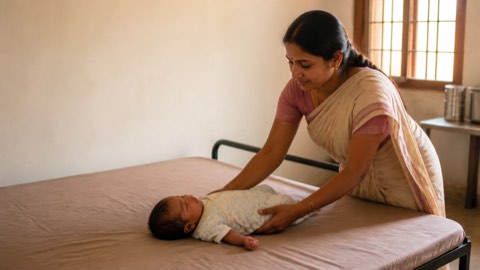
Set the scene: a warm draught-free room, a towel on your outstretched legs or a firm surface, baby undressed, your rings and bangles off, nails short, phone away. The best time is when the baby is calm and awake — not hungry, not just fed (wait 30-45 minutes after a feed), not crying to be rescued.
Legs first — they're the least sensitive introduction. Gentle strokes from thigh to ankle, a soft squeeze-and-glide like milking, thumbs circling the soles. Then arms the same way, shoulder to wrist. Chest: flat palms stroking outward from the centre. Tummy: gentle clockwise circles only (clockwise follows the gut) and skip it entirely if the cord area isn't fully healed.
Back: baby on the tummy across your legs, long strokes from neck to bottom. Face needs almost nothing — the lightest fingertip strokes, and never press the nose, ears or fontanelle (the soft spot — oil touching it is fine, pressure is not). Ten to fifteen minutes total is plenty; stop earlier if the baby protests. A massage is a conversation, not a procedure — crying means stop, not press on.
When to skip, and the dai question
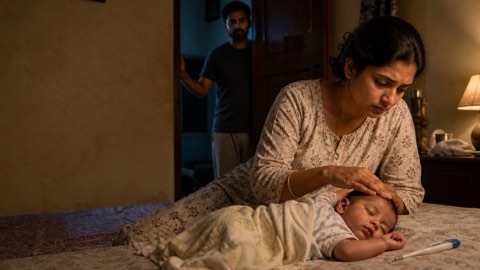
Skip the massage when the baby is unwell or feverish, just vaccinated (skip the injection site for a day or two), or has broken, raw or infected skin. On eczema-prone skin, ask your doctor first — some oils help, some worsen it.
Many families hire a traditional masseuse (dai/maalishwali) — often wonderful, sometimes trained in exactly the vigorous techniques to avoid. Watch the first sessions: strokes should be gentle (a baby is not a dough ball), no joint-cracking, no nose-pulling, no holding the baby upside down, no oil drops in the nose or ears, and no massaging a crying baby through the protest. A good dai adapts happily; one who insists the rough version is necessary is the wrong hire.
Bath after massage is the classic sequence and it's fine — warm water, quick, and the baby dried and dressed before it chills. In cold weather, massage-and-bath can be every other day; the massage matters more than the bath.
Frequently asked questions
Morning or evening
when is the best time for malish? — Whenever the house is calm and the baby is in the calm-awake mood — the tradition's late-morning slot (massage, bath, feed, long nap) works beautifully, and an evening massage folded into the bedtime routine helps night sleep. The consistency matters more than the clock.
Does massage help colic?
The tummy strokes and bicycle-legs help some babies pass gas, and the calming touch helps the evening fussing hours — worth doing. It is not a cure for colic, because nothing reliably is; colic peaks around six weeks and fades by three-four months on its own.
Should oil be put in the baby's nose, ears or navel?
No. Oil drops in the nose or ears do no good and can do harm — the tradition's 'cleansing' drops are one to retire. A trace of oil on the outer ear and healed navel during massage is harmless; pouring is not.
My mother-in-law's malish is much more vigorous than this
how do I object without a war? — Borrow the doctor's authority rather than spending your own: 'the doctor said gentle strokes only, no pulling' ends most arguments. Praise the ritual, redirect the technique — the goal is her daily massage with your safety rules, which is the best of both generations.
Sources
Every clinical figure on this page is taken from the guidelines below. Where our numbers and your doctor's differ, ask which guideline they follow.
- WHO. Kangaroo Mother Care: A Practical Guide (2003)Supports the claim that skin-to-skin touch calms babies by settling breathing and heart rate, and improves sleep — consistent with WHO evidence on touch and neonatal stabilisation.
- AAP. Safe Sleep and Skin Care Guidance (HealthyChildren.org: Baby Skin Care) (2023)Supports guidance to avoid adult products, medicated balms, camphor, and menthol on infant skin, and to be cautious with oils on baby's delicate skin barrier.
- NICE. Postnatal Care (NG194) (2021)Supports advice to wait until the cord stump has fully healed before beginning oil massage, and the general principle that the cord stump area should not be disturbed.
- NIH. Infant Massage: Health Benefits, Safety, and Techniques (MedlinePlus) (2022)Supports claims that infant massage can aid relaxation and gas relief, that colic resolves on its own by around three to four months, and the caution against applying oil inside the nose or ears.
- IAP. IAP Guidelines on Neonatal Skin Care (2016)Supports recommending coconut and sesame oil as preferred choices for Indian infant massage, and advising against mustard oil and olive oil due to their potential to disrupt the neonatal skin barrier.
Reviewed by
- Nakul Phatak — CEO, theAsianparent India & IndonesiaHead of theAsianparent India; father of one
- Roshni Chugani — Head of Marketing, theAsianparent India & Singapore12 years in the mother-and-baby space; mother of two
Published by: theAsianparent editorial team