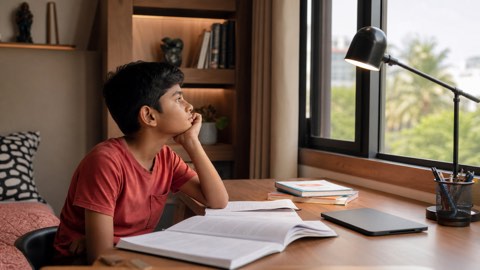
Your child at 9: bigger world, first privacy, early puberty for some

Nine is the last year of clear childhood for many children. Bodies begin changing for some, and the door starts closing — literally.
What changes this year
Thinking becomes abstract enough for hypothetical questions, moral arguments and genuine debate. Interests deepen and children begin to identify with them — a swimmer, an artist, someone who is good at maths.
Bodies: some girls begin puberty — breast buds, a growth spurt, body odour — from around eight to nine. Boys usually start later. Both need to have heard about it before it happens.
Privacy arrives: wanting the bathroom door closed, a diary, time alone, and conversations with friends that are not for you. This should be respected, within safety limits.
Friendships become intense and social hierarchies appear, particularly among girls. Exclusion is the main currency, and it hurts.
Puberty and body talk
Tell girls about periods well before they can happen — by eight or nine, in plain terms, with a pouch of two pads and spare underwear in the school bag from around a year before you expect it.
Tell boys too, and tell boys about wet dreams and erections before they occur. Unexplained, they cause shame; explained, they are a non-event.
Body odour, acne and a growth spurt all arrive quietly. Handle deodorant and hygiene privately and kindly, never as a family joke.
Keep the tone matter-of-fact, and repeat in small doses rather than delivering one big talk. Our puberty guides for girls and boys have the sequence and the ages.
Read next


Screens, school and health
Online life becomes real now — games with chat, videos, and often a first request for social media, which most platforms do not permit under thirteen. Set the rules while you still can: devices out of the bedroom, no accounts without your knowledge, and the standing promise that telling you about a problem will not be met with punishment.
School workload rises. Teach planning — a weekly chart of tests and submissions, filled in by the child — rather than managing it for them.
Health: annual check, haemoglobin (particularly for girls once periods begin), vision and hearing, dental every six months, and the HPV vaccine, which is recommended for both girls and boys from around nine and is best given before adolescence. Ask your paediatrician.
Sleep: 9-12 hours, and it is usually the first thing sacrificed to homework and screens.
When to see a doctor
Same-day at any age: difficulty breathing, a fit, a child who is drowsy or confused, severe abdominal pain, a head injury with vomiting or drowsiness, a rash that does not fade when pressed, or dehydration. Call 108 for breathing difficulty.
At nine to ten specifically: puberty signs before age eight in girls or nine in boys; persistent stomach aches or headaches on school mornings; withdrawal from friends; a marked drop in school performance; disordered eating or preoccupation with weight; or any talk of self-harm.
And treat any talk of self-harm or not wanting to live as an emergency at any age: stay with the child, remove means of harm, and get help the same day. Tele-MANAS on 14416 is free and round the clock; Childline is 1098.
This article is general information, not medical advice, and is no substitute for personal medical advice. For any decision about your or your child's health, please consult your doctor.
Frequently asked questions
My daughter has breast buds at nine. Is that early?
Within the normal range, which starts at eight. Before eight needs assessment. Prepare her rather than worrying her.
He wants to close his door all the time.
Normal and healthy. Respect it with the rule that the door is not locked and you may knock and enter when needed.
Should she have social media?
Most platforms require thirteen, and later is easier. If the answer is no, say so plainly and offer messaging with known family and friends instead.
How do I know if it is normal moodiness or something more?
Duration and function. A mood that lifts is moodiness; two weeks or more of low mood, withdrawal, sleep or appetite change, or falling performance needs attention.
Sources
Every clinical figure on this page is taken from the guidelines below. Where our numbers and your doctor's differ, ask which guideline they follow.
- WHO. WHO Guidelines on Physical Activity, Sedentary Behaviour and Sleep for Children under 5 Years of Age / Global recommendations on physical activity for health (sleep guidance for school-age children) (2020)Backs the page's recommendation of 9–12 hours of sleep per night for children in this age group.
- AAP. Pediatric Clinical Practice Guidelines & Policies: Bright Futures / Sleep in Adolescents (2016)Supports the recommendation for 9–12 hours of nightly sleep for 9-year-olds and the framing of sleep as the first thing sacrificed to screens and homework.
- IAP. IAP Recommended Immunization Schedule for Children Aged 0 Through 18 Years — India, 2022 (2022)Supports the HPV vaccination recommendation starting around age nine for Indian children, consistent with the Indian immunization schedule context of this page.
- NICE. Depression in children and young people: identification and management (NG134) (2019)Backs the page's clinical guidance that two or more weeks of low mood, withdrawal, sleep or appetite change, or falling performance in a child warrants professional attention rather than being attributed to normal moodiness.
Reviewed by
- Nakul Phatak — CEO, theAsianparent India & IndonesiaHead of theAsianparent India; father of one
- Roshni Chugani — Head of Marketing, theAsianparent India & Singapore12 years in the mother-and-baby space; mother of two
Published by: theAsianparent editorial team