Pain relief in labour: epidurals, injections and the drug-free methods

Labour pain relief in India ranges from an epidural on request to nothing at all, depending on the hospital. Deciding what you want — and where it is available — is a third-trimester job.
The epidural
An anaesthetist places a fine catheter in the lower back and delivers local anaesthetic around the nerves, numbing the lower body while you stay awake. It is the most effective labour pain relief available, and it can be topped up or converted for a caesarean if one becomes necessary.
It is usually offered once labour is established, and can be given later than many people expect. Modern low-dose ('mobile') epidurals allow more sensation and movement than older ones.
Real considerations: it requires an anaesthetist available round the clock, which not every Indian hospital has — this is the question to ask when choosing where to deliver. It can lower blood pressure, sometimes causes a temporary inability to pass urine (requiring a catheter), may lengthen the pushing stage slightly, and carries a small risk of a headache afterwards. It does not, on current evidence, increase the caesarean rate.
Cost varies substantially between hospitals and is often not included in the standard package — ask for the figure in advance rather than at the billing counter.
Other medical options
Injectable opioids (pethidine, tramadol or similar) are widely used in Indian hospitals. They take the edge off rather than removing pain, can cause drowsiness and nausea in the mother, and can make the baby sleepy if given close to delivery — which sometimes affects the first feed.
Nitrous oxide (gas and air), common in some countries, is available in relatively few Indian hospitals. Where available, it is self-administered, wears off quickly and is a reasonable middle option.
Local anaesthetic is used for stitching a tear or episiotomy, and a spinal block is used for planned caesareans — a single injection rather than a catheter, and one of the reasons most caesareans are done with the mother awake.
Methods without drugs
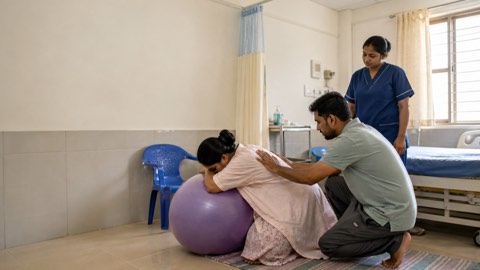
Movement and position: staying upright and mobile, changing position often, using a birthing ball, leaning forward during contractions, and avoiding lying flat on the back. This is the most underused and most effective non-drug approach.
Water: a warm shower or bath during labour reduces pain perception meaningfully. Ask whether the hospital allows it.
Breathing and focus: slow breathing with a longer out-breath, counting through contractions, and a focal point. These do not eliminate pain — they manage the panic that amplifies it, which is the point.
Touch and support: massage, firm counter-pressure on the lower back during contractions, heat packs, and above all a continuous support person. Continuous labour support is associated with shorter labour, less pain relief needed and better satisfaction — one of the strongest findings in obstetric research.
Deciding in advance
Ask these questions at around 34-36 weeks: is an anaesthetist available 24x7 for epidurals; what does an epidural cost; what other pain relief is routinely offered; can I move around, use a ball, or shower in labour; and can my husband or another support person stay with me throughout.
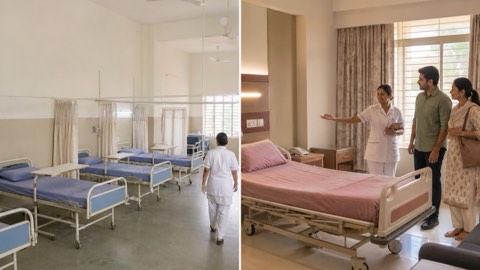
The answers vary enormously between a metro private hospital and a district facility, and they should influence where you plan to deliver — more than the decoration of the room.
Keep the decision flexible. Many women plan to avoid an epidural and change their mind, and many plan to have one and find they do not need it. Neither is a failure, and the decision made in labour is a legitimate one.
When to see a doctor
Tell staff immediately during labour about: severe unrelenting pain between contractions, sudden severe abdominal pain, heavy bleeding, feeling faint, or numbness or weakness that seems wrong after an epidural.
After delivery, seek same-day care for: a severe headache that is worse when sitting or standing and better lying flat (this can follow an epidural or spinal and is treatable), fever, back pain with fever, or leg weakness. And go immediately with any chest pain, breathlessness or one-sided calf swelling.
This article is general information, not medical advice, and is no substitute for personal medical advice. For any decision about your or your child's health, please consult your doctor.
Frequently asked questions
Does an epidural cause permanent back pain?
The evidence does not support it. Back pain after childbirth is very common with or without an epidural, and is mostly explained by pregnancy posture, relaxin and carrying a baby. Temporary tenderness at the insertion site is normal.
Is 'painless delivery' the same as an epidural?
Yes — it is the marketing term Indian hospitals use for epidural analgesia. It reduces pain substantially rather than abolishing all sensation; you should still feel pressure and be able to push.
Will pain relief harm my baby?
Epidurals deliver medication mainly to the local nerves and very little reaches the baby. Injected opioids do reach the baby and can cause sleepiness — which is why they are avoided close to delivery. Discuss timing with your doctor.
My family says enduring the pain is better for the baby.
There is no medical benefit to unrelieved pain, and severe pain and panic can slow labour. Choosing pain relief is a medical decision, not a test of character.
Sources
Every clinical figure on this page is taken from the guidelines below. Where our numbers and your doctor's differ, ask which guideline they follow.
- NICE. Intrapartum care for healthy women and babies (CG190) (2014)Backs the claims that epidurals do not increase the caesarean rate, may lengthen the pushing stage, can lower blood pressure and cause urinary retention, and that continuous labour support is associated with shorter labour and reduced need for pain relief.
- WHO. WHO Recommendations: Intrapartum Care for a Positive Childbirth Experience (2018)Backs the recommendation for continuous labour support (associated with better outcomes and satisfaction), upright and mobile positioning during labour, and the use of epidural analgesia as effective pain relief when an anaesthetist is available.
- NHS. Epidural (for labour and childbirth) (2023)Supports the description of post-dural puncture headache (worse on sitting/standing, better lying flat) as a known complication of epidural or spinal anaesthesia that is treatable, and the note that epidural medication reaches the baby in very small amounts compared with injected opioids.
- ACOG. Labor Pain (FAQ086) (2019)Supports the claim that there is no medical benefit to unrelieved labour pain, that epidurals are the most effective form of labour pain relief, and that injected opioids such as pethidine can cause neonatal sleepiness and affect early feeding.
- NIH. Epidural Analgesia and Caesarean Delivery (MedlinePlus / NICHD evidence summary) (2017)Supports the claim that current evidence does not show an increased caesarean rate with epidural analgesia, and backs the note that back pain after childbirth is common regardless of whether an epidural was used.
Reviewed by
- Nakul Phatak — CEO, theAsianparent India & IndonesiaHead of theAsianparent India; father of one
- Roshni Chugani — Head of Marketing, theAsianparent India & Singapore12 years in the mother-and-baby space; mother of two
Published by: theAsianparent editorial team