The stages of labour, explained plainly

Labour is not one event but a sequence, and knowing the sequence removes most of the fear. Here is what happens, in what order, and roughly how long each part takes.
First stage: early labour
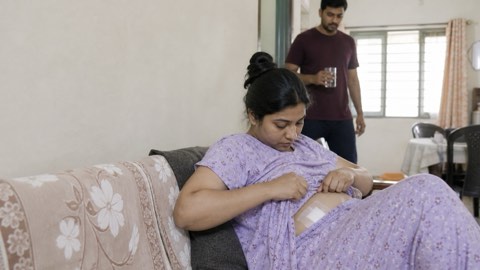
The cervix softens, thins and opens to about 4-6 cm. Contractions start irregular, ten to twenty minutes apart, lasting under a minute, and gradually become closer and stronger. The mucus plug may come away, sometimes blood-tinged.
This is the longest phase, especially in a first baby — it can run six to twelve hours or considerably more, and much of it is best spent at home if your doctor agrees: walking, eating light food, drinking, resting between contractions, and having a warm bath or shower.
The common first-baby rule for leaving for hospital is 5-1-1: contractions five minutes apart, lasting a minute, for an hour. Go immediately regardless of the pattern if the waters break, there is bright-red bleeding, reduced fetal movements, or your doctor has told you to come earlier because of distance or your history.
First stage: active labour and transition
Active labour takes the cervix from about 6 cm to fully open at 10 cm. Contractions come every three to five minutes, last around a minute, and demand full attention — you will not be able to talk through them.
This phase typically runs four to eight hours in a first baby and is faster in later ones. It is when breathing technique, position changes, movement, a birth partner's support, and pain relief if wanted all earn their place. Upright and mobile positions generally help labour progress; lying flat on the back is the least helpful position.
Transition is the last stretch to 10 cm — the most intense part, often with shaking, nausea, and a strong feeling of not being able to continue. It is short (usually 15 minutes to an hour) and its arrival means the end is close. Birth partners: this is the moment to be calm and present, not to ask questions.

Second stage: pushing and birth
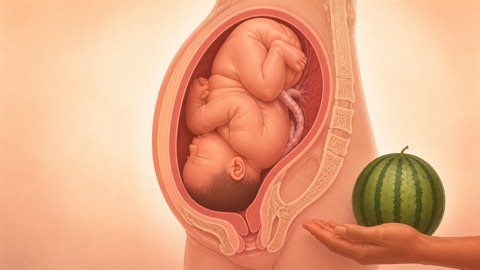
From full dilation to the birth of the baby. There is often an overwhelming urge to push. Typically twenty minutes to two hours in a first baby, shorter afterwards, and often less exhausting than women expect after transition — many describe it as a relief to have something to do.
The medical team will guide the pushing, ask you to slow down as the head crowns (which reduces tearing), and may perform an episiotomy if indicated — it should be discussed rather than routine, and you can ask beforehand what the hospital's practice is.
Then the baby is born, and — where all is well — should come straight onto your chest for skin-to-skin contact, with the first feed within the hour. Say this in advance; ask your birth partner to advocate for it while you are occupied.
Third stage: the placenta, and the hours after
The placenta is delivered within about five to thirty minutes, usually with an injection to speed it and reduce bleeding — this is standard practice and it substantially lowers the risk of postpartum haemorrhage. Any tear or episiotomy is stitched under local anaesthetic.
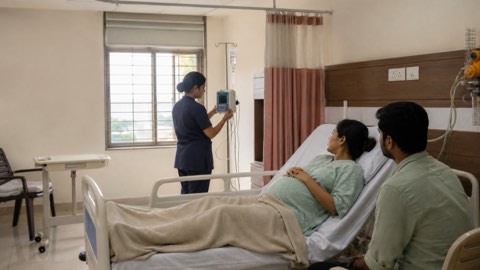
Expect shaking, shivering, intense hunger and thirst — all normal. Staff will check your bleeding, blood pressure and uterine firmness repeatedly in the first hours, which is when the greatest risk of haemorrhage lies.
The baby gets vitamin K, a first check, weighing and identification bands — ideally after that first hour of skin-to-skin. Ask for the checks to be done on your chest where possible.
When to see a doctor
Go to hospital immediately, at any point in pregnancy or labour: waters breaking (a gush or a steady trickle), bright-red bleeding, contractions five minutes apart or continuous severe pain, severe headache with visual changes, reduced or absent fetal movements, or a fit. Use 108 for an ambulance if transport is a problem.
During labour, tell the staff at once about: severe unremitting pain between contractions, heavy bleeding, feeling faint, or greenish fluid when the waters break (meconium, which needs monitoring). Trust your instinct and speak up; you are not being difficult.
This article is general information, not medical advice, and is no substitute for personal medical advice. For any decision about your or your child's health, please consult your doctor.
Frequently asked questions
What does labour pain actually feel like?
Most women describe waves: a tightening that builds to a peak and fully releases, with genuine rest in between. The rests are what the stories leave out. Breathing training is about riding the peaks and using the gaps.
How will I know it is real labour and not false?
Real labour progresses: contractions get closer, longer and stronger, and do not stop with rest, a bath or water. False labour retreats when conditions change. If a pattern holds for an hour, call the labour room and read them the timings.
Can I eat and drink during labour?
Practice varies by hospital. Light food and fluids in early labour are generally fine and helpful; many hospitals restrict food in active labour in case of an emergency caesarean. Ask your hospital's policy in advance.
Who can be with me?
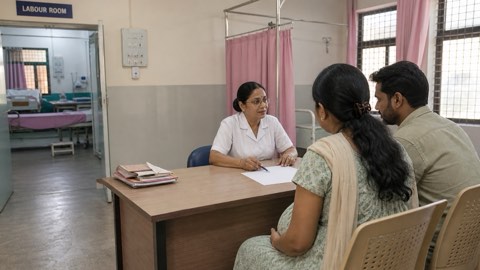
Policies differ widely between Indian hospitals — some allow a birth companion throughout, others restrict entry to the labour room. Ask well before the due date, because the answer may influence where you deliver; a supportive companion measurably improves labour outcomes.
Sources
Every clinical figure on this page is taken from the guidelines below. Where our numbers and your doctor's differ, ask which guideline they follow.
- WHO. WHO recommendations: intrapartum care for a positive childbirth experience (2018)Supports the claim that active labour begins at approximately 6 cm dilation, that upright and mobile positions help labour progress, that episiotomy should not be routine, that skin-to-skin contact should occur immediately after birth, and that a supportive birth companion improves labour outcomes.
- WHO. WHO recommendation on uterotonics for the prevention of postpartum haemorrhage (2018)Supports the claim that an injection (uterotonic) is standard practice after delivery of the baby to speed placental delivery and substantially reduce the risk of postpartum haemorrhage.
- NICE. Intrapartum care for healthy women and babies (CG190) (2014)Supports the description of the stages and phases of labour including cervical dilation thresholds, typical durations of first and second stage in nulliparous women, transition characteristics, second-stage pushing guidance including slowing at crowning to reduce tearing, and monitoring in the immediate postpartum period for bleeding and haemorrhage.
- WHO. Infant and young child feeding (Fact sheet) (2023)Supports the recommendation that the first breastfeed should occur within the first hour after birth and that skin-to-skin contact should be initiated immediately where mother and baby are well.
Reviewed by
- Nakul Phatak — CEO, theAsianparent India & IndonesiaHead of theAsianparent India; father of one
- Roshni Chugani — Head of Marketing, theAsianparent India & Singapore12 years in the mother-and-baby space; mother of two
Published by: theAsianparent editorial team