Postpartum warning signs: what should never wait until morning

Most maternal deaths in India happen after the delivery, not during it — and most of them follow signs that were noticed and waited on. This is the list that should be on the fridge.
Bleeding
Normal: bleeding that is heavy for the first days, then reduces and changes colour from red to pink-brown to yellowish-white over four to six weeks, with the occasional small clot early on and a temporary increase after exertion or feeding.
Go now: soaking a pad in an hour or less; bleeding that had settled and suddenly turns bright red and heavy again; clots larger than a lemon; bleeding with dizziness, breathlessness, a racing heart or feeling faint.
Postpartum haemorrhage is the leading cause of maternal death in India, and it can occur days or weeks after delivery, not just in the first hours. Treat sudden heavy bleeding as an emergency and call 108 if you cannot travel quickly.
Infection, clots and blood pressure
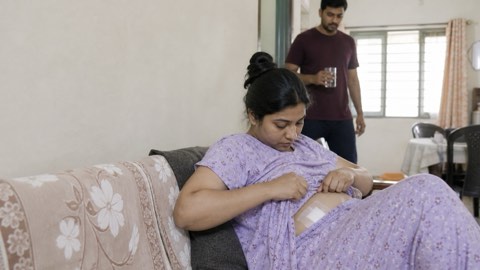
Infection: fever of 38°C or more, chills, foul-smelling vaginal discharge, severe abdominal or pelvic pain, or a caesarean wound that is red, hot, swollen, opening or leaking. Also burning urination with fever or back pain. All same-day.
Clots: one-sided calf pain, swelling, redness or warmth; chest pain; sudden breathlessness; coughing blood. The risk of clots is raised for about six weeks after delivery and is highest after a caesarean. These are emergencies — 108, immediately.
Blood pressure: pre-eclampsia can appear or worsen after delivery, up to six weeks later. Severe headache that does not go with paracetamol, visual disturbance (flashes, spots, blurring), pain under the ribs on the right side, sudden swelling of the face and hands, vomiting, or a fit — all mean immediate hospital.

Breasts, bladder, bowels
Mastitis: a hard, red, painful wedge-shaped area in the breast with fever and flu-like aching. Same-day — it needs antibiotics, and feeding from that breast should continue rather than stop. Untreated it can become an abscess.
Bladder: inability to pass urine, or passing only small amounts with a full-feeling bladder; burning with fever; or complete inability to control urine. Same-day.
Bowels: no bowel movement for several days with a distended painful abdomen; inability to control stool or wind, which is often hidden through embarrassment and needs prompt treatment.
Mental health, and using the system
Emergency: any thought of harming yourself or your baby, feeling you cannot keep the baby safe, hearing or seeing things that others do not, confusion, or not sleeping at all for days. Postpartum psychosis is rare, develops fast, and is a psychiatric emergency with excellent treatment — go the same day, and call Tele-MANAS on 14416 or 112.
Book help promptly for: low mood, hopelessness, panic, or anxiety that persists beyond two weeks after delivery. Postpartum depression affects around one in five Indian mothers and responds well to treatment.
Use the system that exists: the ASHA worker's home visits (days 3, 7, 14, 21, 28 and 42) are designed to catch these signs; the six-week postnatal check covers bleeding, blood pressure, wound healing, mood and contraception; and 108 provides free emergency transport. Put the hospital's number, the doctor's number, 108 and 14416 on the fridge before the delivery.
When to see a doctor
Go to hospital immediately for: heavy bleeding or large clots; fever with chills; foul discharge; a wound that is opening or discharging; severe headache with visual changes or a fit; one-sided calf pain or swelling; chest pain or breathlessness; inability to pass urine; a hard, red, painful breast with fever; or any thought of harming yourself or the baby. When in doubt, go — the cost of an unnecessary trip is far lower than the cost of waiting.
This article is general information, not medical advice, and is no substitute for personal medical advice. For any decision about your or your child's health, please consult your doctor.
Frequently asked questions
How much bleeding is too much?
Soaking a full-size pad in an hour, or bleeding that increases rather than decreases after the first week. Keep a mental note of how often you are changing pads; a sudden change in that rate is the signal.
I feel unwell but cannot describe why. Should I go?
Yes. Mothers are frequently right about this, and 'something is wrong' is a legitimate reason to be checked. Take your discharge summary and any medicines with you.
My family says I should not go out of the house during the confinement period.
Confinement customs are about rest and avoiding infection, not about refusing medical care. Any of the warning signs above overrides every custom, in every family.
What if the hospital is far or I have no transport?
108 is a free national ambulance service, and in most states it will come. Save the number, and ask the ASHA worker in advance about the local arrangement — that is exactly the kind of question she can answer before you need it.
Sources
Every clinical figure on this page is taken from the guidelines below. Where our numbers and your doctor's differ, ask which guideline they follow.
- WHO. WHO Recommendations for Prevention and Treatment of Postpartum Haemorrhage (2012)Backs the claim that postpartum haemorrhage is a leading cause of maternal death and that heavy bleeding with systemic symptoms (dizziness, breathlessness, racing heart) constitutes an emergency.
- WHO. WHO Recommendations on Postnatal Care of the Mother and Newborn (2013)Backs the schedule of postnatal contacts (days 3, 7, 28, and the six-week check) and the clinical signs requiring urgent review including fever, foul discharge, wound complications, mood changes, and blood pressure concerns.
- NICE. Postnatal Care (NG194) (2021)Backs the specific warning signs for postpartum haemorrhage, infection (fever ≥38°C, foul-smelling discharge, wound dehiscence), DVT/VTE (one-sided calf pain, swelling, chest pain, breathlessness), post-delivery pre-eclampsia (severe headache unresponsive to paracetamol, visual disturbances, right upper quadrant pain, sudden facial/hand swelling, seizure), mastitis management (continue feeding, antibiotics needed), urinary retention, and postpartum depression persisting beyond two weeks.
Reviewed by
- Nakul Phatak — CEO, theAsianparent India & IndonesiaHead of theAsianparent India; father of one
- Roshni Chugani — Head of Marketing, theAsianparent India & Singapore12 years in the mother-and-baby space; mother of two
Published by: theAsianparent editorial team