Pregnancy week 39: full term — any day now, officially

Full term. This is the window everything aimed at — the baby complete, the body ready, the bag packed. Time to walk the stages of labour once in the head, so the day itself holds no strangers.
Walking the day in advance
Thirty-nine to forty-one weeks is 'full term' — the optimal exit window that the whole nine months aimed for. From here, labour any day is not early, not late, but exactly on time.
The most useful thing left to do costs nothing: walk through the day once in your head, stage by stage, so nothing on the actual day is a stranger. Early labour: irregular-becoming-regular pains, hours long, best spent at home upright and breathing — per your doctor's come-in threshold. Active labour: the organised, demanding phase, at the hospital, where the breathing training earns its keep. Pushing: shorter than feared, guided throughout. Then: a baby on your chest.
And plan the first hour now, out loud: skin-to-skin as soon as possible, the first feed within the hour (colostrum — the thick yellow first milk — is the entire intended menu), weighing and everything else after. Say it to your escort so someone advocates for it while you're busy being amazed.
Your baby this week
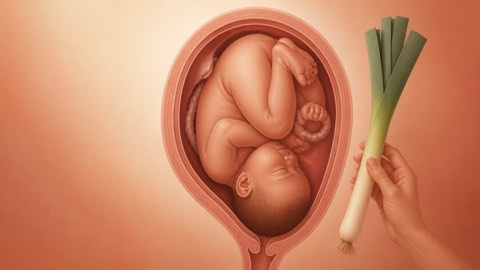
The baby is about fifty centimetres and three to three and a half kilos — birth-sized, birth-ready. Fat now runs the thermostat; the lungs sit stocked for the first breath.
The umbilical cord — the whole story's supply line — is preparing for retirement; after birth it's clamped, painlessly, and its stub falls off in the first weeks.
The baby's stress hormones near birth run high by design — they're what kick-start the lungs and alertness at delivery. Newborns arrive wide-eyed for exactly this reason; the first hour's gaze is chemistry doing its job.
Read next

Changes in your body
The cervix may be dilating quietly — two-three centimetres can accumulate without organised labour. Every practice run is real preparation now; the body is not wasting a single rehearsal.
The 'is this it?' question may fire daily. The test never changes: progression. Time them when they organise; call when a pattern holds an hour; go on the go-now list.
Eat normally, walk daily, rest in instalments. Some doctors suggest light perineal massage from these weeks — ask before starting. And keep drinking water; dehydrated muscles cramp, including that one.
What to do this week
Rehearse the first-hour plan aloud with your escort: skin-to-skin, feed within the hour, calls and photos after. One sentence to the duty staff on arrival — 'we'd like immediate skin-to-skin and the first feed before anything routine' — sets it up.
Confirm this week's visit and the post-date monitoring schedule — from forty weeks the checks (count, NST, fluid) usually step up in frequency; know your hospital's version in advance.
Pre-draft the announcement message and the not-yet reply ('No news, all well — we'll tell YOU') — the daily aunty-network deserves a warm auto-response that costs you nothing.
Last hardware check: phone charged nightly, vehicle fuelled or auto-driver's number saved, 108 known, bag untouched by helpful reorganisers. Then back to the job description: eat, walk, count, sleep, wait.
Week 39 at a glance
The week's essentials in one place. Your doctor may adjust these for your situation.
| Item | In week 39 |
|---|---|
| Main event | Full term — the optimal window |
| Baby's size | ~50 cm, 3-3.5 kg — birth-ready |
| Mental prep | Stages walked once; no strangers on the day |
| First hour | Skin-to-skin + first feed — said aloud, assigned |
| Possible signs | Quiet dilation, daily 'is this it?' |
| From week 40 | Monitoring steps up — know the schedule |
| Hardware | Phone, vehicle, 108, bag — checked |
When to see a doctor at once
Go-now, unchanged: waters, bright-red bleeding, five-minute pains, severe headache with vision changes, failed or slumped count. Call-first: organised tens, slow counts, fever, burning, any unease. The count runs to the last morning.
Post-date is not an emergency but it is a schedule: from the due date, expect stepped-up monitoring, and know that most hospitals discuss induction somewhere between forty-one and forty-two weeks on specific indications. That conversation is routine care, not alarm — but skipping the monitoring visits is how routine gets missed.
This article is general information only and no substitute for personal medical advice. The person who can advise you knowing your health, your medicines and your previous pregnancies is your obstetrician, or the doctor at your nearest health centre.
Work out your due date
Enter the first day of your last period and your cycle length — your estimated due date, this week's count and the anomaly scan window all appear right here.
It is only an estimate — most babies aren't born on the exact date. A first-trimester scan dates a pregnancy more accurately; in the end, your doctor's date is the one that counts.
Frequently asked questions
What does labour pain actually feel like
honestly? — Most describe waves: a tightening that builds to a peak and fully releases, like the worst period cramp plus a band of pressure, with genuine rest between waves. The between-wave rest is the secret the stories skip — you get breaks the whole way. Breathing training is about riding the peaks and using the rests.
When exactly do we leave for the hospital?
Your doctor's threshold rules (it varies by distance and history), but the common first-baby rule is 5-1-1: contractions five minutes apart, lasting one minute, for one hour. Waters or bleeding: immediately, pattern or not. When unsure, call the labour room — deciding is literally their job.
Epidural
should I decide in advance? — Know your hospital's answer in advance (is it available 24/7? what's the window?), but the decision itself can wait for the day — plenty of women decide in active labour, both directions. Wanting it isn't weakness; declining it isn't heroism. It's logistics plus preference, nothing more.
What actually happens in the first hour after birth?
In the usual happy version: baby to your chest, dried and covered on you; the first feed nudged into place; cord clamped; weighing, vitamin K injection and checks — ideally after the skin-to-skin. The baby is alert, staring, memorising your face with womb-trained ears hearing the known voices. It is, by broad testimony, the best hour there is.
Sources
Every clinical figure on this page is taken from the guidelines below. Where our numbers and your doctor's differ, ask which guideline they follow.
- WHO. WHO recommendations: intrapartum care for a positive childbirth experience (2018)Backs the page's recommendations on skin-to-skin contact immediately after birth, initiation of breastfeeding within the first hour, and delayed cord clamping as standard intrapartum care.
- WHO. Preterm birth fact sheet / WHO recommendations on antenatal care for a positive pregnancy experience (2023)Supports the page's definition of 39–41 weeks as full term and the description of the baby's approximate size and weight at term (≈50 cm, 3–3.5 kg).
- ACOG. ACOG Committee Opinion No. 764: Medically Indicated Late-Preterm and Early-Term Deliveries (2019)Supports the page's statement that 39–41 weeks is the optimal full-term window and that delivery before 39 weeks without indication is not recommended.
- ACOG. ACOG Practice Bulletin No. 107: Induction of Labor (2009)Supports the page's statement that most hospitals discuss induction between 41 and 42 weeks and that stepped-up post-date monitoring (NST, fluid assessment) is routine care.
- NICE. Intrapartum care for healthy women and babies (CG190) (2023)Supports the page's description of the 5-1-1 contraction rule for hospital admission, active labour management, and the recommended first-hour care sequence (skin-to-skin, early breastfeeding, vitamin K injection, weighing after skin-to-skin).
- IAP. IAP Guidelines on Newborn Care and Breastfeeding (2020)Supports the page's guidance that colostrum is the sole intended feed in the first hour, and that routine newborn procedures (weighing, checks) should follow rather than interrupt initial skin-to-skin and the first breastfeed.
Reviewed by
- Nakul Phatak — CEO, theAsianparent India & IndonesiaHead of theAsianparent India; father of one
- Roshni Chugani — Head of Marketing, theAsianparent India & Singapore12 years in the mother-and-baby space; mother of two
Published by: theAsianparent editorial team