Formula feeding: choosing, preparing safely, and doing it without guilt

Formula exists for good reasons and feeds healthy babies every day. What matters is preparing it correctly — that part is not optional, and most of the risk lives there.
When formula is the right answer
Low supply that has not responded to proper lactation help, certain maternal medicines or illnesses, adoption, a mother returning to work without expressing options, twins where supply cannot keep up, or simply a mother who has decided — all real reasons. A fed baby with a functioning mother is the goal; the route is secondary.
What matters is that the decision is informed rather than accidental. Most 'not enough milk' is fixable with feeding frequency and latch help, so get one proper lactation consultation before switching — and if you still switch, do it without apology.
Mixed feeding — breast plus formula — is common and workable. Expect supply to drop in proportion to feeds replaced, so if you want to keep breastfeeding going, keep the breast feeds regular and use formula for specific gaps rather than randomly.
Preparing it safely
Wash hands. Boil clean water and let it cool to around 70°C — hot enough to kill bacteria in the powder, which is not sterile. Pour the measured water into a sterilised bottle first, then add the exact number of scoops from the tin's own scoop, levelled, never packed or heaped.
The ratio is not negotiable. Extra water to stretch a tin starves the baby; extra powder to 'strengthen' it overloads immature kidneys and causes dehydration. Follow the tin, exactly.
Cool the bottle quickly under running water and test on your wrist. Feed within two hours; throw away what the baby leaves — saliva has entered the bottle and bacteria grow fast in Indian temperatures. Never microwave (hot spots burn mouths), never prepare a night's worth and leave it out, and never carry made-up feeds on long journeys — carry measured powder and boiled water separately, mixed at the feed.

Bottles, sterilising and quantities
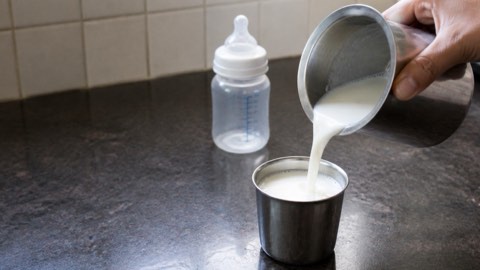
Sterilise everything — bottles, teats, rings, caps — for the first year. Boiling is free and effective: scrub with a bottle brush and detergent first, rinse, then boil submerged for five to ten minutes, and store covered in a clean, dry place. Steam sterilisers do the same job faster if you have one.
A rough guide to quantity: about 150 ml of formula per kilo of body weight per day for the first months, spread over feeds — so a 4 kg baby needs roughly 600 ml a day. Newborns take 60-90 ml every three hours, growing to 150-240 ml per feed by a few months. Your baby's growth chart, not the tin's table, is the real answer.
Feed responsively rather than by the clock: paced bottle-feeding, holding the baby semi-upright and letting them pause, prevents the overfeeding that bottles make easy. A baby turning away, sealing lips or slowing right down is finished — never push the last ounce.
Which formula, and what to avoid
For a healthy term baby, a standard stage-1 infant formula is what you want; the brands are broadly equivalent and price mostly buys marketing. Anti-reflux, soy, lactose-free, hydrolysed and follow-on formulas are for specific medical situations and should be started on a doctor's advice, not a chemist's suggestion.
Never feed cow's, buffalo, goat or any animal milk as the main drink before one year — the protein and mineral load is wrong for an infant's kidneys, the iron content is poor, and it causes anaemia. Also never: condensed milk, milk powder meant for adults, top-of-the-milk cream mixtures, or diluted dairy 'to save money'.
India's Infant Milk Substitutes Act restricts formula advertising for a reason — health claims on tins about brain development and immunity are marketing. Choose on price and availability, prepare it correctly, and spend the saved money on the family's food.
When to see a doctor
Same-day: a baby feeding much less than usual or refusing feeds; vomiting forcefully after most feeds or vomit that is green or blood-stained; fewer than six wet nappies a day after the first week; a baby who is unusually sleepy or floppy; blood in the stool; or any fever in a baby under three months. Also urgent: signs of dehydration during a diarrhoea illness while formula feeding.
Discuss soon, not urgently: poor weight gain on the chart, constant discomfort and arching after feeds, eczema with feeding trouble (possible cow's-milk protein allergy), or persistent constipation — several of these change the formula, and that change belongs to a doctor.
This article is general information, not medical advice, and is no substitute for personal medical advice. For any decision about your or your child's health, please consult your doctor.
Frequently asked questions
Can I mix breastmilk and formula in the same bottle?
Better not: if the baby leaves some, you have wasted precious expressed milk. Give breastmilk first, then top up with formula in a separate bottle if needed.
Water for mixing
RO, boiled, bottled? — Any safe water, boiled and cooled. Boiling matters even with RO or bottled water for the first months, and the 70°C step matters because the powder itself is not sterile.
My baby is constipated on formula
should I add sugar, gripe water or extra water? — None of those. Formula-fed babies do pass firmer, less frequent stools than breastfed ones, which is normal. Hard pellet stools with straining and distress need a doctor — sometimes it is the preparation ratio, sometimes it needs a formula change.
How long can made-up formula be kept?
Two hours at room temperature and only if untouched by the baby, or up to 24 hours in the back of the fridge if prepared and cooled immediately. Once the baby has drunk from it, the clock is one hour and then it goes.
Sources
Every clinical figure on this page is taken from the guidelines below. Where our numbers and your doctor's differ, ask which guideline they follow.
- WHO. How to Prepare Formula for Bottle Feeding at Home (2007)Backs the 70°C water temperature instruction for killing bacteria in non-sterile powdered formula, the two-hour discard rule for made-up feeds at room temperature, the 24-hour limit for refrigerated prepared formula, and the advice to carry powder and boiled water separately when travelling.
- WHO. Infant and Young Child Feeding: Model Chapter for Textbooks (2009)Backs the recommendation to avoid cow's, buffalo's, and other animal milks as the main drink before one year due to inappropriate protein and mineral loads, and the general guidance that a fed baby's needs are the primary goal when breastfeeding is not possible.
- NHS. Formula milk: common questions (2023)Backs the guidance on paced bottle-feeding and responsive feeding, the recommendation to use a standard stage-1 formula for healthy term babies, and the caution that anti-reflux, soy, hydrolysed and follow-on formulas are for specific medical situations rather than routine use.
- NHS. Sterilising baby bottles (2023)Backs the instruction to sterilise bottles, teats, rings and caps for the first year, the method of scrubbing with a bottle brush and detergent before boiling submerged, and the equivalence of steam sterilisers as an alternative method.
Reviewed by
- Nakul Phatak — CEO, theAsianparent India & IndonesiaHead of theAsianparent India; father of one
- Roshni Chugani — Head of Marketing, theAsianparent India & Singapore12 years in the mother-and-baby space; mother of two
Published by: theAsianparent editorial team