15 make-ahead breakfasts for school mornings

The breakfast a child actually eats is the one that is ready. Fifteen options that are made before the morning starts.
Why this matters more than the recipe
A child who leaves without breakfast is running on nothing by the second period, and it shows as inattention, irritability and headaches rather than as hunger.
The obstacle is almost never willingness — it is a six-thirty departure and a kitchen doing three things at once. So the fix is preparation rather than persuasion.
Aim for protein plus a grain: that combination holds until the tiffin, where a plate of plain carbohydrate does not.
Prepared the night before (1-6)
1. Overnight soaked oats or dalia with milk, chopped banana and a spoon of ground nuts, kept in the fridge.
2. Chilla batter — besan or moong dal — mixed and refrigerated, cooks in four minutes flat.
3. Boiled eggs, done for two or three days at a time, peeled and eaten with salt and pepper or mashed on toast.
4. Idli or dosa batter kept fermented and ready; steam idlis while the bag is being packed.
5. Paratha dough kneaded and rested overnight, with the stuffing already made and refrigerated.
6. Sprouts soaked and tied overnight, ready to steam with lemon and salt in the morning.
Batch-cooked on Sunday (7-11)
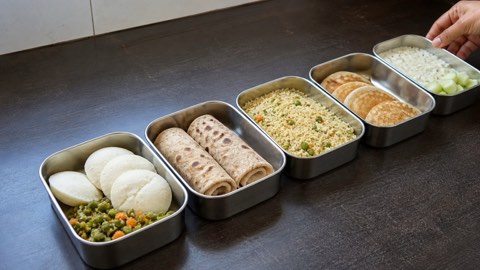
7. A jar of multigrain porridge mix — ragi, wheat, moong dal and rice, roasted and ground. Two spoons plus milk makes breakfast in five minutes.
8. Roasted powder for podi idli, plus a box of ghee, so the same idlis feel different across the week.
9. Frozen parathas: make a dozen, half-cook, layer with butter paper, freeze. Straight onto the tawa from frozen.
10. Energy balls of dates, roasted nuts and a little ghee, kept for the mornings when nobody has time to sit.
11. Boiled and cubed potato kept in the fridge for a fast poha or upma.
Five-minute assemblies (12-15)
12. Curd with fruit, a spoon of gud and ground nuts stirred in.
13. Peanut butter or homemade nut paste on toast with a banana.
14. Milk with two dates and a handful of soaked almonds, plus a paratha from the freezer.
15. Leftover khichdi or upma from last night, warmed with a spoon of ghee — a completely legitimate breakfast that Indian households are oddly reluctant to admit to.
And the one rule for all of them: eaten sitting down, without a screen. A child eating in front of a phone at 6.45 eats less and notices nothing.
Frequently asked questions
My child refuses breakfast entirely.
Start very small — one idli, half a paratha, a glass of milk with a date — rather than fighting for a full plate. And check the bedtime; children who are short of sleep are rarely hungry early.
Is milk alone enough?
No. Milk plus a grain or an egg holds far longer, and milk alone in a hurry is a common reason for mid-morning slumps.
How early should breakfast be before the bus?
At least twenty to thirty minutes before leaving, so it is eaten rather than rushed and so a nervous child is not eating and running.
Cereal from a packet?
Occasionally fine; most are high in sugar. Read the sugar per 100 g, and treat it as a convenience rather than the default.
Sources
Every clinical figure on this page is taken from the guidelines below. Where our numbers and your doctor's differ, ask which guideline they follow.
- WHO. Healthy diet – Key facts (2020)Backs the page's guidance to limit added sugars in children's diets, supporting the advice to check sugar content on packaged cereals and treat them as occasional convenience foods rather than defaults.
- ICMR. Dietary Guidelines for Indians (2024)Supports the protein-plus-grain breakfast combination and the inclusion of traditional Indian foods such as idli, dalia, ragi porridge, eggs, and pulses as appropriate, balanced breakfast choices for children.
- IAP. IAP Guidelines on Feeding the Normal Child (2010)Supports the advice to start with small portions for children reluctant to eat breakfast and to ensure adequate sleep as a factor influencing morning appetite in school-age children.
Reviewed by
- Nakul Phatak — CEO, theAsianparent India & IndonesiaHead of theAsianparent India; father of one
- Roshni Chugani — Head of Marketing, theAsianparent India & Singapore12 years in the mother-and-baby space; mother of two
Published by: theAsianparent editorial team