Baby refuses to self-feed

Some babies grab the spoon at seven months and some want nothing to do with it at fifteen. Most of the gap is temperament, and some of it is fixable.
Why it happens
Texture and mess. Some babies genuinely dislike the feel of food on their hands, and will eat happily from a spoon while refusing to touch anything. This is common and usually settles with unpressured exposure.
Habit. A baby who has always been fed, often by several willing family members, has no reason to learn. In many Indian households a child is fed by hand well past the age they could manage themselves, and the skill simply never gets practised.
Distraction feeding. A baby fed in front of a screen, or walked around the building while someone spoons food in, is not participating in the meal at all. Volume goes in and the skill does not develop.
Fine-motor readiness. Pincer grip arrives around nine to twelve months, and before that picking up small pieces is genuinely hard.
And appetite. A baby full of milk is not motivated to work for food.
What to change
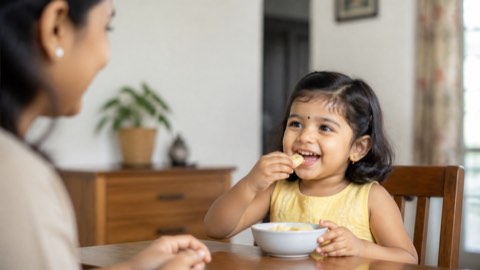
Eat together. Babies learn to feed themselves by watching people feed themselves, and eating alone in a high chair while adults watch is a much weaker lesson.
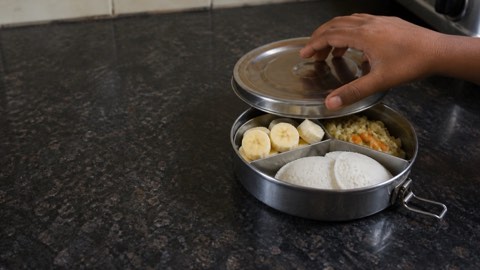
Offer the right shapes: at first, pieces the length of an adult finger that can be held in a fist with some sticking out — a strip of soft chapatti, a finger of steamed carrot, a wedge of banana. Small pea-sized pieces come later once the pincer grip arrives.
Preload a spoon and hand it over. This is the bridge for babies who hate touching food: they get the self-feeding without the mess.
Two spoons — one for you, one for them — so the meal is not a fight over the tool.
Accept the mess, visibly. A baby watching a parent wipe their hands after every touch learns that food on hands is a problem.
Turn off the screen and stop walking them around. Meals at a fixed place, with an end point.
Time it right: offer solids when they are hungry but not desperate, and before the milk feed rather than after.
And stop after about 20 to 30 minutes without a battle. Pressure is the one thing that reliably makes eating worse.
When to see a doctor
See a doctor if: the child is not gaining weight or is losing weight, has fewer than a handful of accepted foods, gags or vomits at the sight of food, or refuses whole texture categories completely.
Also for: coughing, choking, gagging or wet-sounding breathing during feeds, which needs a swallowing assessment; or a baby who tires quickly and sweats while feeding.
Ask for a referral to a paediatric dietitian or a feeding therapist if refusal is severe and persistent — this exists in most Indian cities and is under-used.
Raise developmental concerns alongside feeding: a baby who is not sitting steadily, cannot bring hands to mouth, or has a poor pincer grip well past twelve months.
This article is general information, not medical advice, and is no substitute for personal medical advice.
Frequently asked questions
At what age should a baby feed themselves?
Finger foods from around six to eight months, a spoon with a lot of mess from about twelve to eighteen, reasonably neat by two to three.
Is baby-led weaning better?
Both approaches work and most families use a mix. What matters more is that the baby participates rather than being a passive recipient.
Everyone feeds my baby by hand and says self-feeding is unhygienic.
Hands washed before a meal are fine. Feeding themselves is how children learn appetite regulation as well as the motor skill.
My baby throws all the food.
Normal experimentation around ten to fourteen months. End the meal calmly when throwing starts; it usually passes in a few weeks.
Sources
Every clinical figure on this page is taken from the guidelines below. Where our numbers and your doctor's differ, ask which guideline they follow.
- WHO. Complementary feeding: family foods for breastfed children (2000)Supports the claim that infants should be active participants in feeding and that responsive feeding practices, including eating together and following hunger cues, promote healthy development.
- AAP. Starting Solid Foods (HealthyChildren.org) (2023)Supports the introduction of finger foods starting around six months, offering age-appropriate textures, timing solids when the baby is hungry but not distressed, and the developmental progression from fist-grip foods to pincer-grip foods.
- NICE. Faltering growth: recognition and management (NG75) (2017)Supports the advice to refer to a doctor if the child is not gaining weight or is losing weight, as faltering growth is a key clinical indicator warranting assessment.
- IAP. IAP Guidelines on Complementary Feeding (2022)Supports the developmental timeline for self-feeding skills, appropriate food textures for Indian infants including soft chapatti and steamed vegetables, and the recommendation to raise concerns about developmental milestones such as sitting and hand-to-mouth ability alongside feeding difficulties.
- WHO. Infant and young child feeding: Model Chapter for textbooks for medical students and allied health professionals (2009)Supports the recommendation to offer solids before the milk feed to ensure adequate hunger motivation, and that a baby full of milk is less motivated to eat solid food, consistent with responsive complementary feeding guidance.
Reviewed by
- Nakul Phatak — CEO, theAsianparent India & IndonesiaHead of theAsianparent India; father of one
- Roshni Chugani — Head of Marketing, theAsianparent India & Singapore12 years in the mother-and-baby space; mother of two
Published by: theAsianparent editorial team