Is a vegan diet safe for babies and toddlers?

It can be done safely, and it cannot be done casually. The nutrients at risk are specific, and B12 is the one that causes irreversible harm when it is missed.
The honest position
A well-planned vegan diet can meet the needs of infants and toddlers, and major dietetic bodies say so. The words doing the work in that sentence are 'well-planned'.
Infancy is the highest-risk period for any restrictive diet, because growth is fastest, stomachs are small, and deficiencies show up as developmental harm rather than as a blood result nobody looked at.
This is a diet that needs a paediatrician and ideally a paediatric dietitian involved from the start, plus regular growth monitoring. That is not a reason to avoid it; it is the condition for doing it safely.
For the first six months, breastmilk or an appropriate infant formula covers everything — with the important caveat that a vegan breastfeeding mother must herself be reliably supplemented with B12, because a deficient mother produces deficient milk.
Soy-based infant formula is the only vegan formula option and should be used only on medical advice. Plant milks — almond, oat, rice, soy drink — are not infant formula and must never replace it. Rice-based drinks in particular are not recommended for young children because of inorganic arsenic.
The four to watch
Vitamin B12. The critical one. There is no reliable plant source, and deficiency in an infant can cause permanent neurological damage and developmental regression. Supplementation is not optional — for the baby once weaned, and for a breastfeeding vegan mother throughout. Fortified foods alone are usually not enough.
Iron. Plant iron is absorbed far less efficiently than iron from meat. Serve dal, ragi, green leafy vegetables, tofu, and dried fruit with a vitamin C source at the same meal — lemon, amla, guava, orange — which substantially improves absorption. Avoid tea and milk drinks with meals, both of which block it. Most Indian infants need an iron supplement regardless; a vegan infant almost certainly does.
Calcium and vitamin D. Without dairy, calcium must come from fortified plant milks, tofu set with calcium, ragi, sesame and almonds. Vitamin D needs supplementation for practically every Indian infant, vegan or not.
Energy, protein and fat. Vegan diets are bulky and filling, and a small stomach can fill up before the calories are in. Add fat generously — nut and seed butters thinly spread, oils, avocado, coconut. Include a protein source at every meal: dal, tofu, tempeh, soy, and ground nuts and seeds.
Also worth attention: omega-3 DHA, iodine, and zinc. Ask the dietitian about all three.
Practical shape of the day
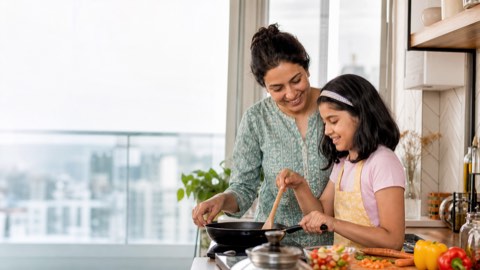
Indian vegan food is well-suited to this once it is planned: dal or sambar with rice and a squeeze of lemon, ragi porridge, khichdi with ghee replaced by oil, chana and rajma, tofu bhurji, sesame and peanut chikki in small amounts, and plenty of fruit and vegetables.
Introduce allergens including peanut and soy in the usual window from around six months rather than delaying them, unless your doctor has advised otherwise.
Watch textures: bulky high-fibre food fills a baby quickly, so offer concentrated foods first in the meal.
Keep supplements as a fixed daily routine rather than something remembered occasionally. B12 in particular is not a nutrient to be casual about.
Weigh and measure regularly. Growth faltering is the earliest reliable signal that a plan is not working, and it is easy to miss at home.
When to see a doctor
Before starting: see a paediatrician and ask for a referral to a paediatric dietitian. Ask specifically about B12, iron, vitamin D, calcium, iodine and DHA, and about a supplementation schedule in writing.
See a doctor promptly for: slowing or faltering growth, pallor, tiredness, poor appetite, or a baby who is not meeting developmental milestones.
Urgently for: loss of skills the baby previously had, unusual floppiness, irritability with poor feeding, or developmental regression — these can be signs of B12 deficiency and need immediate assessment.
Never use a plant milk in place of infant formula, and never switch formula without medical advice.
This article is general information, not medical advice, and is no substitute for personal medical advice. For any decision about your child's health, please consult your doctor.
Frequently asked questions
Is a vegetarian diet with dairy easier?
Considerably, because dairy covers B12, calcium and protein. Most Indian vegetarian households are already well-placed; strict vegan needs more planning.
Can I use almond or oat milk instead of formula?
No, under any circumstances before one year. They are nutritionally inadequate and have caused serious harm in infants.
Is soy safe for babies?
Soy foods are fine as part of a varied diet. Soy formula is a medical decision, not a shelf choice.
What if my family objects?
This is a decision for the parents in consultation with a doctor. The strongest position is to have the paediatrician's written plan, which usually ends the argument.
Sources
Every clinical figure on this page is taken from the guidelines below. Where our numbers and your doctor's differ, ask which guideline they follow.
- WHO. Infant and young child feeding: Model Chapter for textbooks for medical students and allied health professionals (2009)Backs the claim that breastmilk covers all nutritional needs for the first six months, and that complementary feeding with adequate nutrient coverage and growth monitoring is essential after that period.
- NHS. Vitamins for children (2023)Backs the claims that vitamin D supplementation is needed for practically all infants, that B12 supplementation is essential for vegan breastfeeding mothers and their babies, and that plant milks are not suitable as a main drink before age one.
Reviewed by
- Nakul Phatak — CEO, theAsianparent India & IndonesiaHead of theAsianparent India; father of one
- Roshni Chugani — Head of Marketing, theAsianparent India & Singapore12 years in the mother-and-baby space; mother of two
Published by: theAsianparent editorial team