Foods to help a baby gain weight — and when weight is the wrong worry

Before adding food, check whether there is a problem at all — and if there is, the answer is usually energy density rather than quantity.
First, check the worry is real
A baby tracking steadily along their own curve — even a low one — is growing well. The concerning patterns are no gain over several weeks, crossing downward through two major percentile lines, or weight falling while length rises.
Under six months, weight gain comes from milk, not food. Starting solids early does not fix poor weight gain and usually makes it worse by displacing milk. If a young baby is not gaining, the answer is a feeding review, not cereal.
And rule out the common medical causes before changing the menu: anaemia, worms, repeated infections, cow's-milk protein allergy, reflux, and a poor latch or too-fast teat. A doctor sorts these quickly.
Adding energy without adding bulk
A baby's stomach is small, so the goal is more calories in the same volume rather than bigger meals.
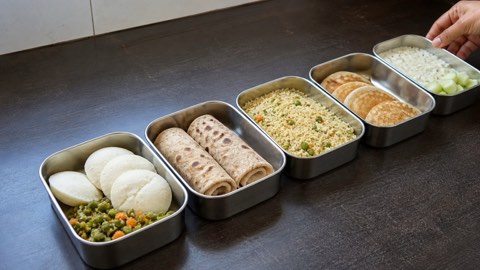
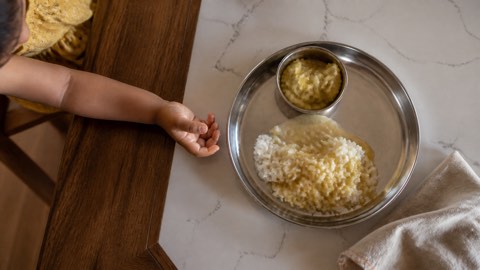
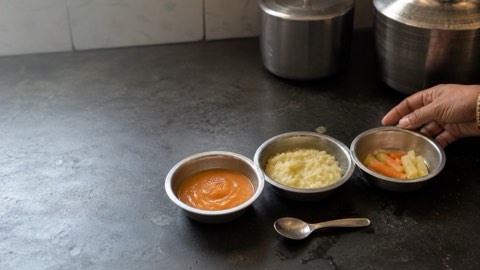
Ghee: half a teaspoon stirred into khichdi, dal, porridge or mashed rice at each meal from six months. It is the simplest, cheapest and most effective energy addition available in an Indian kitchen.
Full-fat dairy from the right ages: curd from around seven to eight months, paneer, and cheese in small amounts. Milk as a drink only after one year.
Nut and seed powders: almonds, walnuts, cashews and til dry-roasted and ground fine, a spoon stirred into porridge or dal. Never whole nuts before four or five years.
Ragi, which is both calorie-dense and rich in calcium and iron; banana, chikoo, mango and avocado; well-mashed dal and rajma; egg yolk daily from six months; and a spoon of peanut butter without added sugar for older babies.
Feed frequently — three meals plus two snacks — and offer food before milk once solids are established, so the baby is not too full to eat.
What not to do
No sugar, no biscuits dipped in milk, no packaged juices or sweetened drinks. They add calories that displace nutrition and set up habits that are hard to undo.
No cow's milk as a drink before one year, and no more than about 400-500 ml a day after that — excess milk is one of the commonest causes of a toddler who does not eat and is mildly anaemic.
No force-feeding, no chasing around the house, and no feeding in front of a screen. All three reduce intake over time and create the fussy eating that follows.
No appetite tonics or weight-gain syrups without a doctor's advice — several contain steroids or antihistamines and are not appropriate for children.
When to see a doctor
Same-day: a baby losing weight, refusing feeds, lethargic, with fewer than six wet nappies a day, vomiting persistently, or with diarrhoea and dehydration.
Book an appointment for: no weight gain over three to four weeks in the first year, crossing two percentile lines downward, a baby who tires during feeds, persistent loose stools, blood or mucus in the stool, eczema with feeding problems, or a baby who was born preterm or small and is not catching up. Ask for haemoglobin to be checked at the same time.
This article is general information, not medical advice, and is no substitute for personal medical advice. For any decision about your or your child's health, please consult your doctor.
Frequently asked questions
How much ghee is safe for a baby?
Around half to one teaspoon per meal for a baby on solids is a reasonable range, and your paediatrician can advise for your child. It is fat, not medicine — more is not better.
My baby is chubby everywhere but the chart says low weight.
Take the chart plus the doctor's assessment over appearance, and remember length matters too. A long, lean baby of lean parents is often exactly right.
Should I give a commercial weight-gain formula?
Only if prescribed. Specialised high-calorie formulas exist for specific medical situations and are not for general use.
Everyone in the family says the baby is too thin.
Ask for the growth chart to be shown to them. A curve is a better argument than an opinion, and it usually ends the conversation.
Sources
Every clinical figure on this page is taken from the guidelines below. Where our numbers and your doctor's differ, ask which guideline they follow.
- WHO. WHO Child Growth Standards (2006)Supports the use of growth charts and percentile curves to assess whether a baby is growing well, and the clinical significance of crossing two major percentile lines downward as a marker of concern.
- WHO. Complementary Feeding: Report of the Global Consultation and Summary of Guiding Principles (2003)Supports the claim that under six months weight gain comes from milk not food, that early introduction of solids displaces milk and does not fix poor weight gain, and that complementary feeding should begin at six months.
- ICMR. Nutrient Requirements and Recommended Dietary Allowances for Indians (2020)Supports identification of anaemia as a common cause of poor weight gain in infants and toddlers, the nutritional value of ragi as calcium- and iron-rich, and avoidance of sugar and nutrient-poor foods that displace nutrition in the infant diet.
Reviewed by
- Nakul Phatak — CEO, theAsianparent India & IndonesiaHead of theAsianparent India; father of one
- Roshni Chugani — Head of Marketing, theAsianparent India & Singapore12 years in the mother-and-baby space; mother of two
Published by: theAsianparent editorial team