Cot, cradle or co-sleeping: setting up where the baby sleeps

The safest sleep setup is the cheapest one: a firm flat surface with nothing on it, in your room. Everything else is convenience.
What a safe sleep surface needs
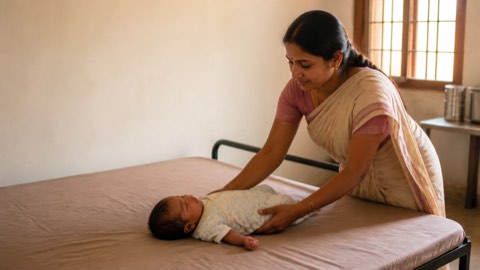
Firm and flat. A mattress that dips under the baby's weight, a soft quilt as a base, or a folded blanket used as a mattress are all unsafe. Press it — if your hand sinks in, it is too soft.
Bare. No pillows, no soft quilts, no bumper pads, no toys, no positioners or wedges. All of them are sold for babies and none of them belong in the cot in the first year.
The right size mattress for the frame — no gap at the edges where a baby's head can wedge — and cot bars close enough together that a head cannot pass through.
In your room for at least the first six months, which is the single strongest protective factor after back-sleeping.
Cot, cradle, jhula or co-sleeper
A full-size cot lasts to age two or three, converts to a toddler bed in many designs, and takes up a bedroom corner. If you buy one thing, buy this.
A cradle or bassinet is small, portable and outgrown by around four to six months when the baby can push up or roll. Useful, not essential.
The traditional jhula or cloth cradle rocks a baby beautifully and needs two rules: the baby sleeps on the back on a firm base, and the swinging cloth must not fold in around the face. Do not leave a baby unattended in a deeply curved cloth cradle.
A bedside co-sleeper cot with one side open attaches to your bed and gives easy night feeding with a separate surface — a good middle path for families who want the baby within arm's reach.
Bed-sharing is the norm in most Indian homes. If you do it, do it the careful way: firm mattress, baby on the back beside the mother, no thick quilts or pillows near the baby, no gaps between bed and wall, no smoking in the house, and never with an adult who has drunk alcohol, taken sedating medicine or is extremely exhausted. Never on a sofa or armchair, which is the most dangerous surface of all.
Buying practically
Check the mattress fits with no more than a two-finger gap at any edge, that the paint is non-toxic and unchipped, that there are no cut-outs or decorative gaps in the headboard, and that the drop-side mechanism (if any) locks firmly — drop-side cots have been recalled in several countries for this reason.
Buy the mattress new even if the cot is second-hand. Set the base at the highest level for a newborn and drop it the day the baby can push up on hands and knees.
Skip the bumper set, the cot mobile with dangling cords, the quilt set and the pillow, however lovely they look bundled together in the shop.
For heat, a cotton sheet and a light layer beat any blanket. Overheating is a real risk, so the rule is one light layer more than you are comfortable in.
When to see a doctor
Emergency: a baby found unresponsive, blue, or with breathing difficulty — call 108 immediately and start rescue breaths if trained.
Same-day: a baby who is unusually hard to wake, breathing fast or with effort during sleep, or has a persistent noisy breathing pattern or snoring with pauses, which needs assessment rather than a change of mattress.
This article is general information, not medical advice, and is no substitute for personal medical advice. For any decision about your or your child's health, please consult your doctor.
Frequently asked questions
Everyone in our family co-sleeps. Is that wrong?
It is the norm in most of India and it can be done safely with the conditions above. The dangerous versions are soft bedding, an adult who cannot be roused, and sofas.
Is a pillow needed for a baby's head shape?
No. Flat pillows sold to shape a baby's head are unnecessary and add a suffocation risk. Head shape settles by itself; vary the head position during sleep and give supervised tummy time when awake.
When can the baby have a pillow and quilt?
Generally from around 18 months to two years, once the cot is left behind. In the first year, a sleeping bag or light layers replace both.
The cot is expensive and we have no space.
Then a firm flat surface beside your bed and the same bare-cot rules is genuinely enough. Safe sleep costs nothing; the cot is furniture.
Sources
Every clinical figure on this page is taken from the guidelines below. Where our numbers and your doctor's differ, ask which guideline they follow.
- WHO. WHO recommendations on maternal and newborn care for a positive postnatal experience (2022)Supports the recommendation for room-sharing (keeping the baby in the parents' room) as a protective practice during early infancy and safe positioning guidance for newborns.
- NHS. Safe sleeping advice for babies (2023)Backs the guidance on a firm flat mattress, no soft bedding or pillows in the first year, room-sharing for at least the first six months, the 'one layer more than an adult' warmth rule, and hazards of bed-sharing with a smoker or someone who has drunk alcohol or taken sedating medication.
- NICE. Postnatal care (NG194) (2021)Supports advice on safe infant sleep environments postnatally, including room-sharing, avoidance of soft bedding, and risks associated with sleeping on a sofa or armchair with an infant.
- IAP. IAP Guidelines on Safe Sleep for Infants (2022)Supports the India-specific context of bed-sharing being common and provides the safe bed-sharing conditions described (firm mattress, back position, no thick quilts or pillows, no alcohol or sedation, no smoking in the household), as well as back-sleeping as the primary protective factor.
Reviewed by
- Nakul Phatak — CEO, theAsianparent India & IndonesiaHead of theAsianparent India; father of one
- Roshni Chugani — Head of Marketing, theAsianparent India & Singapore12 years in the mother-and-baby space; mother of two
Published by: theAsianparent editorial team