Choosing videos, apps and games for children — and why watching together matters

Not all screen time is the same. The difference between the good and the bad is mostly about pace, autoplay and whether an adult is anywhere nearby.
What makes content good or bad
Pace. Fast-cut, high-stimulation video is harder for young children to follow and is associated with poorer attention immediately afterwards. Slow, calm, story-driven content is easier to absorb and easier to stop.
Autoplay and infinite scroll. These are designed to prevent stopping, and they are the single feature that turns twenty minutes into two hours. Turn them off wherever the setting exists.
Interactivity that means something. A good app asks the child to do something and responds to what they did; a bad one is a video with buttons and a loot box.
Adverts and in-app purchases. Content aimed at children with adverts embedded, or with purchases one tap away, is designed against your interests. Paid apps without adverts are often cheaper than the free ones turn out to be.
And the simplest test: does your child come away calm and full of ideas, or wired and demanding more? That answer is more reliable than any rating.
Settings worth changing today
Turn off autoplay on every video platform, and use the kids' version of the app where one exists — with the age setting adjusted and search restricted for younger children.
Remove saved payment methods from any device a child uses, and require a password for every purchase. In-game purchases are the commonest way Indian families lose money on a child's account.
Set content restrictions in the app store and on the device, and turn off recommendations where possible.
Use downloaded or offline content for young children — a chosen playlist ends, and an algorithm does not.
And check the settings again after every major app update, which frequently resets them.
Why watching together changes it
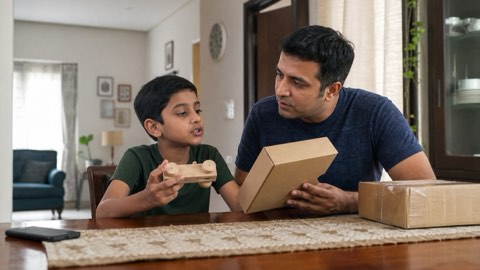
Young children learn very little from video alone and a great deal from video with an adult talking about it. Co-viewing is what converts screen time from consumption into learning at this age.
It does not need to be the whole session. Watching the first few minutes, asking about it afterwards, and letting them explain the game to you achieves most of the benefit.
It also means you know what they are watching, which matters more each year — children's platforms in India carry a great deal of low-quality and occasionally unsuitable content that passes automated filters.
And it changes the argument at the end. A shared activity ends more easily than a solitary one.
Frequently asked questions
Are educational apps actually educational?
Some are, and the label is unregulated. Judge by whether the child is doing something and being responded to, rather than by the marketing.
My child watches other children playing with toys for hours.
Extremely common and mostly low-value content designed to drive toy demand. Redirect toward slower, story-based content and set a clear stopping point.
Is gaming worse than video?
Not inherently; good games involve problem-solving and often social play. The risks are specific: chat with strangers, purchases, and games engineered to be hard to stop.
How do I stop the fight when time is up?
Give a five-minute warning, use content that ends rather than continuing, and where possible end at a natural break — the end of an episode or a level.
Reviewed by
- Nakul Phatak — CEO, theAsianparent India & IndonesiaHead of theAsianparent India; father of one
- Roshni Chugani — Head of Marketing, theAsianparent India & Singapore12 years in the mother-and-baby space; mother of two
Published by: theAsianparent editorial team