Screens before bed: what they actually do to children's sleep

Of everything screens are blamed for, the sleep effect is the best evidenced — and the easiest to fix.
The three mechanisms
Displacement, which is the biggest one: time on a screen is time not spent sleeping. A child who starts a video at nine is not asleep at nine.
Arousal: games, videos and messaging are stimulating, and a wound-up brain does not settle quickly. This matters more than the light does.
Light: screen light in the evening suppresses melatonin and shifts the body clock later. Night mode helps a little and does not remove the effect, because content and timing matter more than colour temperature.
The result across studies is consistent: more evening screen use, later bedtimes, shorter sleep, and worse daytime functioning.
What to do
Screens off an hour before bed, for everyone in the room. This single rule produces the biggest measurable change of anything in this article.
Devices charge outside bedrooms overnight — including for teenagers, and including the parents' phones. A phone within reach at midnight is a phone used at midnight.
Replace rather than remove: the hour before bed becomes reading, a bath, drawing, a card game or a conversation. An empty hour with a bored child produces a lost argument.
Keep the television out of a child's sleeping area where possible, and off during the wind-down even if nobody is watching.
And be realistic in a one-room home: agree a household lights-and-screens-off time rather than an individual one. That shared decision is what makes it possible.
When to see a doctor
See a doctor if sleep problems persist after the screen rules are in place for a few weeks — the screens may not have been the cause.
Specifically: loud snoring most nights, pauses in breathing, gasping, extreme daytime sleepiness, or a child who is exhausted despite adequate hours. Enlarged adenoids, sleep apnoea, anaemia and thyroid problems are all common and treatable causes.
Also worth raising: difficulty falling asleep because of worry, which is anxiety rather than a screen habit and responds to different help.
This article is general information, not medical advice, and is no substitute for personal medical advice. For any decision about your or your child's health, please consult your doctor.
Frequently asked questions
Does night mode make it safe?
It reduces blue light and does not address the content and the timing, which matter more. Treat it as a small help rather than a solution.
What if homework is on a laptop until late?
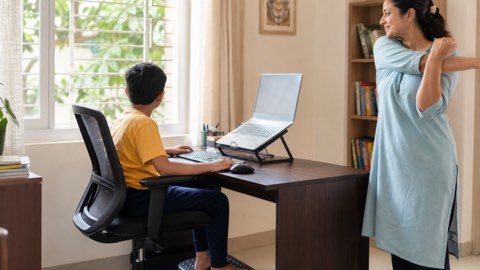
Finish screen homework earlier where possible, use a lamp rather than an overhead light afterwards, and keep the last thirty minutes screen-free. If school work routinely runs to eleven, that is worth raising with the school.
A video helps my child fall asleep.
It helps them stop resisting, and it worsens the sleep that follows. Substitute an audio story or music, which achieves the settling without the screen.
My teenager needs the phone as an alarm.
Buy an alarm clock. It is the cheapest sleep intervention available.
Sources
Every clinical figure on this page is taken from the guidelines below. Where our numbers and your doctor's differ, ask which guideline they follow.
- WHO. Guidelines on physical activity, sedentary behaviour and sleep for children under 5 years of age (2019)Backs the page's core claim that screen time in children is associated with shorter sleep duration and worse daytime functioning, and supports the recommendation to limit sedentary screen time.
- AAP. Sleep and Your Growing Child (HealthyChildren.org) (2022)Supports the advice to keep televisions and devices out of children's sleeping areas and to establish a consistent pre-sleep routine that replaces screens with calming activities.
- NICE. Sleep problems in children and young people (NICE guideline NG217) (2023)Supports the page's advice to see a doctor if sleep problems persist after behavioural changes are in place, and backs the flagging of loud snoring, breathing pauses, and extreme daytime sleepiness as symptoms warranting clinical review.
- NHS. Sleep tips for children (2023)Supports the one-hour screen-free wind-down before bed, keeping devices out of bedrooms overnight, and replacing screen time with calming pre-sleep activities such as reading or a bath.
- NIH. Sleep Deprivation and Deficiency (National Heart, Lung, and Blood Institute) (2022)Supports the page's claims that evening light suppresses melatonin and shifts the body clock later, and that sleep disruption leads to worse daytime functioning in children.
Reviewed by
- Nakul Phatak — CEO, theAsianparent India & IndonesiaHead of theAsianparent India; father of one
- Roshni Chugani — Head of Marketing, theAsianparent India & Singapore12 years in the mother-and-baby space; mother of two
Published by: theAsianparent editorial team