Screen posture, eye strain and movement breaks for children

Screens do not permanently damage eyes, and they do cause real strain, headaches and neck pain — and the rise in short-sightedness in Indian cities has a related cause worth knowing.
Eyes
Digital eye strain is real: dryness, burning, blurred vision, headaches. The cause is mostly reduced blinking — people blink about half as often while looking at a screen — plus sustained close focus.
The 20-20-20 rule is the standard advice and it works: every 20 minutes, look at something about 20 feet away for 20 seconds. Set a timer for younger children; they will not remember.
Short-sightedness (myopia) is rising sharply among Indian urban children. The strongest protective factor identified is time outdoors in daylight — around two hours a day is associated with a meaningfully lower risk. That is one of the most robust findings in child eye health, and it is about daylight rather than about avoiding screens.
So the eye advice is really two things: breaks from close work, and get outside.
Neck, back and hands
A head bent over a phone puts several times its weight through the neck. In children, hours of that produces neck and upper-back pain that is increasingly seen in school-age patients.
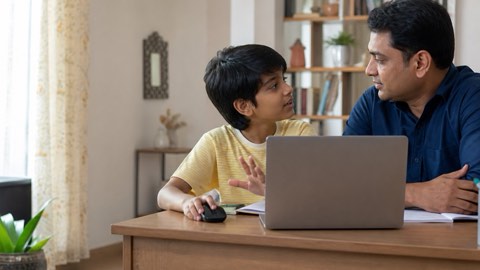
Set-up for online classes and homework: screen at eye level (a stack of books works), the chair pulled in with feet flat on the floor or a stool, back supported, and the device on a table rather than a lap or a bed.
Phones and tablets held in the lap are the worst position of all. Prop them up, and use a laptop or desktop for anything longer than a few minutes.
Movement breaks every 30 to 45 minutes: stand, stretch, walk to the door and back. Two minutes is enough, and it does more for concentration than pushing through.

Building the breaks in
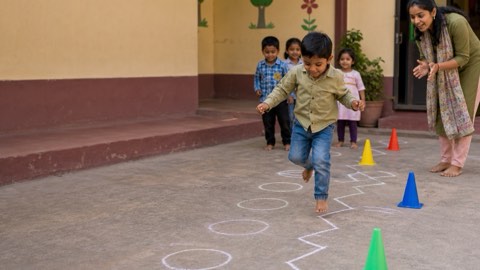
Use the class timetable: a stretch between subjects, a walk at the break, and no eating in front of the screen — which also stops the mindless snacking that comes with it.
For younger children, make the break physical and specific: ten star jumps, a lap of the flat, carrying something to another room.
Keep water beside the desk. Dehydration worsens headaches and is easy to miss during long screen sessions.
And check the lighting: a screen in a dark room forces harder work from the eyes. Ambient light in the room, and no screen directly facing a window's glare.
When to see a doctor
Book an eye test for: squinting, sitting very close to the screen or television, holding books close, headaches especially at the end of the day, rubbing the eyes frequently, complaining that the board is blurry, or a drop in school performance with no other explanation.
Same-day: sudden vision changes, eye pain, redness with light sensitivity, double vision, or an eye that has started turning inward or outward.
Every child should have a vision check before starting school and periodically afterwards, because a child with one weak eye has no way of knowing anything is unusual.
This article is general information, not medical advice, and is no substitute for personal medical advice. For any decision about your or your child's health, please consult your doctor.
Frequently asked questions
Do screens cause permanent eye damage?
There is no good evidence of permanent damage from ordinary screen use. Strain, dryness and headaches are real and reversible, and the myopia link is mainly about time indoors rather than the screen itself.
Are blue-light glasses worth buying?
The evidence for them is weak. Breaks, distance, lighting and outdoor time do more, and cost less.
How far should a screen be?
Roughly an arm's length for a laptop, further for a television. Anything that has the child leaning in is too close or too small.
Online classes run for four hours. What can we do?
Set the desk up properly, enforce the 20-20-20 rule, insist on the scheduled breaks being used for movement, and get outdoor time afterwards rather than more screen.
Sources
Every clinical figure on this page is taken from the guidelines below. Where our numbers and your doctor's differ, ask which guideline they follow.
- WHO. Guidelines on physical activity, sedentary behaviour and sleep for children under 5 years of age (2019)Supports the general principle that sedentary screen time should be limited and broken up with movement, underpinning the article's advice on movement breaks every 30–45 minutes for younger children.
- NICE. Myopia in children and young people (NICE guideline NG229) (2023)Supports the claim that time outdoors in daylight (around two hours a day) is associated with meaningfully lower risk of myopia, and the recommendation for periodic vision checks in children.
- AAP. Children and Media Tips from the American Academy of Pediatrics (2018)Supports the advice on structured screen breaks, limiting prolonged sedentary screen sessions, and using scheduled breaks for physical activity in school-age children.
Reviewed by
- Nakul Phatak — CEO, theAsianparent India & IndonesiaHead of theAsianparent India; father of one
- Roshni Chugani — Head of Marketing, theAsianparent India & Singapore12 years in the mother-and-baby space; mother of two
Published by: theAsianparent editorial team