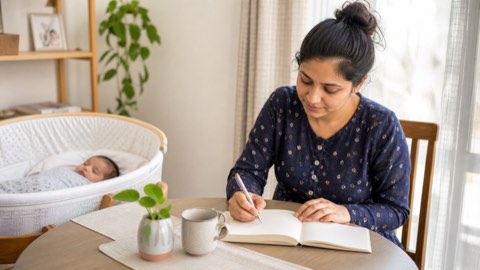
Sleep deprivation: what it does to a mother, and how to get some back

Sleep deprivation is treated as a joke about new parenthood. It is a health problem with measurable effects — and the fixes are logistical rather than heroic.
What it actually does
Chronic broken sleep impairs concentration, memory, reaction time and emotional regulation — which is why small things feel unmanageable and why the crying feels unbearable at 3 a.m. in a way it does not at noon.
It also raises the risk of postpartum depression and anxiety substantially, weakens the immune system, and increases accidents — including the genuinely dangerous ones: falling asleep while feeding in an unsafe position, or driving while exhausted.
Recognising this as a health issue rather than a character weakness is the first step, because it justifies asking for the help most mothers do not ask for.
Why the standard advice fails
'Sleep when the baby sleeps' assumes a household where nothing else needs doing and nobody is visiting. In most Indian homes the baby's nap is when the mother cooks, washes, feeds herself, and receives relatives.
The workable version is narrower: protect one block. One stretch of four to five hours of unbroken sleep does more for functioning than the same total broken into fragments — sleep cycles need to complete.
That block has to be created deliberately: someone else takes the baby between feeds, or gives one bottle of expressed milk, and the phone goes on silent in another room. It is an arrangement, not a hope.
Read next

Practical ways to get sleep back
Split the night. One parent handles until 2 a.m., the other after — each gets a solid block. Where the mother is exclusively breastfeeding, the partner can still do the changing, settling and returning of the baby, which removes half the waking time.
Use the help that exists. If a grandmother or relative is offering, ask specifically for a morning sleep-in rather than for help with cooking. If domestic help is affordable, buy time rather than perfection.
Nap without guilt, and lower the housekeeping standard for a year. The house being untidy is a smaller cost than a mother who cannot function.
Practical sleep hygiene still applies: dark room, phone out of reach (scrolling after a night feed is the commonest self-inflicted sleep loss), no caffeine after mid-afternoon, and going to bed early rather than reclaiming the evening as 'my time' — a tempting trade that costs more than it gives.
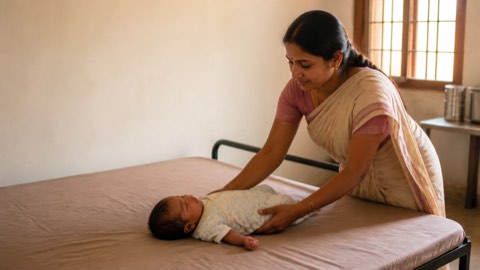
Feed safely when exhausted: never on a sofa or armchair where you might fall asleep with the baby, which is genuinely dangerous. If you might fall asleep, feed in a bed prepared safely — firm mattress, no pillows or loose quilts near the baby, baby on the back beside you.
When exhaustion is not just sleep
Anaemia is extremely common after delivery in India, especially with heavy bleeding or a pre-existing deficiency, and produces exactly this exhaustion. Get haemoglobin checked and continue iron as prescribed.
Thyroid problems appear or worsen after pregnancy — postpartum thyroiditis affects a noticeable minority and causes fatigue, mood changes, weight change and hair loss. A simple blood test finds it, and it is treatable.
Depression is exhaustion's twin: tiredness that rest does not touch, loss of interest, hopelessness, disturbed sleep even when the baby sleeps. If sleep is available and you still cannot rest or feel no better, that is a signal.
Also consider vitamin D and B12 deficiency, both common, and simple to test and correct.
When to see a doctor
Book tests if exhaustion persists despite sleep, or comes with pallor, breathlessness, palpitations, hair loss or weight change — haemoglobin, thyroid, vitamin D and B12 are the standard set.
Seek help urgently for: exhaustion with low mood, hopelessness, panic, or any thought of harming yourself or the baby; falling asleep unintentionally while holding the baby; or being so tired that you cannot safely care for your child. Tele-MANAS on 14416 is free, confidential and round the clock.
This article is general information, not medical advice, and is no substitute for personal medical advice. For any decision about your or your child's health, please consult your doctor.
Frequently asked questions
Will sleep training fix this?
For a baby over about six months, some structured approaches help, and our newborn and toddler sleep guides cover the groundwork. For a newborn, no method makes them sleep through — the fix is redistributing the night among adults.
I sleep badly even when the baby sleeps. Why?
Common: the body stays on alert, and anxiety keeps the mind running. Try a physical distance from the cot for one block (with someone else on duty), a wind-down without the phone, and mention it to a doctor if it persists — it can signal postpartum anxiety.
My husband says he cannot help because he has work in the morning.
So does the mother, and hers has no fixed hours. Split the week rather than the night if necessary: he takes two full nights, she gets those mornings. The principle is that both parents lose sleep, not one.
How long does this last?
Most babies sleep in longer stretches by six to nine months, and most parents describe the second year as sharply better. Knowing there is an end helps; so does the fact that you do not have to survive it alone.
Sources
Every clinical figure on this page is taken from the guidelines below. Where our numbers and your doctor's differ, ask which guideline they follow.
- WHO. Infant and young child feeding: Model Chapter for textbooks for medical students and allied health professionals (2009)Backs the article's guidance on exclusive breastfeeding practices and the safety considerations around feeding positioning for newborns.
- NHS. Sudden infant death syndrome (SIDS) – Safer sleep for babies (2023)Backs the article's safe sleep guidance when feeding while exhausted: firm mattress, no pillows or loose quilts near the baby, and baby placed on their back.
- NICE. Postnatal care (NG194) (2021)Backs the article's claims that postpartum depression and anxiety are risks associated with poor maternal sleep, and that postpartum thyroiditis causing fatigue, mood changes and hair loss should be identified and treated.
- ICMR. ICMR-NIN Dietary Guidelines for Indians (2024)Backs the article's note that anaemia, vitamin D deficiency and vitamin B12 deficiency are extremely common in India, particularly postpartum, and contribute significantly to maternal fatigue.
- NIH. Postpartum Depression: MedlinePlus (2023)Backs the article's description of postpartum depression symptoms — tiredness unrelieved by rest, loss of interest, hopelessness, and disturbed sleep even when the baby sleeps — as distinct from ordinary sleep deprivation.
Reviewed by
- Nakul Phatak — CEO, theAsianparent India & IndonesiaHead of theAsianparent India; father of one
- Roshni Chugani — Head of Marketing, theAsianparent India & Singapore12 years in the mother-and-baby space; mother of two
Published by: theAsianparent editorial team