Helping a preschooler build a positive self-image

A four-year-old's view of themselves is assembled almost entirely from what the adults around them say. That is a heavy responsibility and a useful lever.
Where a self-image comes from
Three sources at this age: what adults say about them, what they can actually do, and how they are treated compared with other children in the family.
Young children take descriptions literally and hold on to them. 'She's the shy one', 'he's the naughty one', 'she's not good at studies' said casually in front of a four-year-old becomes a fact about themselves.
So the first rule is simple: no labels, and no discussing a child's character or appearance in their hearing, including the modest self-deprecation Indian families use with guests.
What to say
Describe rather than judge: 'you climbed all the way up', 'you kept trying after it fell', 'you drew our whole street'. Description tells a child what they did; praise tells them what an adult thought.
Praise effort and strategy rather than ability. 'You worked hard at that' builds a child who attempts difficult things; 'you're so clever' builds one who avoids them to protect the label.
Be specific and honest. Blanket praise for everything is noticed and discounted by four-year-olds faster than adults expect.
And say the unconditional part explicitly and often: that you love them regardless of what they achieve, and then behave that way on the day something goes badly.
The Indian complications
Complexion. Comments about a child being dark or fair are made constantly, usually affectionately, and they land as a verdict. Interrupt them every time, in front of the child, so they see the comment refused.
Comparison with siblings and cousins, which is close to a national pastime and is corrosive at every age. Compare a child only with their own previous work.
Gendered praise: girls praised for being pretty and good, boys for being clever and strong. Notice which words you use, and swap some of them deliberately.
Public criticism at family gatherings — about marks, weight, shyness or eating. A child humiliated in front of relatives remembers it for decades, and it is entirely within your power to stop.
Building real competence
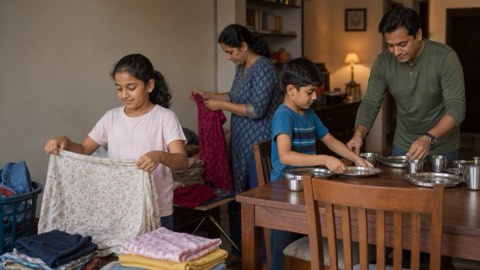
Confidence at four comes mostly from being able to do things. Let them dress themselves badly, pour their own water, carry their plate, choose their clothes, and do real chores.
Let them fail at small things and recover, with you nearby rather than intervening. A child rescued from every difficulty learns that they need rescuing.
Give them responsibility that matters — feeding a pet, watering a plant, being in charge of one household job. Being useful is a stronger foundation than any compliment.
And take their interests seriously, even the ones you find dull. A child whose enthusiasm is treated as valuable comes to treat themselves the same way.
Frequently asked questions
My mother-in-law calls my daughter dark and says it kindly.
Interrupt it lightly and consistently — 'we don't talk about her colour' — every single time, in front of the child. Consistency matters more than the argument.
Won't too much praise make him arrogant?
Effort-based, specific praise does not. Empty inflated praise might. The far more common Indian problem is praise withheld on principle.
He says 'I can't do it' about everything.
Break the task down until there is a part he can do, describe what he managed, and resist doing it for him. Learned helplessness at four usually comes from being helped too fast.
Should I correct her when she boasts?
Boasting at four is normal and usually a test of whether the achievement was real. Acknowledge the achievement and move on; it fades.
Reviewed by
- Nakul Phatak — CEO, theAsianparent India & IndonesiaHead of theAsianparent India; father of one
- Roshni Chugani — Head of Marketing, theAsianparent India & Singapore12 years in the mother-and-baby space; mother of two
Published by: theAsianparent editorial team