Indoor games without screens: what to do with a child in a small flat

Small flat, no garden, monsoon outside, and a bored child. Here are the games that work — most of them using what is already in the kitchen.
One to three years
Household treasure: a box of steel katoris, spoons, lids and a plastic bottle with rajma inside — stacking, filling, emptying and banging occupy a toddler longer than most toys. Add a low box of dry rajma or rice for scooping (supervised, because of choking).
Movement games in a small space: pillow paths, crawling tunnels made from a sheet over two chairs, dancing to film songs, balloon volleyball, and simple obstacle courses. Toddlers need to move, and a flat can supply it.
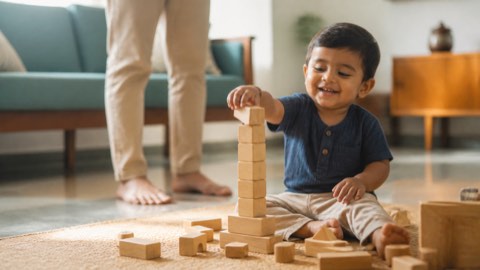
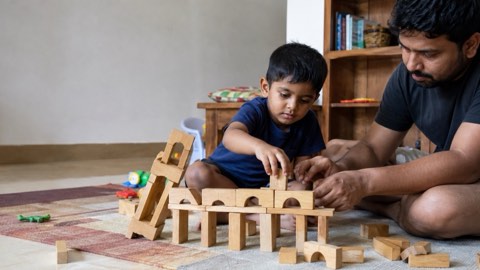
Water play in a bucket or a tray on the balcony with cups and spoons; playdough (flour, water, salt and a little oil, made at home); posting objects into a slot cut in a box; and stacking anything.
Old favourites: peekaboo, hide and seek with barely-hidden adults, chasing games, and the running commentary of naming everything. Attention from an adult is the toy at this age.
Three to six years
Pretend play is the engine: a shop with real vegetables and paper money, a doctor's clinic, a kitchen with real utensils, a train made of chairs. Add a dupatta and a box of old clothes and the games run for hours.
Traditional Indian games that need no equipment: pittu (seven stones) with a soft ball, lagori, kho-kho in a corridor, langdi (hopping), Chinese whispers, statue, antakshari, and name-place-animal-thing for the older end.
Making things: paper boats and planes, drawing and colouring, cutting and sticking with old magazines, cardboard-box houses, rangoli with rice flour or chalk, and clay or dough modelling.
Board and card games: ludo, snakes and ladders, memory pairs with home-made cards, carrom for older ones, and simple card games — all of which teach turn-taking, waiting and losing, which is the real curriculum.
Six and above
Games that hold older children indoors: carrom, chess, ludo, card games, dumb charades, antakshari, twenty questions, treasure hunts with written clues, and building projects with cardboard, tape and string.
Kitchen work: real cooking with supervision — kneading, rolling, measuring, chopping soft things with a butter knife, and making something the family eats. It teaches maths, sequencing and a life skill, and children take it seriously.
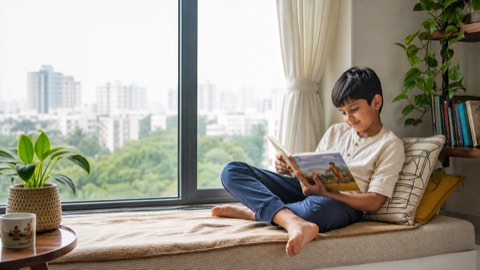
Reading challenges, comics, writing a family newspaper, keeping a nature diary from the balcony, growing methi or coriander in a pot, and looking after a plant or a pet.
Involve them in the household: sorting laundry, watering plants, laying the table, packing their own bag. Boring to adults, satisfying to children, and it builds competence that praise cannot.
Boredom, and the adult's role
Boredom is not an emergency to be solved with a screen. It is the state from which imaginative play emerges, and children who are never bored never learn to entertain themselves. Say 'you'll think of something' and let the ten uncomfortable minutes pass.
You do not have to play all the time. Fifteen minutes of undivided, child-led play — where they choose and you follow — is worth more than an afternoon of half-attention, and it usually buys a stretch of independent play afterwards.
Keep a rotating toy shelf: put half the toys away and swap them monthly. The same toys become new again, and children play more deeply with fewer options in front of them.
Get outside where you can. A park, a terrace, a walk, cycling — outdoor physical play is what most Indian urban children are shortest of, and it improves sleep, appetite, mood and eyesight.
Frequently asked questions
My child says everything is boring and only wants the phone.
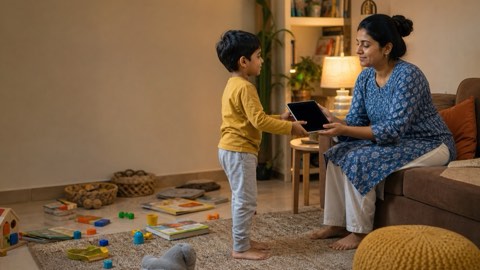
Expect a difficult week if screen time has been high. Reduce gradually, keep the phone physically out of sight, be available for the first stretch of alternative play, and hold the line. Interest in other things returns, usually faster than parents expect.
We live in a one-room house. What can we do?
Almost everything on this list — steel utensils, pretend play, card and board games, cooking, reading, singing, storytelling. Space is far less important than attention and a few open-ended objects. Use the terrace or the street outside where it is safe.
Are educational toys worth the money?
Rarely in proportion to their price. Open-ended things — blocks, dough, boxes, utensils, cloth, paper — support more learning than single-purpose electronic toys that do the playing for the child.
How much play does a child need daily?
Several hours, most of it unstructured and self-directed, including physical play. This is not a luxury around schoolwork; it is how children of this age develop.
Reviewed by
- Nakul Phatak — CEO, theAsianparent India & IndonesiaHead of theAsianparent India; father of one
- Roshni Chugani — Head of Marketing, theAsianparent India & Singapore12 years in the mother-and-baby space; mother of two
Published by: theAsianparent editorial team